DeepSkyHosting

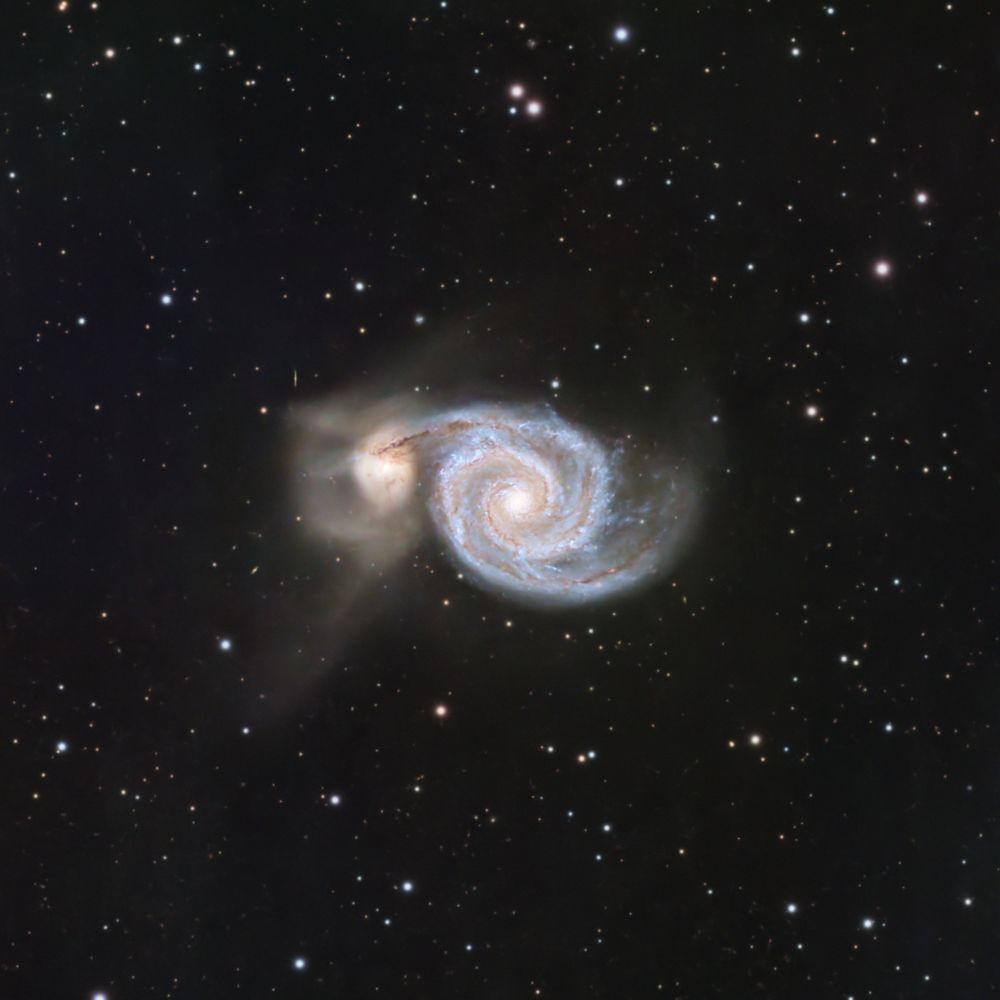
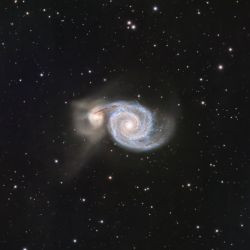
M51, RASA 8", 4 hrs (no filter)

ankorot
67782
Category:Deep Sky
Published:
468
M51, RASA 8", 4 hrs (no filter)IC 4257NGC 5194NGC 5195IC 4263IC 4277IC 4278IC 4282IC 4284IC 4285
Resolution:
1881x1963 px
File size:
685 KB

Photo description / processing

First test of the Player One Poseidon-C on an RASA 8" tube. A crop of the central part. (The camera is here, but there are no objects for it in the spring.)

Technical information

Telescope/Lens
Celestron RASA 8
Camera
Player One Poseidon-C
Mount
ZWO AM5N
Software
N.I.N.A., Pixinsight
Location
Софрино

Light pollution

Orange, Bortle 6 zone

Date taken

Exposure

  • 123 × 120″ · ISO/Gain: 125 · no filter ·

Total exposure: 4 h 6 m

Photo versions

M51, RASA 8", 4 hrs (no filter)
Updated
M51, RASA 8", 4 hrs (no filter)

Mar 16th, 2026

4 h 6 m

Stacked with Drizzle 2x In this same "stack" (group), there is also a result stacked with Drizzle 1x. You can compare them. Everything else is the same:RASA 8", NINA, phd2 PixInsight: WBPP, SPCC, noiseX, blurX, crop (important!), MAS, starX, a bit of sharpening (gentle LHE at 17,55 and 111) via a mask.
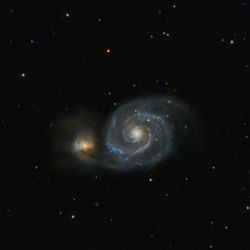
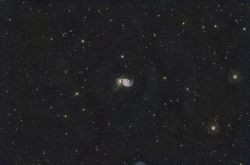
M51, Canon R6 mark II,  30 sec X ISO1000, 2.6 hrs
M51, Canon R6 mark II, 30 sec X ISO1000, 2.6 hrs

Mar 15th, 2026

2 h 42 m

What happens when shooting with high ISO and short exposures compared to low ISO? (total imaging time is the same)This frame is "low ISO and long exposures," though on a good camera body. A crop of the central part. Right next to it is a frame from a different camera body—a Canon 77D—where exposures had to be 5 minutes long to see anything. Here, 30 seconds and everything looks fine.

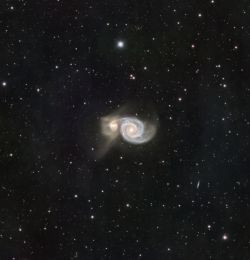
M51, Canon R6 mark II,  10 sec X ISO4000, 3hrs
M51, Canon R6 mark II, 10 sec X ISO4000, 3hrs

Mar 15th, 2026

2 h 50 m

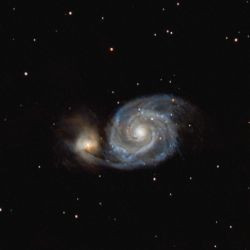
What happens when shooting with high ISO and short exposures compared to low ISO? (total shooting time is the same) This frame uses "high ISO and short exposures," though on a good camera body. Crop of the central part. You can compare it here with a frame that has one difference—a different camera body: here it's a Canon R6 MK2, while the adjacent frame is from a Canon 77D.

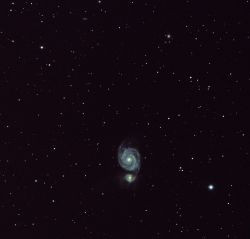
M51, Canon 77D, 2hrs

Mar 15th, 2026

1 h 50 m

An "old" image (2017), taken using older techniques—a standard, unmodified Canon 77D on an ED80 tube with a flattener. Focal length = 510mm. The Heq5 Pro still had gears and was constantly jerky. 5 minutes of exposure per frame. How did I manage to shoot 5-minute exposures? It's unclear. I wouldn't risk it like that now.

M51, RASA 8", 4 hrs (no filter)
Current photo
M51, RASA 8", 4 hrs (no filter)

Mar 15th, 2026

4 h 6 m

First test of the Player One Poseidon-C on an RASA 8" tube. A crop of the central part. (The camera is here, but there are no objects for it in the spring.)

M51, RASA 8", 4 hrs (no filter)

Mar 15th, 2026

4 h 6 m

First test of the Player One Poseidon-C (large APS-C sensor) on a Celestron RASA 8" telescope. No filters used, which was a mistake—this caused large star halos. A UV/IR cut filter must be used; it's impossible to operate this telescope without a filter. (Celestron are quite the jokers—their telescope can't be used without filters, yet there's no standard way to mount them.)

Show changes
Previous version
Current version

Comments

oeswww
Nice. But unfortunately, RASA isn't suitable for galaxy season. I didn't even feel like shooting galaxies with my 750mm focal length. I captured M106 as an afterthought (after midnight). Let's see how it turns out. I shot it before at 1000mm, so now I'll be able to compare.
Reply

Sign up or sign in to leave a comment.

yas
I wonder what the sky background is at Bortle 6, 2 minutes exposure, and gain 125 compared to the average for BIAS?
The average for BIAS is probably around 121 (with an offset of ~10).
Reply

Sign up or sign in to leave a comment.

ankorotReply to yas
Although such a high average might be due to the presence of a galaxy, I measured the average on a frame with Markarian's Chain, where there is no galaxy in the center. (Obviously, it doesn't make sense to measure the background on a galaxy.) I took a smaller area, but still right in the center: Image01->Preview01 count (%) 100.00000 count (px) 192304 mean 15545.7 median 17823.0 avgDev 4105.6 MAD 5213.6 minimum 10960.0 maximum 48029.0 And here is the entire image: Image01 K count (%) 99.99031 count (px) 26105821 mean 14555.4 median 14669.0 avgDev 3810.2 MAD 4602.0 minimum 8789.0 maximum 65510.0 There are "burnt" overexposures and well saturation, but only in individual stars. The main object is not overexposed. In this case, does it make sense to reduce the exposure?
Reply

Sign up or sign in to leave a comment.

yasReply to ankorot
The issue isn't that the stars are "blown out," but rather what the background looks like. The exposure should provide an optimal background level for a single frame and an optimal signal-to-noise ratio for the stacked exposures. There's a lot of information on this topic online.
Reply

Sign up or sign in to leave a comment.

More photos by ankorot