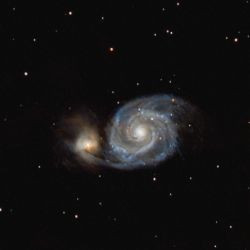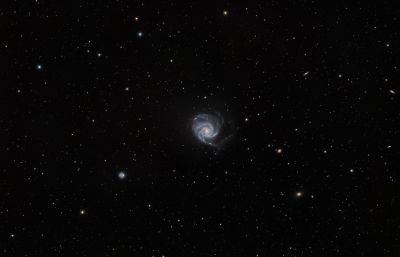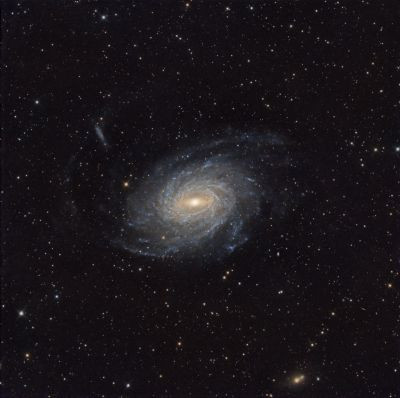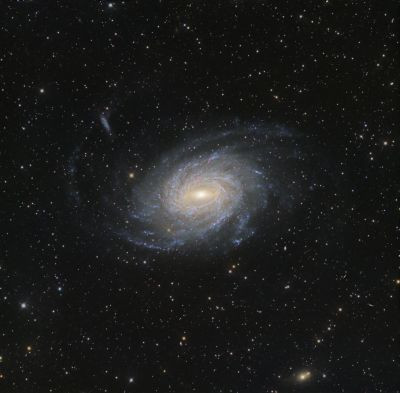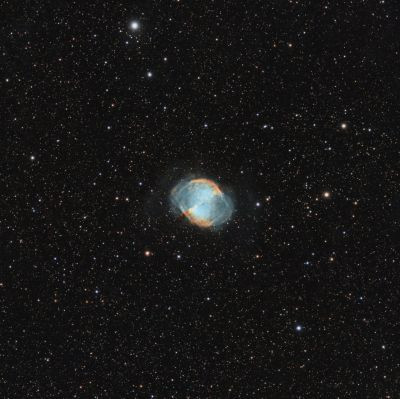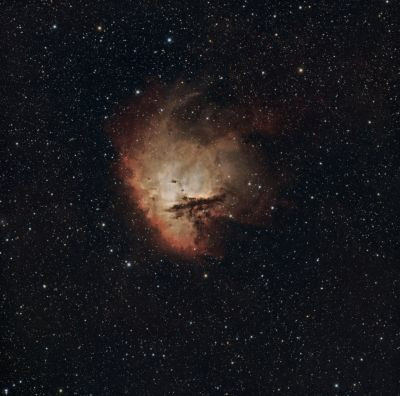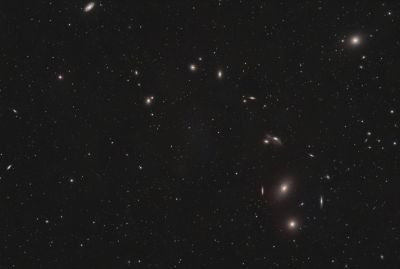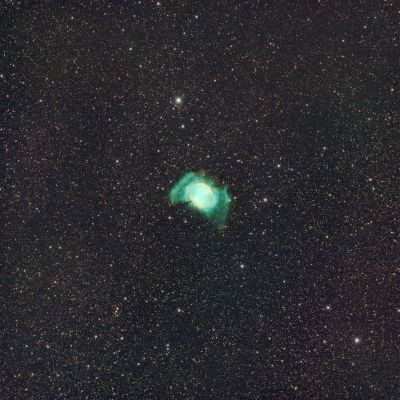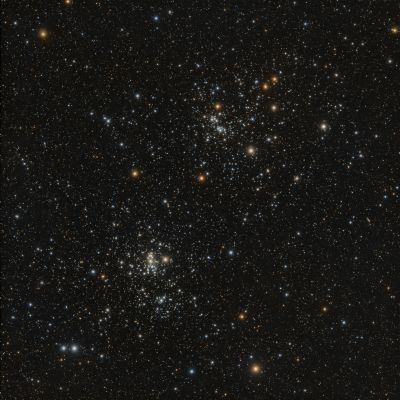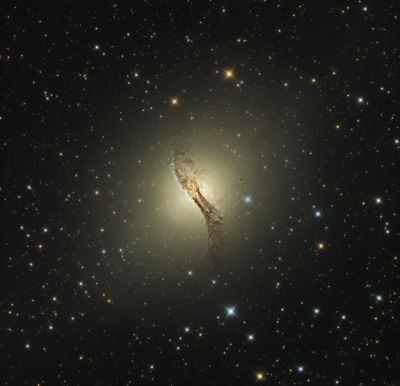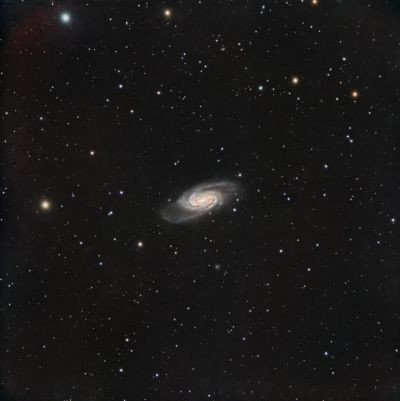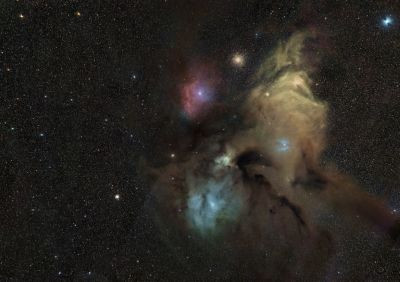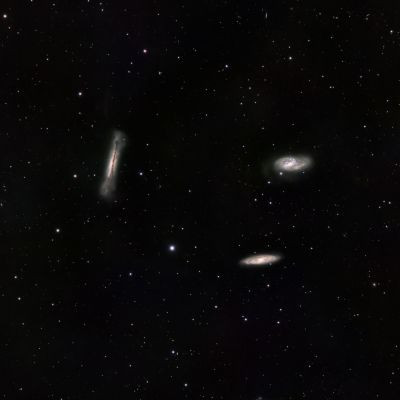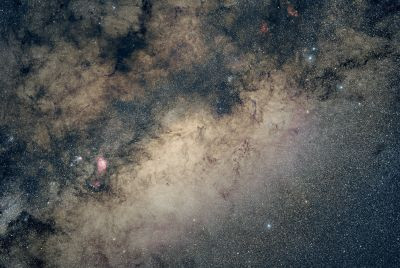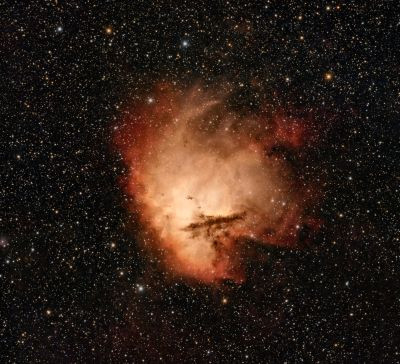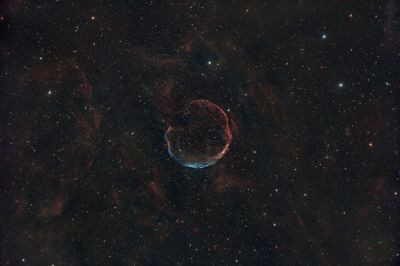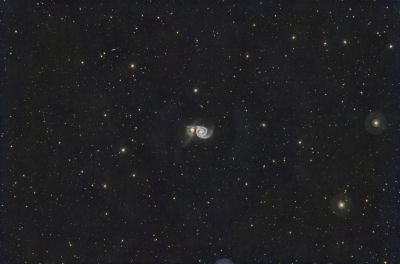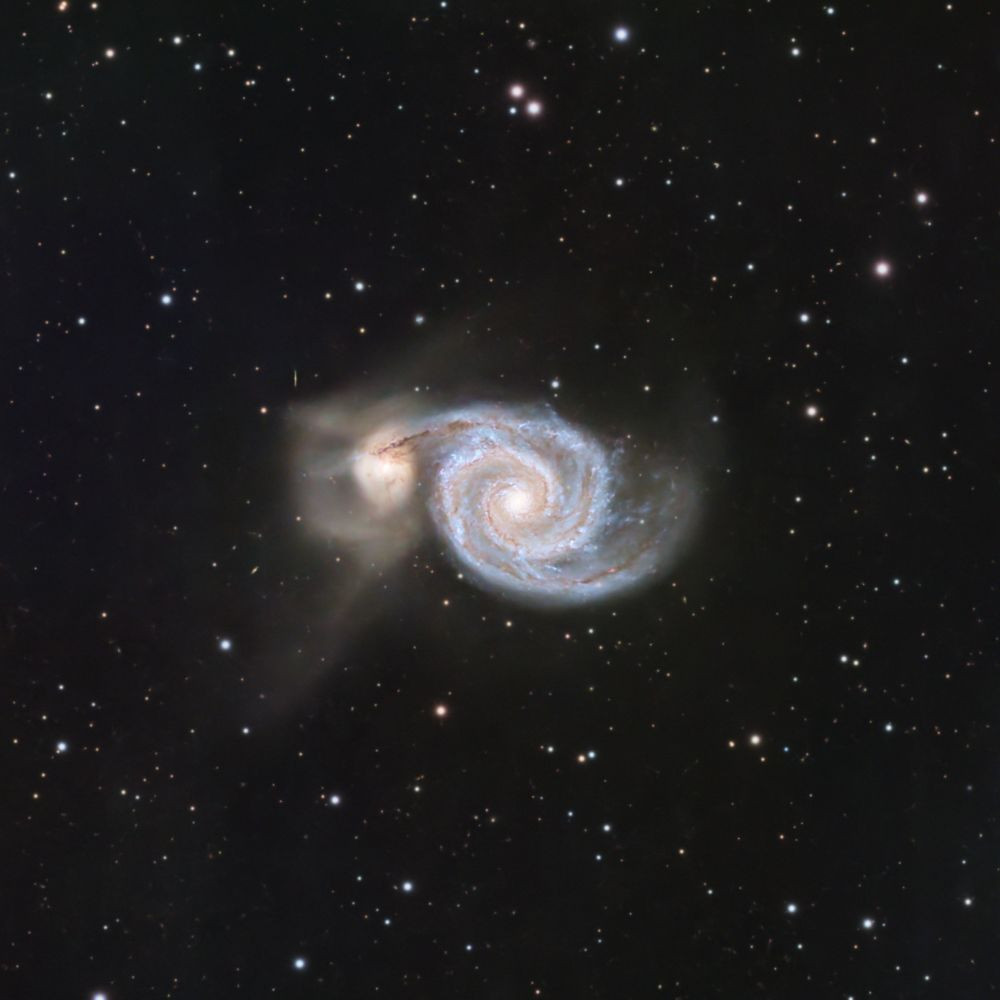
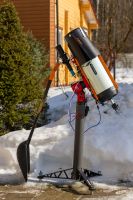
M51, RASA 8", 4 hrs (no filter)

 Posted: Mar 16th, 2026
Show astrometry on hover
NGC
IC
HD
Technical Info
Telescope/Lens: Celestron RASA 8
Camera: Player One Poseidon-C
Mount: ZWO AM5N
Software: Nina, PixInsight
Exposure:
123 x 120" ISO/Gain: 125 - no filter
Orange, Bortle 6 zone:
 Sofrino, Russia
 Mar 14th, 2026
4 h 6 m
177
Resolution: 2000x2000 px
Scale: 644 KB

Stacked with Drizzle 2x

In this same "stack" (group), there is also a result stacked with Drizzle 1x.

You can compare them.


Everything else is the same:
RASA 8", NINA, phd2

PixInsight: WBPP, SPCC, noiseX, blurX, crop (important!), MAS, starX, a bit of sharpening (gentle LHE at 17,55 and 111) via a mask.
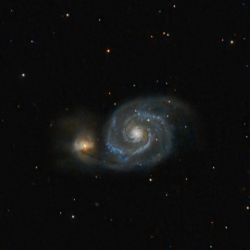
Current photo Updated
  16 Mar, 2026
  4 h 6 m
Stacked with Drizzle 2x In this same "stack" (group), there is also a result stacked with Drizzle 1x. You can compare them. Everything else is the same:RASA 8"…
  15 Mar, 2026
  2 h 42 m
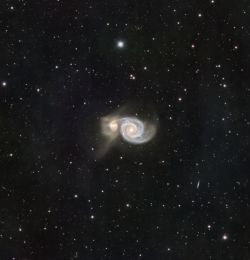
What happens when shooting with high ISO and short exposures compared to low ISO? (total imaging time is the same)This frame is "low ISO and long exposures," th…
  15 Mar, 2026
  2 h 50 m
What happens when shooting with high ISO and short exposures compared to low ISO? (total shooting time is the same) This frame uses "high ISO and short exposure…
  15 Mar, 2026
  1 h 50 m
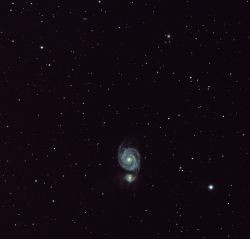
An "old" image (2017), taken using older techniques—a standard, unmodified Canon 77D on an ED80 tube with a flattener. Focal length = 510mm. The Heq5 Pro still…
  15 Mar, 2026
  4 h 6 m
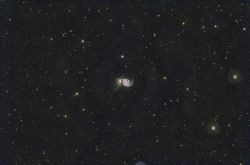
First test of the Player One Poseidon-C on an RASA 8" tube. A crop of the central part. (The camera is here, but there are no objects for it in the spring.)
  15 Mar, 2026
  4 h 6 m
First test of the Player One Poseidon-C (large APS-C sensor) on a Celestron RASA 8" telescope. No filters used, which was a mistake—this caused large star halos…
Show changes
Add comment

Comments

Nice. But unfortunately, RASA isn't suitable for galaxy season. I didn't even feel like shooting galaxies with my 750mm focal length. I captured M106 as an afterthought (after midnight). Let's see how it turns out. I shot it before at 1000mm, so now I'll be able to compare.
17 Mar, 2026 Reply
Ankorot Replied to Oeswww
A valid point. I completely agree. 400mm for galaxies is laughable.
That's why I don't even have a UV/IR cut filter, only a dual-band filter.

But what can you do when you have a RASA "barrel" and suddenly get clear nights? You have to use what you have.
17 Mar, 2026 Reply
Oeswww Replied to Ankorot
You should try capturing Markarian's Chain. Or, as a last resort, M81 with M82. At least there's some dust across the entire frame there.
17 Mar, 2026 Reply
Ankorot Replied to Oeswww
M81 is out of my field of view, but I'll post Markarian today—it's already processed. It just fit on the 400mm with a large sensor. Stay tuned!
17 Mar, 2026 Reply
I wonder what the sky background is at Bortle 6, 2 minutes exposure, and gain 125 compared to the average for BIAS?
The average for BIAS is probably around 121 (with an offset of ~10).
30 Mar, 2026 Reply
Ankorot Replied to Yas
BIAS. Median = 601 Lights at the center (this is important here due to very strong vignetting). median = 21111
30 Mar, 2026 Reply
Yas Replied to Ankorot
That is, the offset is around 80. Overall, it seems everything is not quite optimal. However, such a high average could be due to the presence of a galaxy. Simply put, the optimal maximum exposure time for your parameters would be a few seconds.
31 Mar, 2026 Reply
Ankorot Replied to Yas
Although such a high average might be due to the presence of a galaxy, I measured the average on a frame with Markarian's Chain, where there is no galaxy in the center. (Obviously, it doesn't make sense to measure the background on a galaxy.) I took a smaller area, but still right in the center: Image01->Preview01 count (%) 100.00000 count (px) 192304 mean 15545.7 median 17823.0 avgDev 4105.6 MAD 5213.6 minimum 10960.0 maximum 48029.0 And here is the entire image: Image01 K count (%) 99.99031 count (px) 26105821 mean 14555.4 median 14669.0 avgDev 3810.2 MAD 4602.0 minimum 8789.0 maximum 65510.0 There are "burnt" overexposures and well saturation, but only in individual stars. The main object is not overexposed. In this case, does it make sense to reduce the exposure?
31 Mar, 2026 Reply
Yas Replied to Ankorot
The issue isn't that the stars are "blown out," but rather what the background looks like. The exposure should provide an optimal background level for a single frame and an optimal signal-to-noise ratio for the stacked exposures. There's a lot of information on this topic online.
31 Mar, 2026 Reply

Comments are available only to registered users. Register or log in to leave a comment.