
a group of galaxies in the constellations Ursa Major and Camelopardalis, including galaxies Messier 81 (Bode's Galaxy) and Messier 82 (Cigar Galaxy) and interstellar dust
 NGC 2630NGC 2631NGC 3063NGC 3174NGC 3194NGC 3218NGC 3231IC 2438IC 2440NGC 2614NGC 2629NGC 2633NGC 2634NGC 2636NGC 2641NGC 2646NGC 2650NGC 2715NGC 2748NGC 2760NGC 2787NGC 2810NGC 2938NGC 2957NGC 2959NGC 2961NGC 2963NGC 2976NGC 2977NGC 2985NGC 3027NGC 3031NGC 3034NGC 3061NGC 3065NGC 3066NGC 3077NGC 3144NGC 3147NGC 3155NGC 3183NGC 3252NGC 3343NGC 3348NGC 3364IC 511IC 520IC 529IC 2389IC 2574IC 2600IC 2601
Photo description / processing
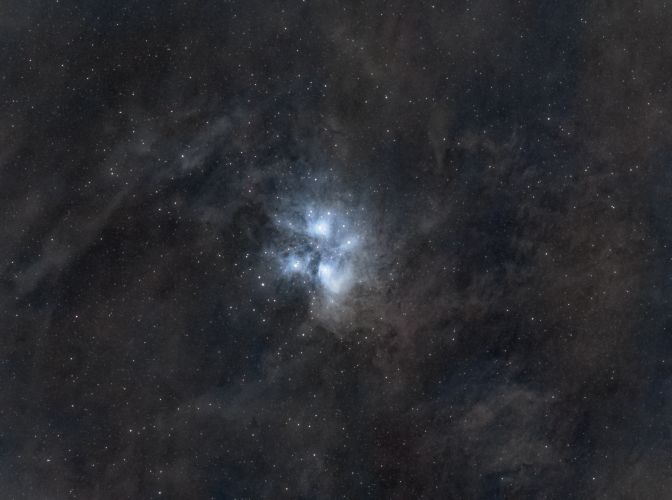
Probably my most agonizing astrophotography to date. I collected signal for last year's hour-long session on the "leftover" time from shooting other objects this winter during the remaining dark time, trying to align the field on the stars based on last year's data. It resulted in 3 separate sessions of 1.5-2 hours per night. Due to the limitations of my equipment and tracker, I set exposures at 30 seconds, so I ended up with a lot of frames - almost 1000 together with last year's session. I couldn't manage to stack such a quantity in PixInsight; it required 2.5 TB of free disk space and used all the RAM, and in the end, it still gave some error and wouldn't build the final stack. After the 4th attempt (each taking over a day to process), I had almost given up and wanted to abandon the whole thing, but decided to try a different approach. I stacked the individual sessions from each night separately and then stacked those stacks into one, and "oh, miracle!" it finally worked! But by then, I had no mental energy left to process the result :)) I only returned to it just now, after 2 months. Let it be like this for now, maybe I'll redo it later, or better yet, reshoot it :))
Technical information
- Telescope/Lens
- Samyang 135mm f/2 ED UMC
- Camera
- Nikon D850
- Mount
- iOptron SkyTracker
- Software
- Pixinsight, Adobe Photoshop
- Location
- Батецкий р-н Новгородская область, Россия
Light pollution
Blue, Bortle 3 zone
- Date taken
Exposure
- 977 × 30″ · ISO/Gain: 1600 ·
Total exposure: 8 h 9 m



Comments
Reply
Sign up or sign in to leave a comment.
Reply
Sign up or sign in to leave a comment.
Reply
Sign up or sign in to leave a comment.
Reply
Sign up or sign in to leave a comment.
Reply
Sign up or sign in to leave a comment.
Reply
Sign up or sign in to leave a comment.
Reply
Sign up or sign in to leave a comment.
Sign up or sign in to leave a comment.