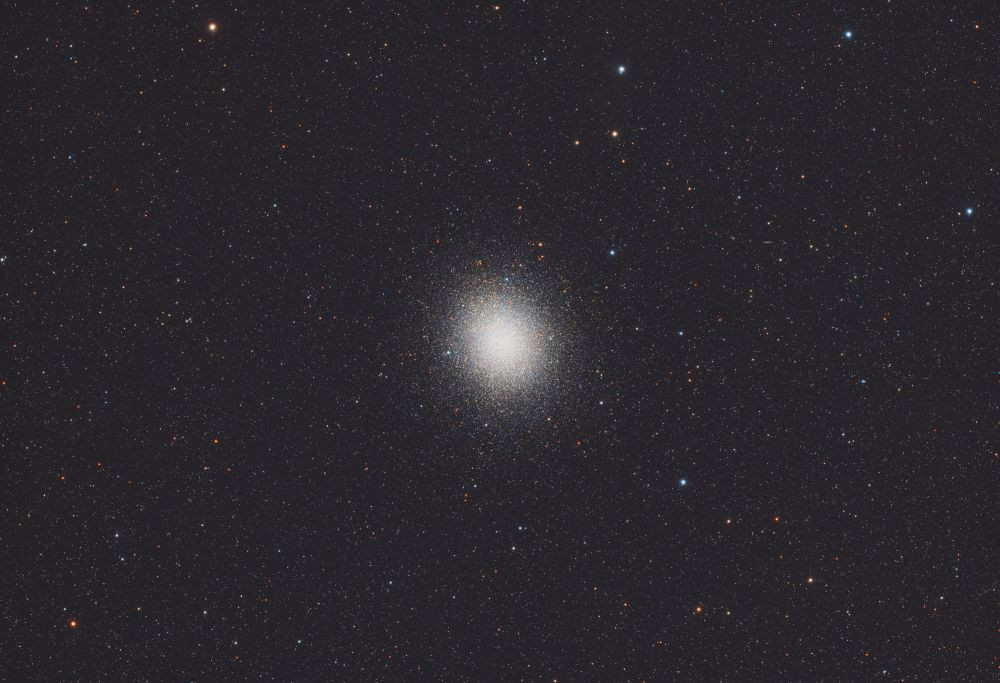
NGC 5139 is the largest and most massive globular cluster in our Galaxy: about 10 million stars with a total mass of ~4 million solar masses packed into a sphere about 150 light-years across. For comparison, the famous M13 (the favorite globular cluster of Northern Hemisphere photographers) is about 7 times less massive.
According to the latest understanding, NGC 5139 is the core of a dwarf galaxy that was absorbed by the Milky Way billions of years ago. This conclusion is supported by the discovery of the "Fimbulthul" tidal stream based on Gaia DR2 data in 2019: a stellar tail stretching 28° across the sky along the cluster's orbit.
Most globular clusters formed all their stars at roughly the same time. But NGC 5139 is a striking exception: it contains several stellar generations with a spread in metallicity and age of up to 3–5 billion years. This also supports the theory of its past as an entire dwarf galaxy that experienced multiple waves of star formation before being absorbed.
In 2024, a group of astronomers from the University of Utah and the Max Planck Institute for Astronomy published convincing evidence for the existence of an intermediate-mass black hole (IMBH) at the center of NGC 5139.
In the central zone of NGC 5139, stars are separated by distances of only ~0.1 light-years. Due to the incredible density in the core, thousands of direct stellar collisions have occurred over 12 billion years, giving rise to exotic "blue stragglers" — hybrid stars rejuvenated by mergers.
Despite its 10 million stars, research from UC Riverside has shown that stars in the core are too closely packed (on average ~0.16 light-years apart), and gravitational perturbations destroy planetary systems roughly every million years. A stable habitable orbit under such conditions is virtually impossible — making NGC 5139 one of the most "anti-habitable" places in the Galaxy's vicinity.

Comments
https://app.astrobin.com/i/ynuwdc
Comments are available only to registered users. Register or log in to leave a comment.