DeepSkyHosting

M16

Epsio
21278
Category:Deep Sky
Published:
775
M16NGC 6611IC 4703
Resolution:
3414x1944 px
File size:
3206 KB

Photo description / processing

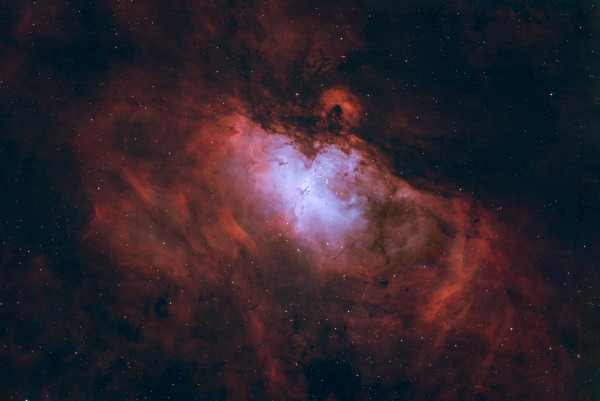
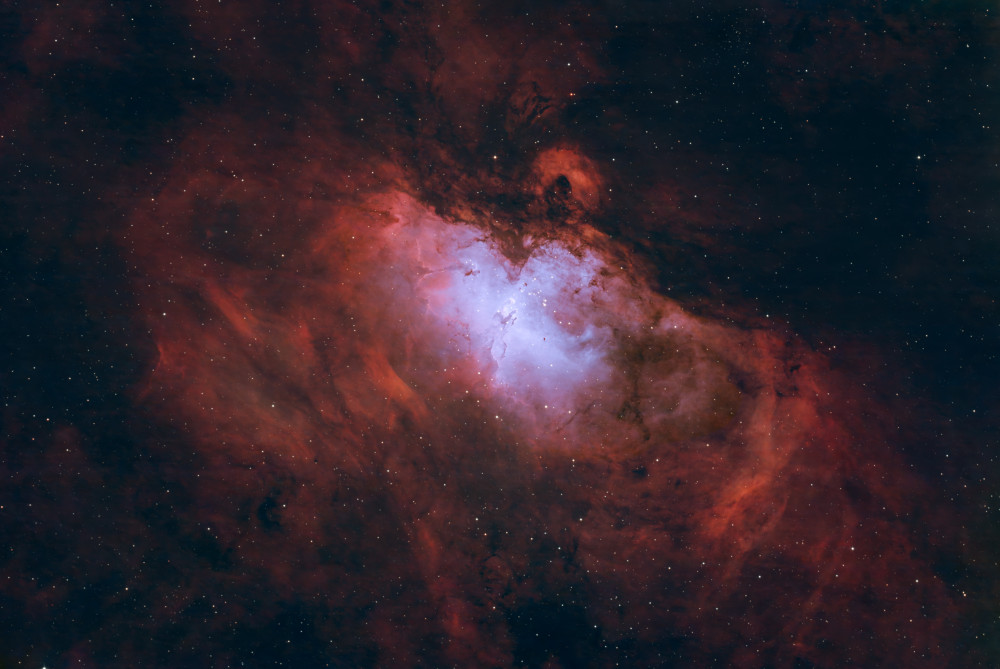
The Eagle Nebula (also known as Messier Object 16, M 16 or NGC 6611) is a young open star cluster in the constellation Serpens. The name comes from the shape of the nebula, which is said to resemble an eagle with outstretched wings. The nebula is a region of active star formation. Inside it is a cluster of young stars that formed approximately 2 million years ago. Among them are several very massive, hot stars. Some features: The "Pillars of Creation" region — three large gas pillars that were photographed by the Hubble Space Telescope in 1995. The Star Spire — a large gas tower that protrudes from the nebula region, with a height of about 9.5 light-years. Parameters:

Technical information

Telescope/Lens
Sky-Watcher 150/750
Camera
Canon 450D mod
Mount
HEQ5 Pro
Guide Scope
Angeleyes 50mm Telescope
Guide Camera
Datyson T7C
Accessories
MEYON 2” MPC 1x
Software
Pixinsight, Siril
Location
Пролетарск, Россия

Light pollution

Blue, Bortle 3 zone

Date taken
t.me/AstroPodd

Exposure

  • 28 × 300″ · ISO/Gain: 800 ·

Total exposure: 2 h 20 m

Photo versions

M16
Updated
M16

Sep 2nd, 2026

5 h 8 m

Messier 16 (M 16) or NGC 6611 The Eagle Nebula - is not just a nebula, but an entire system: a young open star cluster (NGC 6611) is embedded in an emission nebula (an H II region cataloged as IC 4703). It is the cluster's stars that "illuminate" the surrounding gas, causing it to glow. Star formation processes are occurring here right now. The name comes from its shape: the nebula's outlines resemble an eagle with spread wings. If you look through binoculars or a spotting scope, you can make out a distinctive triangle of stars — it looks like the eagle's beak or head. The nebula has several striking features that have made it famous: The "Pillars of Creation." These are the most recognizable details — tall columns of gas and dust. They look like sculpted forms, and they are what most often appear in stunning images. In reality, these are regions where stars continue to form. Ultraviolet radiation and stellar winds from young massive stars are gradually "eroding" these structures. Parameters ???? telescope SW 150/750 Mount: Heq 5pro AstroPC Stellavita ???? camera Touptek atr2600c Guide scope Angeleyes 50mm ???? guide camera: Zwo662 Coma corrector: MEYON 2" MPC 1x Filter LAIDA dual-band 7 nm 74x250'' Location: Proletarsk, Rostov Oblast, Manych River area Bortle 3

M16
Current photo
M16

Aug 11th, 2025

2 h 20 m

The Eagle Nebula (also known as Messier Object 16, M 16 or NGC 6611) is a young open star cluster in the constellation Serpens. The name comes from the shape of the nebula, which is said to resemble an eagle with outstretched wings. The nebula is a region of active star formation. Inside it is a cluster of young stars that formed approximately 2 million years ago. Among them are several very massive, hot stars. Some features: The "Pillars of Creation" region — three large gas pillars that were photographed by the Hubble Space Telescope in 1995. The Star Spire — a large gas tower that protrudes from the nebula region, with a height of about 9.5 light-years. Parameters:

Show changes
Previous version
Current version

Comments

Nickolay
Beautiful shot, the background is so uneven — is that due to white nights or because no calibration frames were taken?
Reply

Sign up or sign in to leave a comment.

EpsioReply to Nickolay
Thanks! I was shooting out in the fields, so to speak, the object was very low for me, and I was also shooting in between field cleanups—sometimes they burn, sometimes they clear—dust everywhere)
This is what my current skill level allowed for at the moment. I'm sure that in more capable hands, the result would be even better)
Reply

Sign up or sign in to leave a comment.

More photos by Epsio