Thank you for sharing your photos - this is exactly what this project is all about! :-)
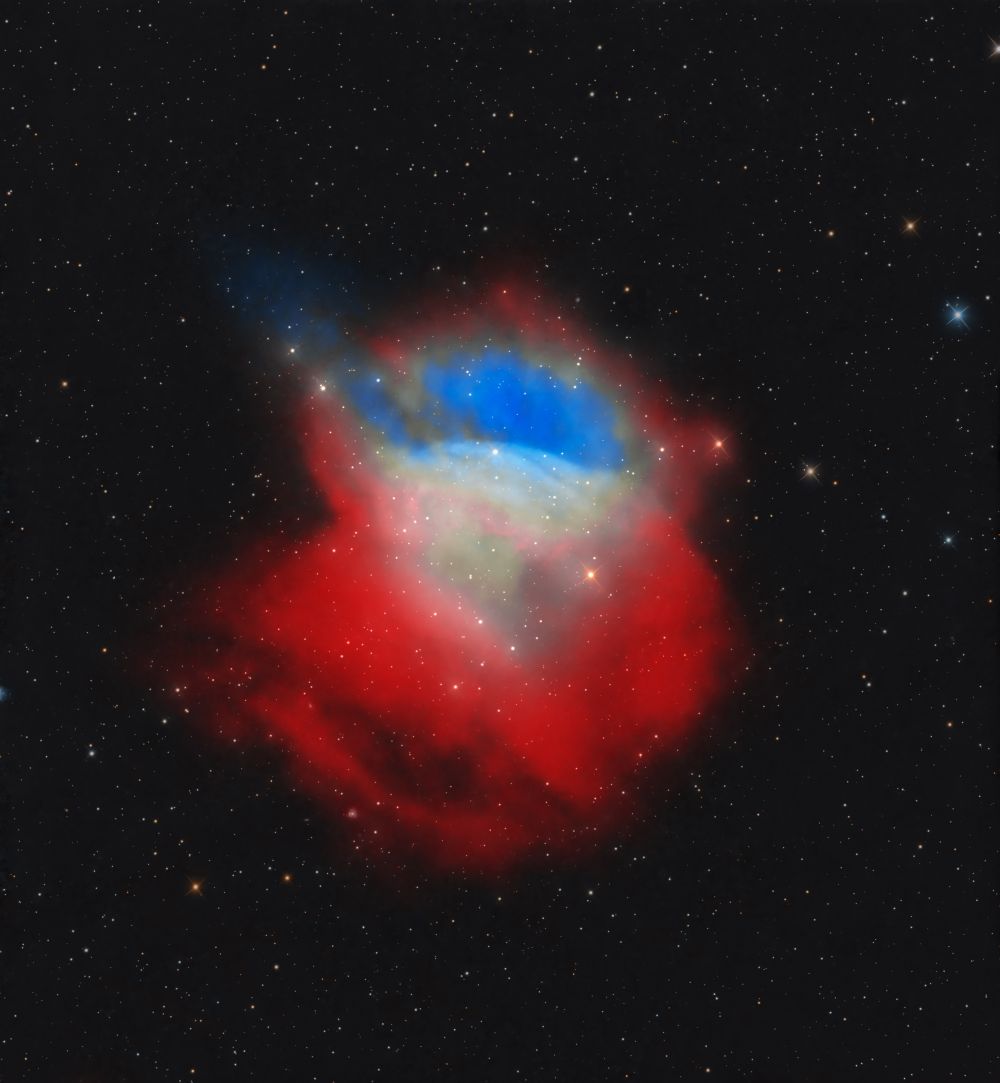
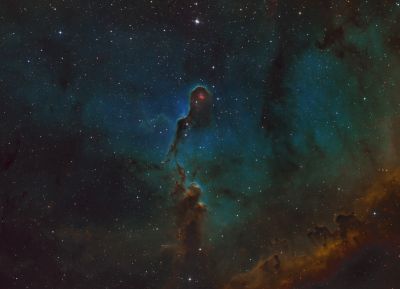
I really liked the object photographed by Goodwin; of course, his vacuum can't compare to mine, and the integration time is only 10 hours so far. I will shoot more if possible.
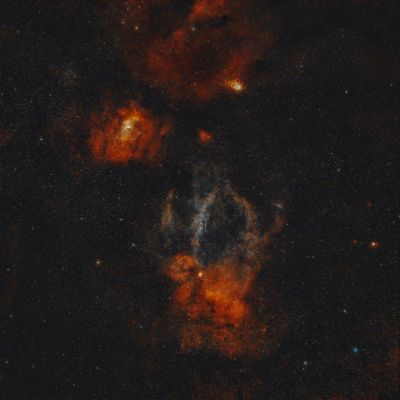
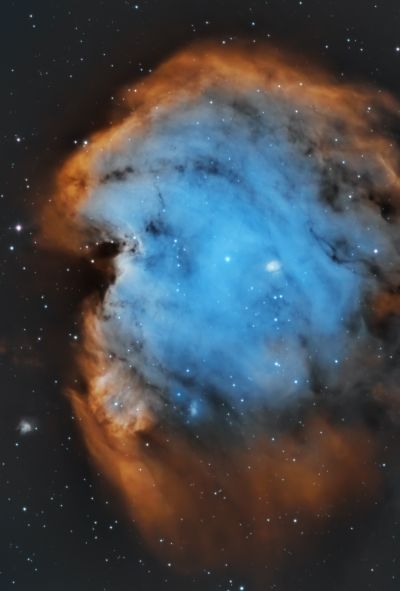
The nebula Sh2-174, located in the constellation Cepheus at a distance of about 1000 light-years, is one of the northernmost nebulae in the sky and has an amazing feature: its true nature has still not been precisely determined!
Discovered in 1959 by the American astronomer Stewart Sharpless, it is the 174th entry in his catalog. A few years later, his colleague Beverly T. Lynds observed it with the Mount Palomar telescope and added it to his catalog of bright nebulae ("LBN"). However, a problem soon arose: no star formation was observed in this nebula, and the star responsible for its ionization had not been identified...
It was only in 1970 that this star, a white dwarf named GD 561, was identified, and in 1993 two astronomers, R. Napiwotzki and D. Schönberner, established an apparent connection with the nebula and proposed classifying it as a "planetary nebula." Indeed, at first glance, Sh2-174 possesses characteristics typical of planetary nebulae, with a noticeable signal in the Ha (hydrogen) and OIII (oxygen) lines—the filters used for this image.
However, there are a number of mysterious details, not least of which is its morphology, which is unusual for a planetary nebula. Such nebulae are usually spherical or very symmetrical. But this is not the case with Sh2-174, where the HII and OIII regions don't even seem to overlap...
Even more curiously, the white dwarf—the star that gave rise to the planetary nebula when its outer layers were expelled at the end of its life—is typically located close to the "center" of the nebula; however, in the case of Sh2-174, the star is significantly offset to the west, so much so that astronomers Tweed and Napiwotzki, in a 1994 paper establishing the physical connection between the white dwarf GD 561 and the nebula, described the latter as a "planetary nebula abandoned by its central star."
GD 561 is moving at a speed of 71 km/s relative to the surrounding interstellar medium.
Add comment
Comments
There are no comments on this picture yet
Comments are available only to registered users. Register or log in to leave a comment.


Comments
There are no comments on this picture yet
Comments are available only to registered users. Register or log in to leave a comment.