Thank you for sharing your photos - this is exactly what this project is all about! :-)
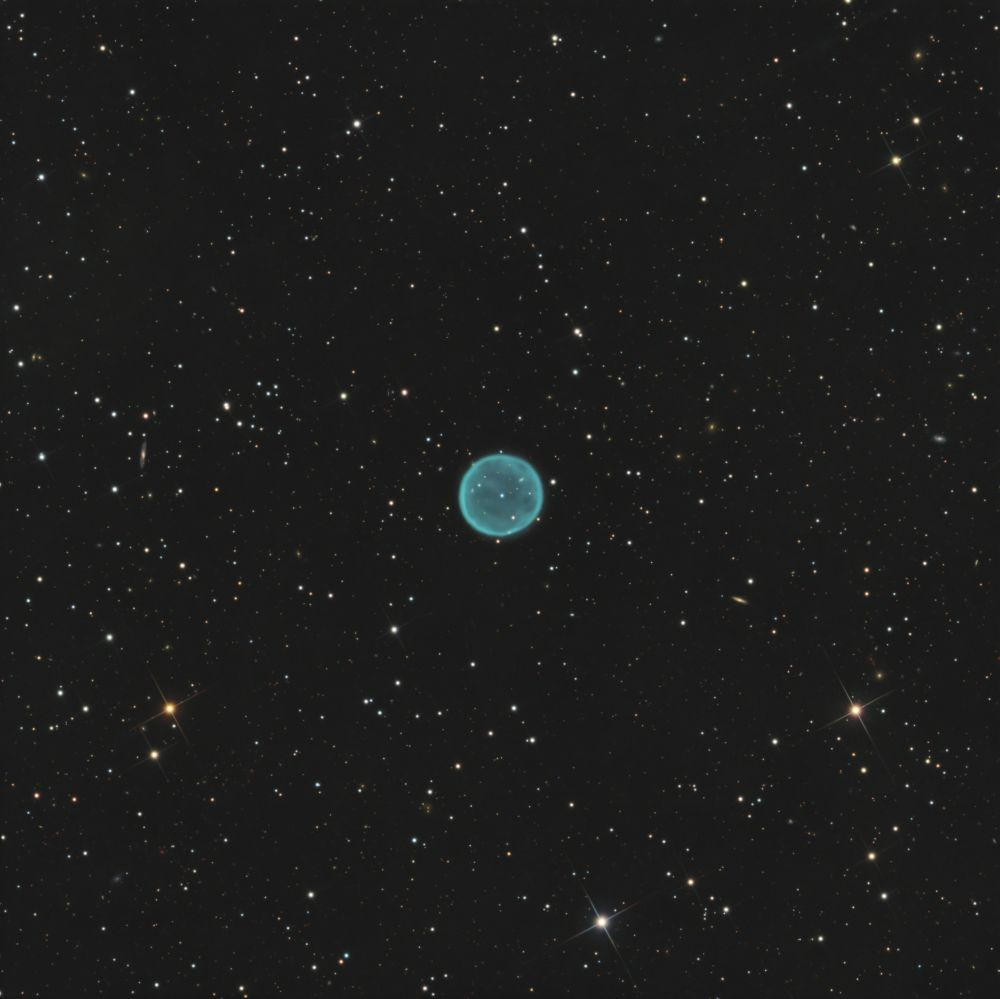
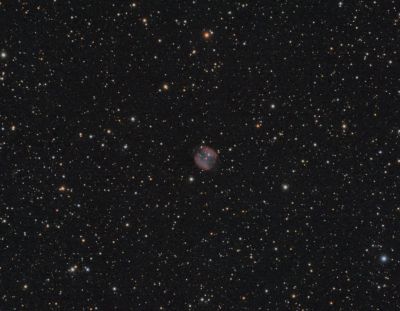
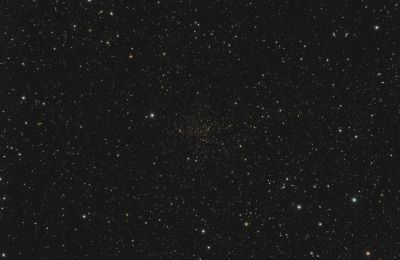
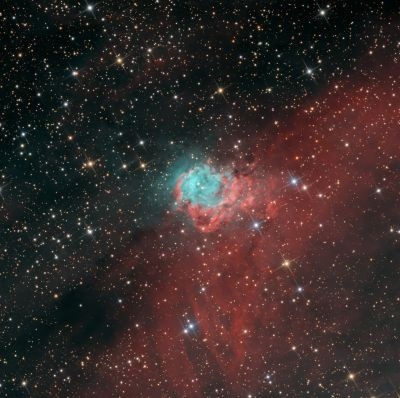
The planetary nebula Abell 39 in the constellation Hercules is notable for its nearly perfect spherical shape. The sphere has a diameter of about 5 light-years, and the thickness of the glowing shell is roughly one-third of a light-year. The distance to the nebula, located in the constellation Hercules, is estimated at 7,000 light-years. It was discovered in 1966.
The central star associated with the nebula is offset from the center of the sphere by an angular distance of about 2″ (or 0.1 light-year). This offset currently lacks a clear scientific explanation, but it is thought to be caused by a slight asymmetry in mass during the star's explosion. The apparent magnitude of the star is 15.5m ± 0.2. The star's mass is about 0.61 M☉, and the nebula's gas mass is estimated at an additional 0.6 M☉. A noticeable asymmetry in the brightness of different parts of the nebula is also observed — opposite edges of the gas shell show a 50% difference in brightness, and brightness inhomogeneities are also visible across the disk in plan view.
According to estimates, the star's explosion occurred 22,100 +1,700 / −1,500 years ago, with the shell expanding at a speed of 32–37 km/s. The shell is quite transparent in the optical range, allowing background stars and galaxies to be observed through it.
This is my second imaging session in my own astro-pavilion with remote control.
The frames were taken between June 1 and June 15, 2026.
The brightness of the planetary nebula (L channel) was captured with a dual-band filter, while the color of everything, stars, and background objects were captured in RGB.
This nebula contains both oxygen and a bit of hydrogen. I wanted to capture them simultaneously for the luminance channel, and take the color from RGB after spectrophotometric calibration.


Comments
And where in Crimea are you located?
Near Alushta.
Comments are available only to registered users. Register or log in to leave a comment.