Thank you for sharing your photos - this is exactly what this project is all about! :-)
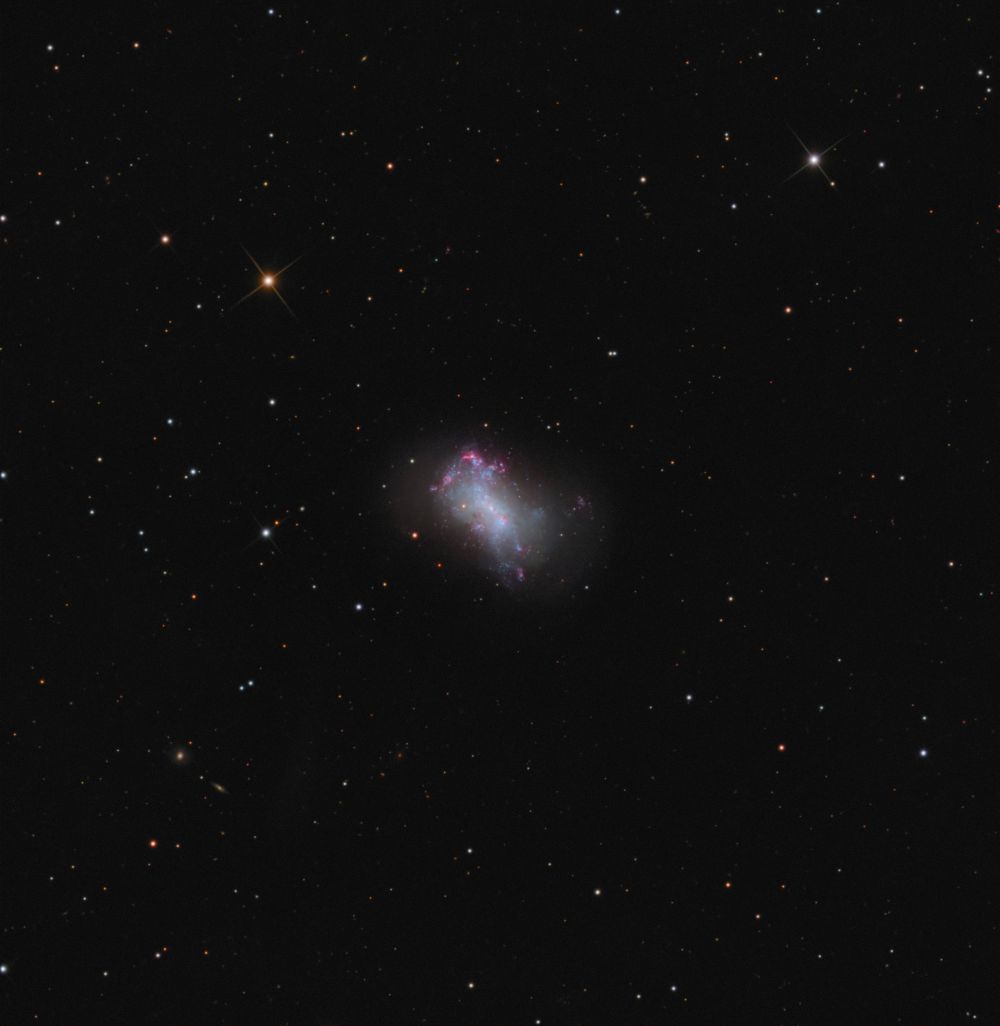
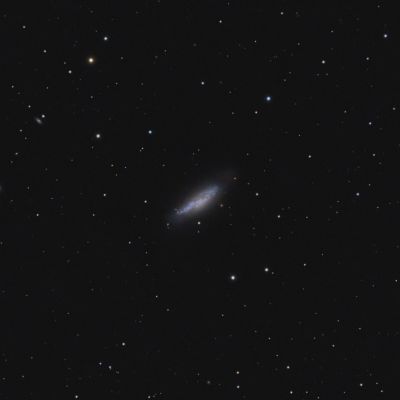
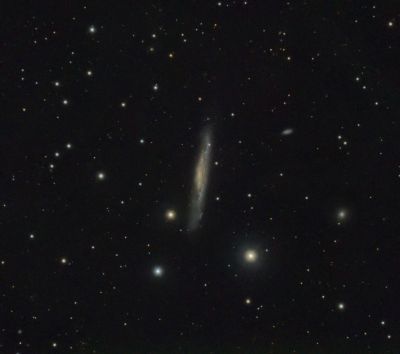
NGC 4449 - an irregular dwarf galaxy, similar to the Large Magellanic Cloud, it exhibits intense and widespread star formation activity.
Probably, interaction with another galaxy led to star formation that, strangely, extends to the very edge of the galaxy. The bluish-white areas are populated by bright, young, massive, short-lived stars, and the red ones are H-II regions. The size of the galaxy is estimated at 20,000 light-years, which is only a fifth of our Milky Way.
The final image was taken using the L(R+Ha)GB technique.
Awesome indeed!
Dmitry, could you please share your guiding parameters if it's not a secret?
I'm interested in the aggressiveness on both axes, exposure time, and pulse length.
And what overall RMS were you able to achieve with these parameters?
The most useful was the PPEC algorithm with the specified period of the worm gear. The rest - default. Guide exposure - 0.2 - 0.5 sec.
I aimed for a total RMS below 0.5", when the seeing allowed, of course. Typically, on a decent night - 0.7, on poor nights - >1". The correlation with the seeing is very good.


Comments
Dmitry, could you please share your guiding parameters if it's not a secret?
I'm interested in the aggressiveness on both axes, exposure time, and pulse length.
And what overall RMS were you able to achieve with these parameters?
I aimed for a total RMS below 0.5", when the seeing allowed, of course. Typically, on a decent night - 0.7, on poor nights - >1". The correlation with the seeing is very good.
Comments are available only to registered users. Register or log in to leave a comment.