Thank you for sharing your photos - this is exactly what this project is all about! :-)
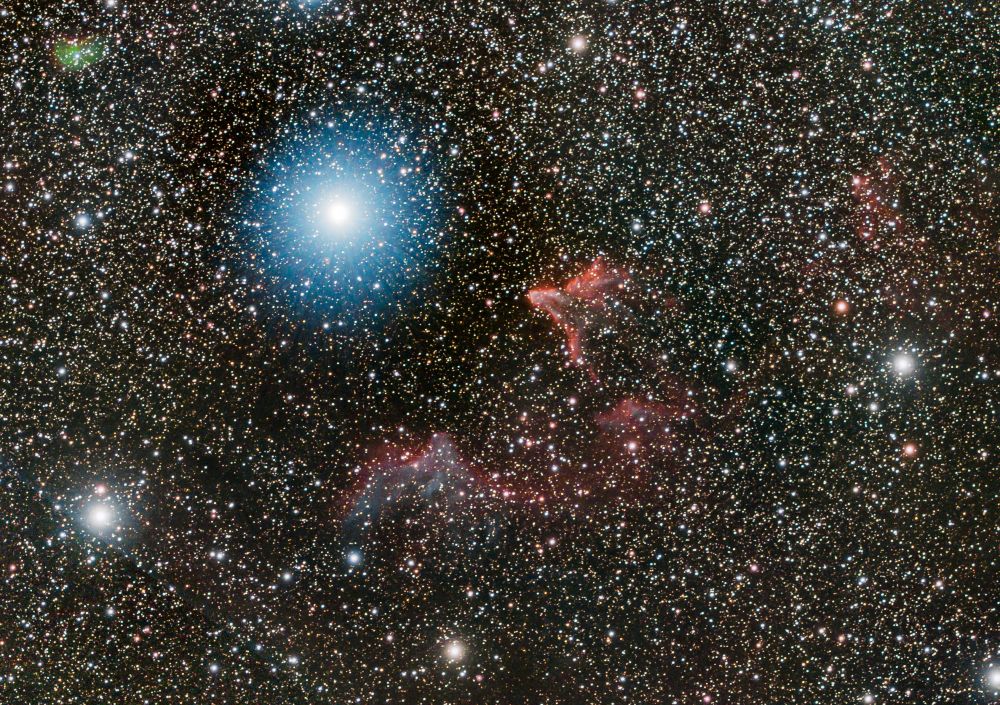
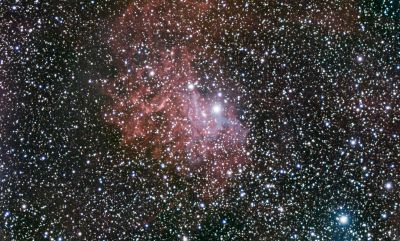
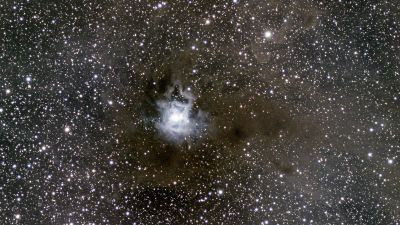
The Ghost of Cassiopeia Nebula (IC 63), located in the constellation Cassiopeia at a distance of approximately 550 light-years from Earth, is a slowly disintegrating cloud of gas and dust that forms a shimmering haze.
The nebula got its name due to the influence of the fiercely shining variable star Gamma Cassiopeiae, which is located a few light-years away from it. Although the star is far away, it makes its presence known with powerful bursts of radiation that affect the nebula.
Gamma Cassiopeiae, a subgiant with a mass 19 times that of the Sun and a luminosity 65,000 times greater than the Sun's, rotates at a speed of 1 million miles per hour, which is more than 200 times the rotation speed of the Sun. This star is surrounded by a disk of material that periodically erupts along with material during its furious rotation, causing the star to temporarily shine brighter in the northern night sky.
The Ghost of Cassiopeia Nebula emits alpha-hydrogen radiation and reflects cold blue light from Gamma Cassiopeiae. Its dimensions are impressive: about 0.31 light-years in height and 0.23 light-years in width.
When viewed from Earth, the entire region of nebulae under the influence of Gamma Cassiopeiae can be seen in the autumn and winter in the Northern Hemisphere, but this region is very faint, and IC 63 is only a small part of it.
Ultraviolet radiation from the star, penetrating the nebula, energizes hydrogen molecules, causing them to emit a dark red alpha-hydrogen glow. Light from the star is also reflected off the dust of the nebula, glowing with a cold blue color.
Although the ultraviolet light that contributes to the ghostly glow of the nebula will also be its destruction—according to the statement, the radiation is slowly dispersing the nebula over distances of light-years. Someday, perhaps, nothing will remain at all.
Add comment
Comments
There are no comments on this picture yet
Comments are available only to registered users. Register or log in to leave a comment.

Comments
There are no comments on this picture yet
Comments are available only to registered users. Register or log in to leave a comment.