DeepSkyHosting

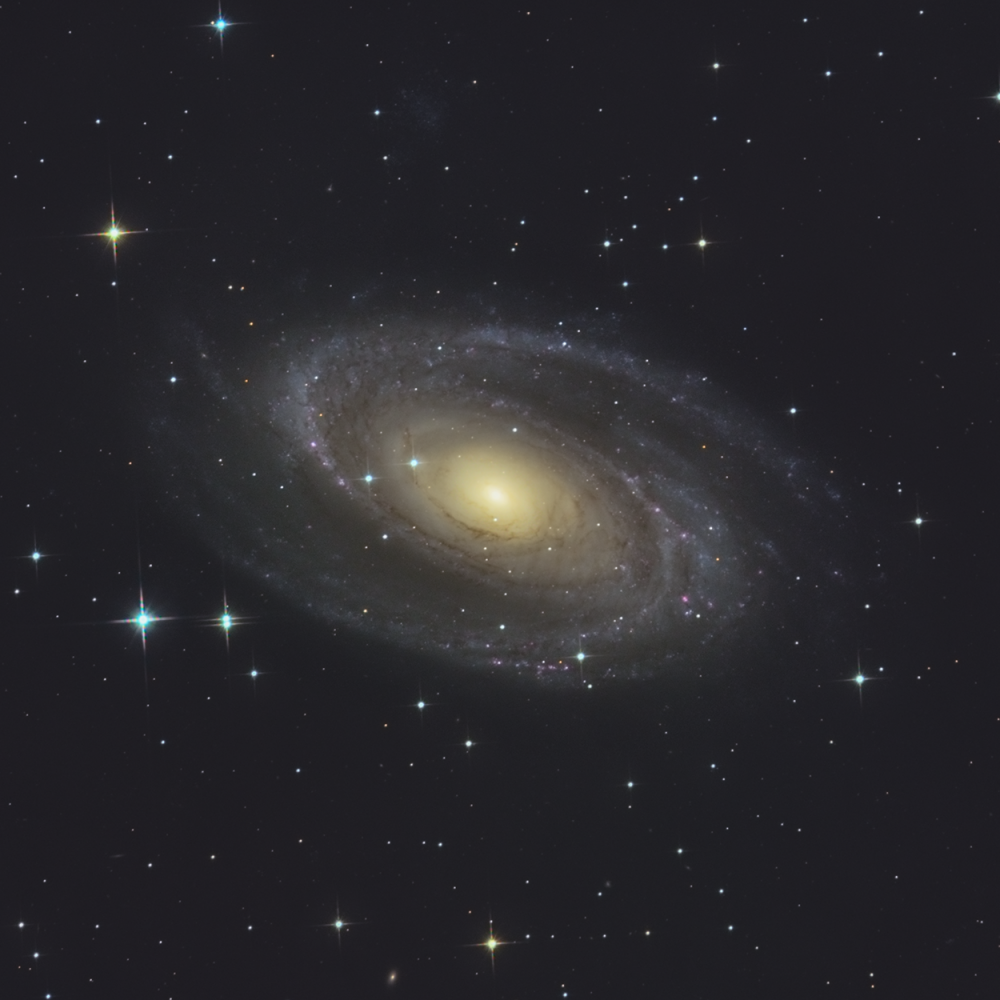
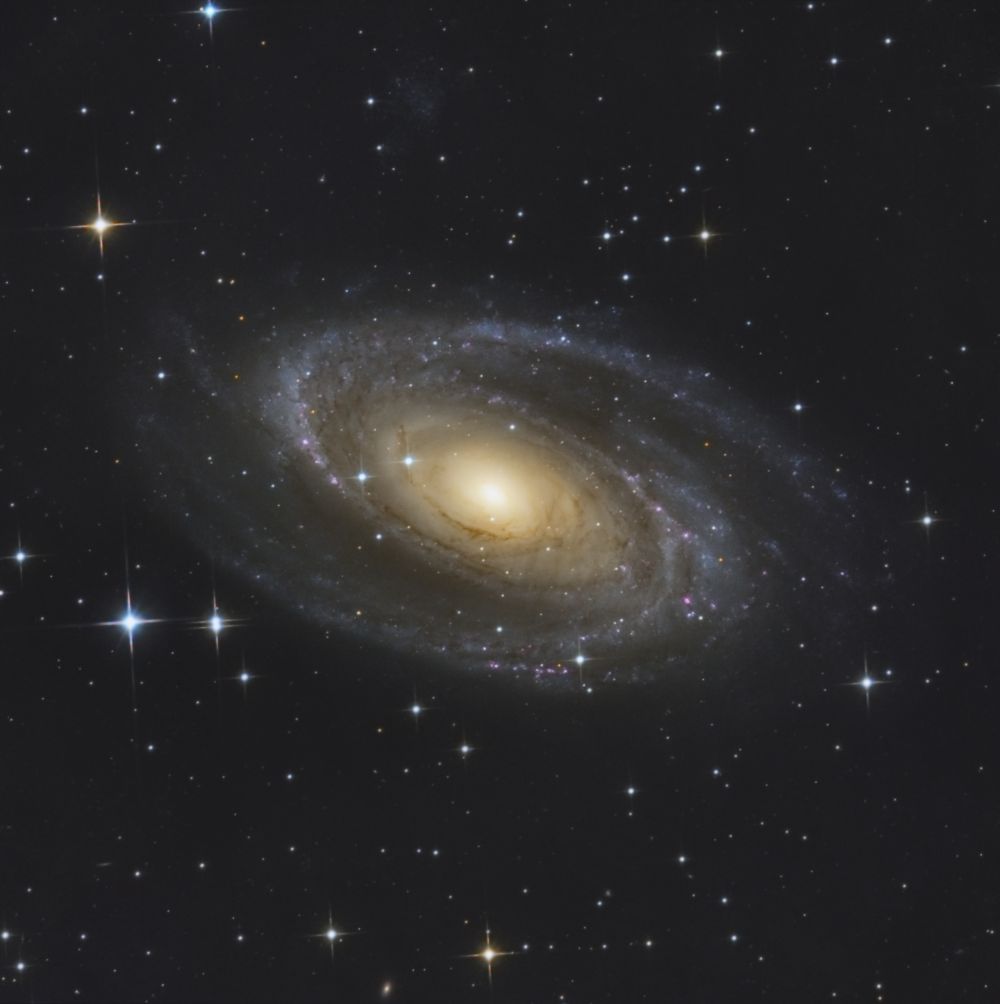
M81

Fatalik
2023372
Category:Deep Sky
Published:
2151
M81NGC 3031
Resolution:
1250x1250 px
File size:
4705 KB

Photo description / processing

Messier 81 (also known as NGC 3031 or Bode's Galaxy) was first discovered by Johann Bode in 1774. Because of this, it is often called Bode's Galaxy. 2 hours of L subs at 60 and 120 seconds each, and 40 minutes each of RGB (subs at 120 seconds).

Technical information

Telescope/Lens
Newtonian 350mm f/3
Camera
ZWO ASI1600MM Pro
Mount
Sky-Watcher EQ8
Accessories
Tele Vue Paracorr Type-2 Coma Corrector
Software
ASIAIR, DeepSkyStacker, Pixinsight, Adobe Photoshop
Location
Санкт-Петербург, Россия

Light pollution

Yellow, Bortle 5 zone

Photo versions

M81
Updated
M81

Mar 26th, 2020

L: 167min RGB: 40min I added another half hour of luminance and re-processed M81. Total: 2 hours 47 minutes of luminance and 40 minutes per color channel. By the way, here’s a simple example of why astrophotographers chase faster optics, despite the more complex collimation and higher cost (not only for the primary mirror but also for correctors). I calculated how much time it would take for a “typical” f/5 Newtonian to gather the same amount of light. My setup: f/2.9 + Paracorr (1.15) 2.9 × 1.15 = 3.335 3.335 × 3.335 = 11.122225 “Typical” Newtonian: f/5 Using a standard corrector without reducing speed: 5 × 5 = 25 So: 25 / 11.122225 ≈ 2.24775 Considering only luminance, not color: 2 hours 47 minutes = 167 minutes 167 × 2.24775 ≈ 375.37 minutes Result: 2 hours 47 minutes at f/3.335 equals about 6 hours 15 minutes at f/5.

M81
Current photo
M81

Mar 24th, 2020

Messier 81 (also known as NGC 3031 or Bode's Galaxy) was first discovered by Johann Bode in 1774. Because of this, it is often called Bode's Galaxy. 2 hours of L subs at 60 and 120 seconds each, and 40 minutes each of RGB (subs at 120 seconds).

Show changes
Previous version
Current version

Comments

There are no comments on this photo yet.

More photos by Fatalik