Thank you for sharing your photos - this is exactly what this project is all about! :-)
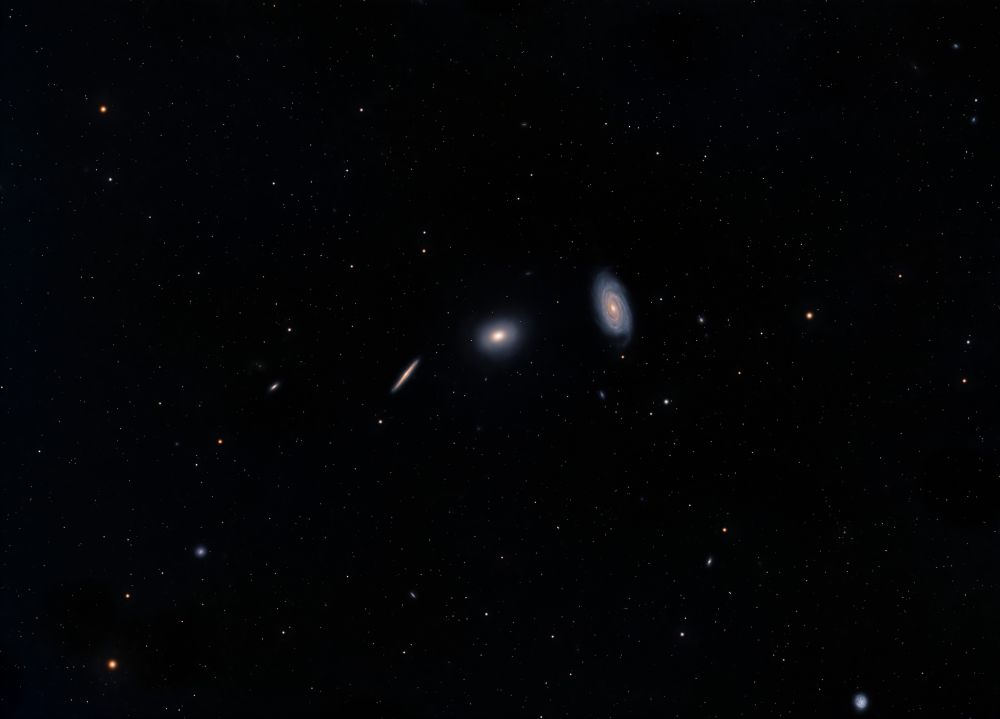
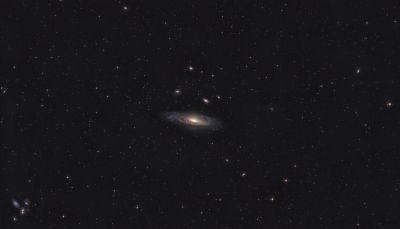
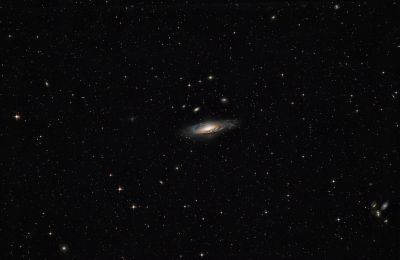
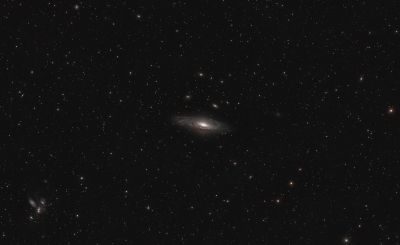
The Draco Trio group of galaxies consists of three bright galaxies: NGC 5981, NGC 5982, and NGC 5985. Although these galaxies appear close together in the sky, astronomical data show that there may be significant distances between them, and they are not necessarily gravitationally bound.
NGC 5981 is an edge-on spiral galaxy. It is located closer than the others (about 112 million light-years from Earth).
NGC 5982 is a classic massive elliptical galaxy. Its nucleus contains a supermassive black hole (mass about 830 million solar masses). It was discovered that it rotates independently of the outer regions, and surrounding it are visible "shell" structures—traces of mergers with other galaxies. The nucleus likely has LINER-type energy—weak nuclear activity.
NGC 5985 is one of the most beautiful spiral galaxies, seen almost face-on. It has a bright, active Seyfert-type nucleus, indicating the presence of powerful emission lines. Its diameter is about 246,000 light-years, which is twice the size of our Galaxy.
The absence of signs of gravitational perturbations from NGC 5982 indicates that these two galaxies are separated by a significant distance in space.
All three galaxies are located at a distance of approximately 100–140 million light-years from Earth.
In the lower right corner, another galaxy can be seen - NGC 5989. This is a poorly studied late-type spiral galaxy, judging by its spectrum - without a bright active nucleus and without noticeable signs of recent powerful collisions.
The Draco Trio group of galaxies consists of three bright galaxies: NGC 5981, NGC 5982, and NGC 5985. Although these galaxies appear close together in the sky…
The Draco Trio group of galaxies consists of three bright galaxies: NGC 5981, NGC 5982, and NGC 5985. Although these galaxies appear close together in the sky…
I have a feeling there's something off with your monitor. On almost all of your works, the background is clipped.
On this specific one, the background point is 2–4 units, while a normal one should be 20–30.











Comments
On this specific one, the background point is 2–4 units, while a normal one should be 20–30.
Comments are available only to registered users. Register or log in to leave a comment.