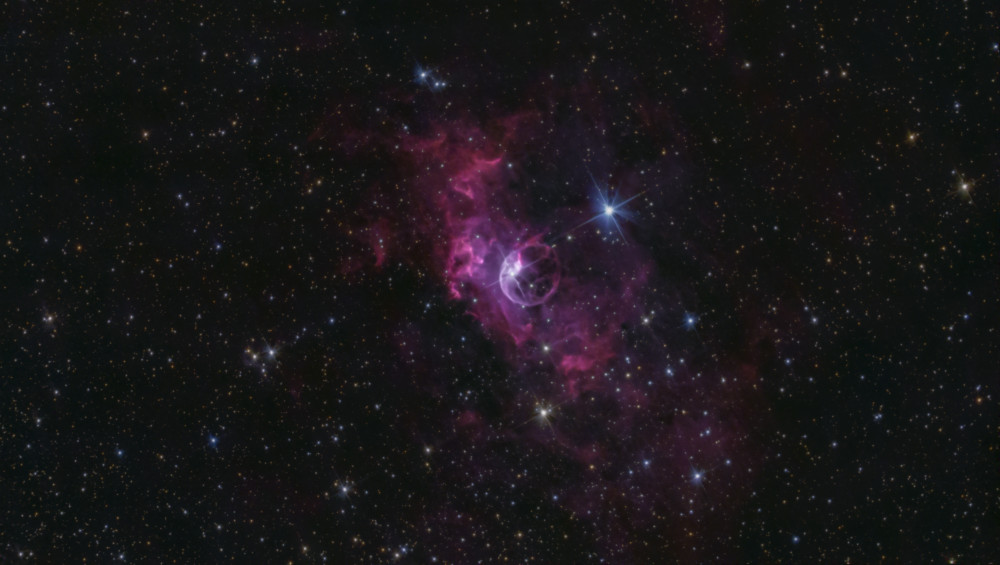
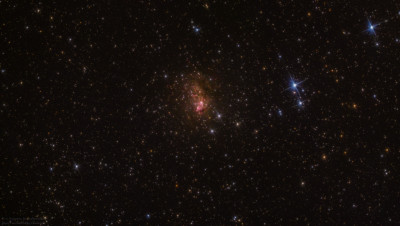
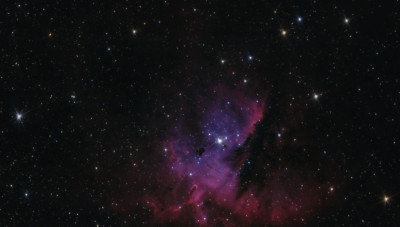
This is an emission nebula — a region of glowing gas in the constellation Cassiopeia. It is roughly 7,100–11,000 light-years from Earth. In projection on the sky, it lies close (about 35 arcminutes) to the open star cluster M 52.
Why "bubble"?
The name comes from its shape: the nebula visually resembles a slightly elongated soap bubble. In reality, it is not just a shell — it is a shock wave front. It was formed by the powerful stellar wind from a hot, massive star at its center. The star sheds gas that accelerates to enormous speeds (over 4 million miles per hour). When this wind, moving at supersonic speed, collides with the colder, denser gas of the surrounding molecular cloud, the material compresses, heats up, and begins to glow.
The creator star.
At the center lies a star designated SAO 20575 or BD +60°2522. It is a very massive and hot object (spectral class O6.5). Its current mass is estimated at about 45 solar masses, and its luminosity is roughly 500,000 times that of the Sun. At birth, the star was even more massive (about 60 solar masses), but over a few million years of life it has lost a significant portion of its mass — precisely what formed the "bubble." Scientists suggest that in about 10–20 million years, this star will end its life in a supernova explosion.
Some characteristics.
The nebula's diameter is about 7–10 light-years.
Its age is on the order of 300,000 years (though some sources give an estimate of about 40,000 years).
Its apparent magnitude is about 10.
It is expanding at roughly 36 km/s.
Why is the shape not perfectly round?
The asymmetry arose because the interstellar medium is not uniform. On one side of the nebula, denser regions of gas are encountered — they slow the expansion, and as a result, the star appears offset from the geometric center of the "bubble." In some places, dense gas pillars (similar to the "Pillars of Creation" in the Eagle Nebula) can be seen, which are ionized by the radiation from the central star.
History and observations.
The nebula was discovered by William Herschel on November 3, 1787. In a medium-sized amateur telescope, the object can indeed be discerned thanks to its rounded shape. The most detailed and beautiful images have been obtained with a space telescope.
Important note.
Do not confuse NGC 7635 with other objects also called "Bubble": for example, the "Soap Bubble" nebula (NGC 6888) in the constellation Cygnus, or the "Hubble Bubble" nebula (Hubble 1925 I) in Sagittarius.

Comments
There are no comments on this picture yet
Comments are available only to registered users. Register or log in to leave a comment.