Thank you for sharing your photos - this is exactly what this project is all about! :-)
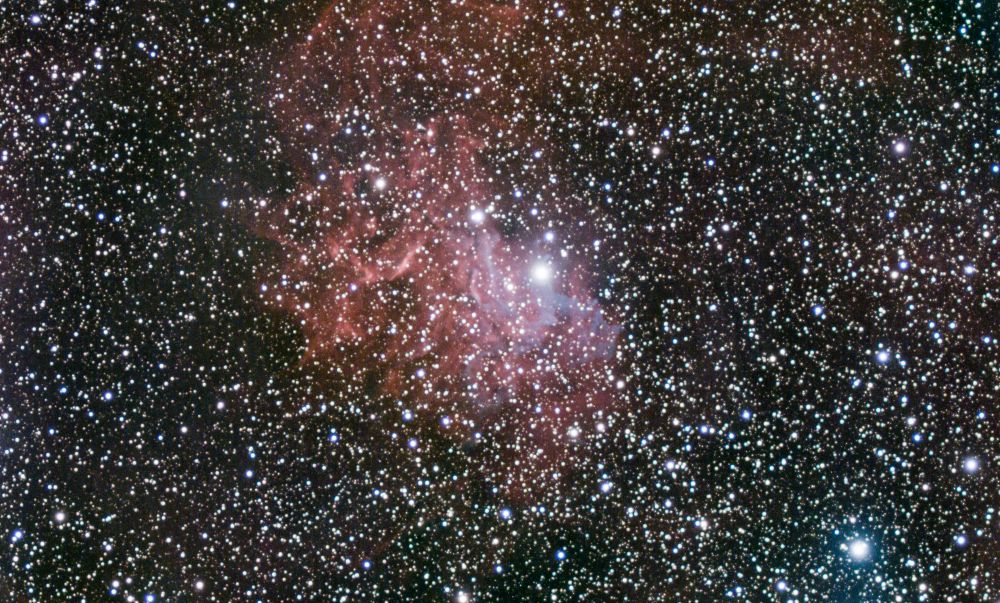
The Flaming Star Nebula, also known as IC 405, SH 2-229, and Caldwell 31, is an emission/reflection nebula in the constellation Auriga that surrounds the bluish irregular variable star AE Aurigae.
This nebula was discovered by John Martin Schaeberle on March 21, 1892. It is located approximately 1,500 light-years from Earth and spans an area of about 37' x 10' in the sky. The Flaming Star Nebula gets its name from the red and purple colors produced by different processes. The intense radiation from AE Aurigae strips electrons from the surrounding gas, and when a proton recaptures an electron, red-wavelength light is emitted. In the purple region, this red emission mixes with the blue light from AE Aurigae reflected by dust surrounding the star. These two regions are referred to as the emission nebula and reflection nebula, respectively.
The Flaming Star Nebula can be observed with a small telescope in the direction of the constellation Auriga. It lies near the open cluster IC 410, the open clusters M38 and M36, and the naked-eye K-class star Iota Aurigae (Hassaleh).
The proper motion of the runaway star AE Aurigae is believed to trace back to the region of Orion's Belt, from which it was once ejected. The physical size of the nebula is about 5 light-years.
Add comment
Comments
There are no comments on this picture yet
Comments are available only to registered users. Register or log in to leave a comment.

Comments
There are no comments on this picture yet
Comments are available only to registered users. Register or log in to leave a comment.