Thank you for sharing your photos - this is exactly what this project is all about! :-)
Dullness, a plan for winter, but I'll probably shoot further with a monochrome camera, I'll definitely reshoot the stars in RGB, and add some hydrogen and oxygen.
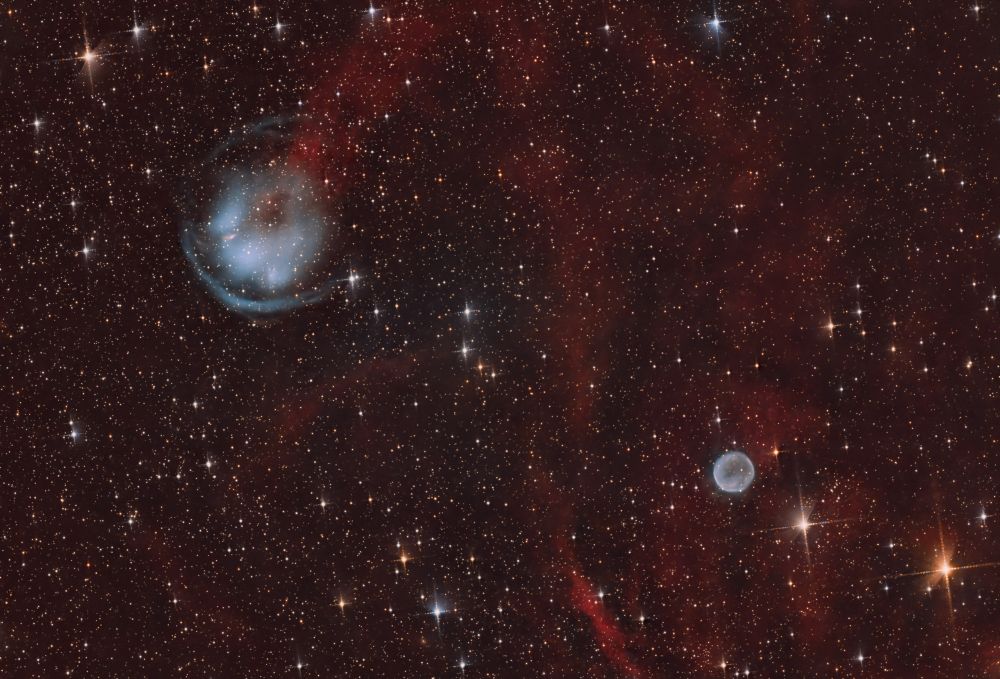
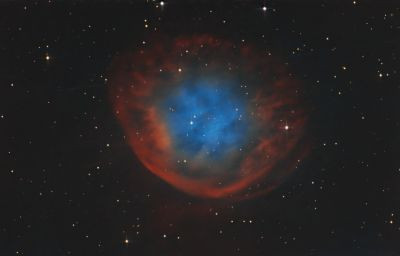
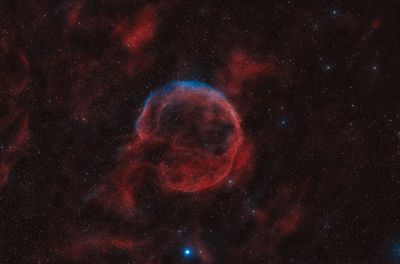
HFG1 is a planetary nebula in the constellation Cassiopeia. It was formed as a result of the rapid movement of the binary star system (V664 Cas) through our Galaxy. When HFG1 breaks through the interstellar medium, a bluish shock wave forms, leaving behind a red gas trail. A deep wide-field image of the planetary nebula HFG1, surrounding the pre-cataclysmic binary system V664 Cas, in the light of Halpha+[N II] emission lines, revealed an emission tail at least 20 arcminutes long with a position angle of 316 degrees. This is a shock wave trail about 10^5 years old, left by V664 Cas as it ejected material into the interstellar medium at speeds from 29 to 59 km/s.
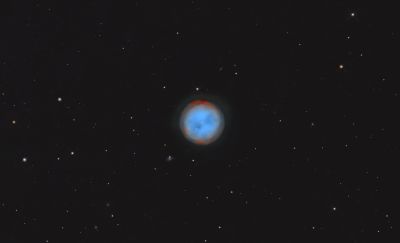
Abell 6 or PK 136+04.1: George Abell's study of the Palomar Observatory Sky Survey in the mid-1960s revealed 86 planetary nebulae, which turned out to be an observer's dream, as many of these celestial objects are not only very faint in brightness even under very dark skies, but also relatively large, with sizes often measured in arcminutes, not arcseconds. Later analysis of the Abell catalog showed that at least four of these objects, namely Abell 11, 32, 76, and 85, are not planetary nebulae at all.
Bright stars at the edges of the frame show bright spikes pointing toward the center.
Is this the corrector not fully correcting coma? Or something else?


Comments
Is this the corrector not fully correcting coma? Or something else?
Comments are available only to registered users. Register or log in to leave a comment.