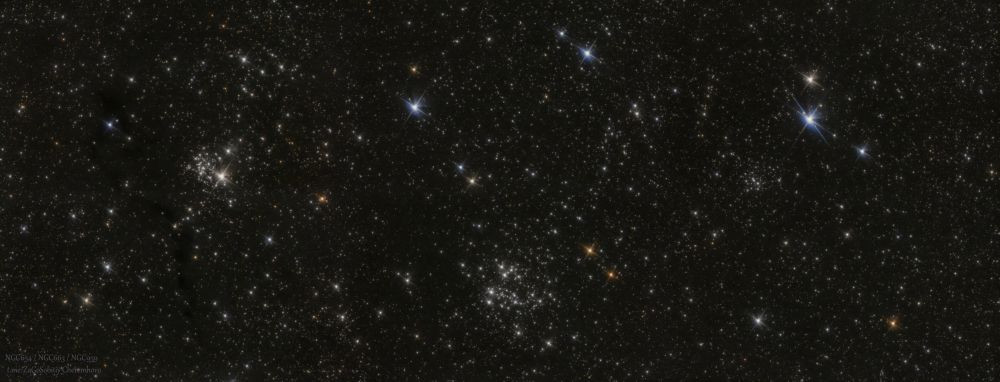
Mosaic.
Object No. 1.
Open cluster NGC 654
NGC 654 (also known as OCL 330) is an open star cluster. It was discovered by William Herschel on November 3, 1787.
Key characteristics:
Distance from Earth — about 6,650 light-years.
Age — approximately 14 million years.
The cluster contains about 80 stars, distributed in small groups over an area of about 14 light-years.
Apparent magnitude — about +6.5.
Two eclipsing binary systems have been found in the cluster, and the supergiants BD +65°315 and HD 10494 are considered probable members.
Dark nebulae LDN 1332, LDN 1334, and LDN 1337
Near NGC 654 are the dark nebulae LDN 1332, LDN 1334, and LDN 1337. They were cataloged by Beverly T. Lynds in 1962 on photographic plates from the Palomar Atlas.
Dark nebula — is a cloud of interstellar dust and gas that does not emit light itself but absorbs light from background stars, making it appear as a dark patch against a bright background.
Why are they together?
The reason is that we are observing a very dusty region of the Milky Way. The dust clouds creating these dark nebulae are located much closer to us than the cluster NGC 654. Therefore, they are not gravitationally linked to the cluster itself — they are simply projected onto it from our viewpoint.
In addition to the dark nebulae, the reflection nebula VdB 6 is also visible in this area. It is illuminated by the star HIP 8074 and reflects its light, so it appears as a bluish glow.
Thus, NGC 654 and the dark nebulae are an example of how different components of the interstellar medium (dust and gas) can lie in the same direction in the sky without being part of the same physical object.
Object No. 2.
NGC 663 (also known as Caldwell 10) — a young open star cluster in the constellation Cassiopeia.
Discovered by William Herschel on November 3, 1787.
Distance to the cluster is approximately 2,420 parsecs (7,900 light-years).
Apparent magnitude — 7.1.
Angular size — 15 arcminutes.
Features:
The brightest stars are concentrated in the northern part of the cluster.
A pair of eighth-magnitude stars and a pair of ninth-magnitude stars create two regions protruding among the fainter stars.
In most northern latitudes with temperate climates, NGC 663 is a circumpolar object, so it is visible year-round. Its highest point in the sky occurs in October, November, and December. From southern regions, the cluster is at best visible low above the northern horizon, and from some southern regions it never rises at all.
Characteristics.
Contains about 400 stars.
Notable for a large number of Be-type stars — about 24 have been found in total. These are B spectral class stars that show hydrogen emission lines in their spectra. Most stars of this type in the cluster belong to classes B0 to B3.
The cluster hosts at least 5 blue stragglers — stars formed from the merger of two stars.
At the edge of NGC 663 there are two red supergiants.
Age.
The estimated age of the cluster is between 20 and 25 million years. This means that stars of spectral class B2 or heavier are already approaching the end of their main-sequence lifetime.
Composition.
One probable member — the star LS I +61° 235, which is a binary system consisting of a Be star and an X-ray star, with an orbital period of about 3 years.
At the edge of NGC 663 there are also two red supergiants.
NGC 663 is possibly a member of the Cassiopeia OB8 stellar association, located in the Perseus Arm of the Milky Way.
Research.
Recent ultraviolet observations with the AstroSat satellite have shown that many Be stars in NGC 663 have hot, compact subdwarf OB (sdOB) companions, which make up about 70% of the Be star population in the cluster. This finding indicates that binary interactions, including mass transfer and the removal of one star, play a key role in the formation and evolution of Be stars in young clusters like NGC 663.
Object No. 3.
NGC 659 (also known as the Yin-Yang cluster or Cr 19, OCL 332) — is an open star cluster in the constellation Cassiopeia.
Discovery history.
The cluster was discovered by Caroline Herschel on September 27, 1783. Later, on November 3, 1787, it was observed by her brother William Herschel, who included the object in his catalog.
Key characteristics.
Distance from Earth: about 6,321 light-years (1,938 parsecs).
Apparent magnitude: about +7.9.
Apparent size: approximately 6 arcminutes.
Age: about 20 million years.
Number of stars: about 40.
Cluster size: approximately 15 light-years.
Position in the sky.
NGC 659 is located near the north celestial pole, so it is visible for most of the year from the northern hemisphere. In the sky, it lies almost directly next to the open clusters NGC 654 and NGC 663.
Observing features.
The cluster can be spotted in a small telescope or binoculars with a 40–50 mm aperture, but because its constituent stars are quite faint, it may seem like a challenging target.
Additional information.
Variable stars have been found in the cluster, including Be stars and pulsating variables of the γ Doradus type.

Comments
There are no comments on this picture yet
Comments are available only to registered users. Register or log in to leave a comment.