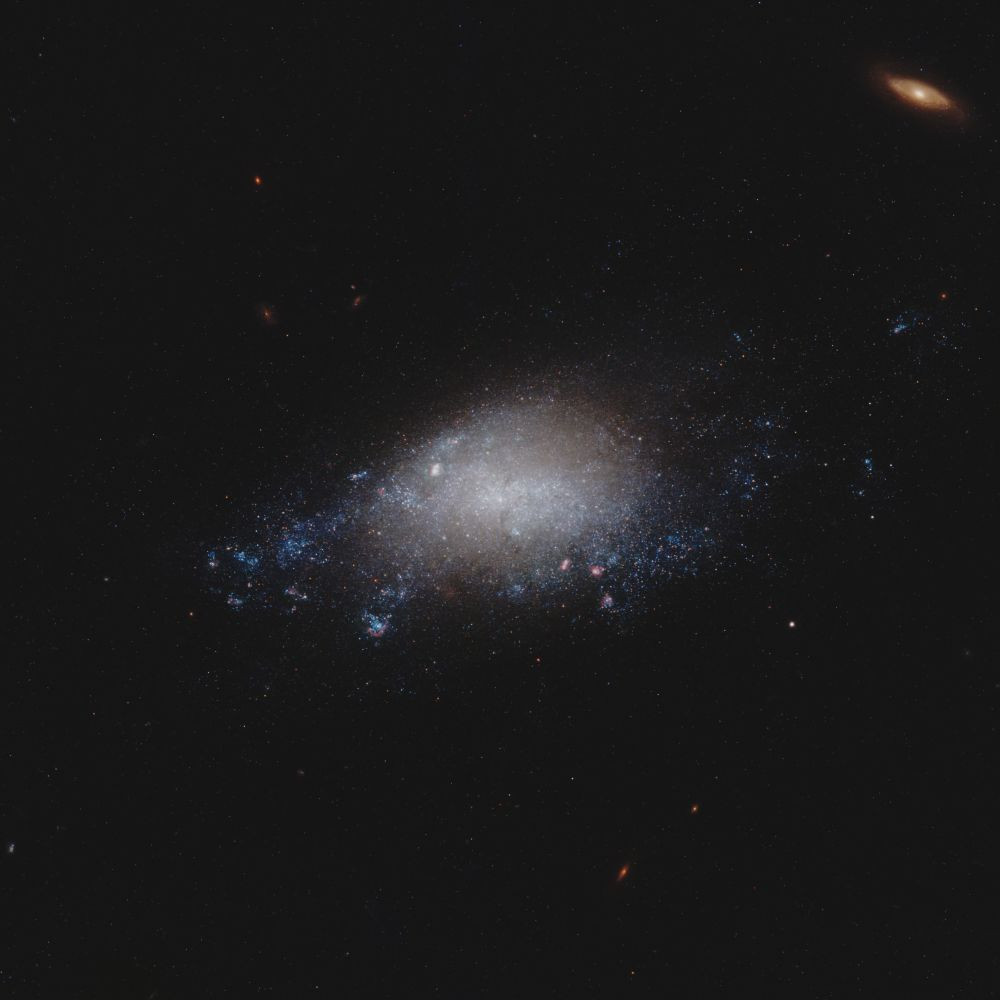

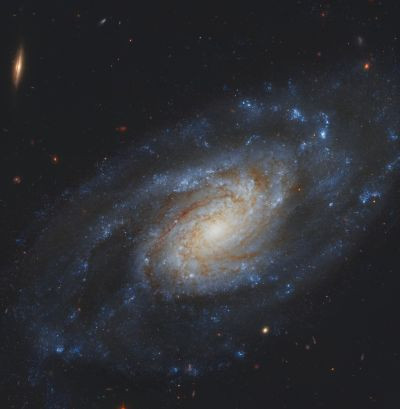
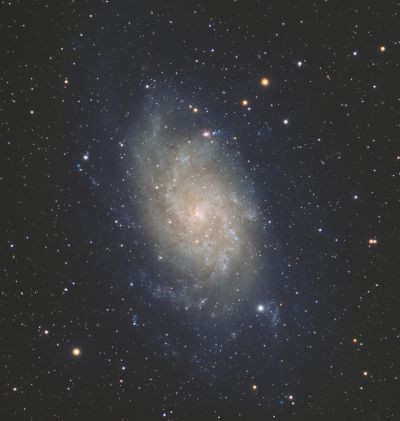
NGC 3274. Author's processing of archival observations from the Hubble Space Telescope, WFC3/UVIS camera. Source data: NASA/ESA, MAST/STScI archive, HST program 13364 (LEGUS), observations from February 5, 2014.
The main RGB was assembled from 9 independent exposures: F438W — 3 frames, 956 s; F555W — 3 frames, 1134 s; F814W — 3 frames, 980 s. Total exposure of the broadband set — 3070 s (51 min 10 s).
Channel mapping: R = F814W, G = F555W, B = F438W. The white point is calibrated to the CALSPEC solar spectrum. This is an approximate BVI palette: F814W captures the near-infrared range, so the colors are not an exact reproduction of human vision.
Preparation of calibrated archival frames, alignment, rejection of defects, and stacking were performed in Siril using Python, Codex. In a separate cosmetic version, small residual defects were replaced by local interpolation; the original stacks and masks were preserved. Neural network inpainting was not used.
The project also separately prepared a narrowband channel F657N (Hα + [NII] + continuum): 3 exposures, 1545 s, program 13773, February 16, 2015. This exposure is not included in the stated total of the main RGB.
Working assembly: 2980 × 2980 pixels, scale 0.05″/pixel, field approximately 149 × 149″. Measured FWHM of stars in the broadband stacks — about 0.10–0.11″.
------
Note the blue scattering around the bright center. Here the galaxy ceases to be just a hazy patch: numerous compact sources and stellar groups become distinguishable. It is precisely the connection between individual stars, clusters, and large star-forming regions that the LEGUS program studies, from which our broadband data were taken. LEGUS description
The golden galaxy in the upper right corner — PGC 213714. It is located significantly farther away than NGC 3274: proximity in the image does not mean proximity in space.


Comments
There are no comments on this picture yet
Comments are available only to registered users. Register or log in to leave a comment.