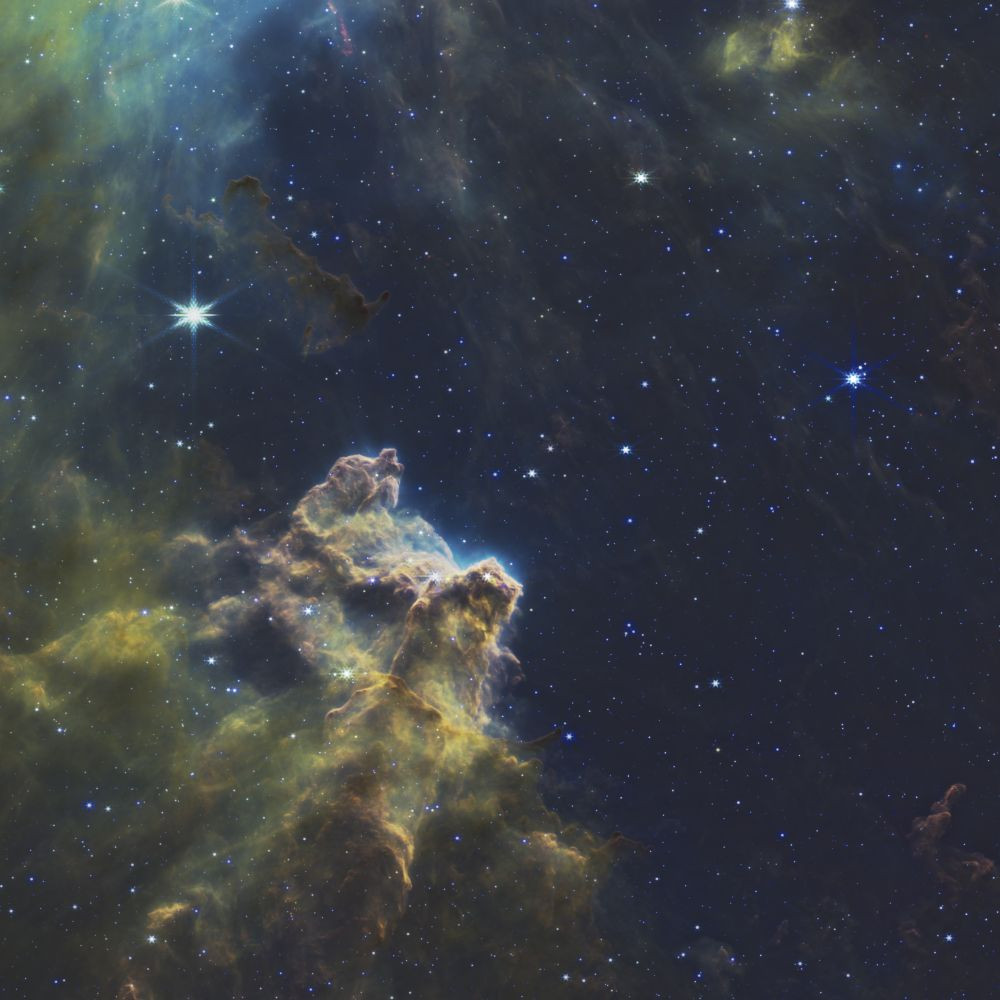
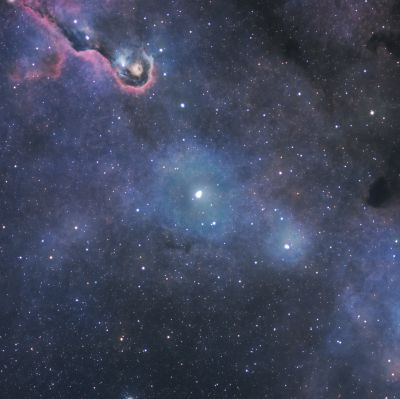
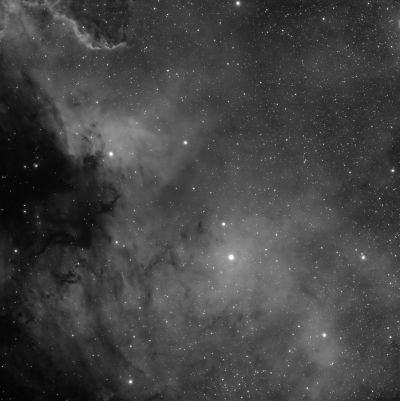
HH 902 region in the Carina Nebula. Archival James Webb / NIRCam observations, program 5408, principal investigator Megan Reiter, July 21–22, 2025. Source FITS: MAST/STScI; data from NASA / ESA / CSA.
Conventional infrared palette: R = F470N, G = F444W, B = F164N. These are not natural visible-light colors and not the classic SHO palette.
The full source mosaic is assembled from 24 independent exposures per channel (72 total); detectors from a single exposure were not counted as separate frames. A typical mosaic point is covered by approximately six exposures. Exposure times across the entire dataset used: F444W — 24 × 128.841 s = 3092.2 s; F164N and F470N — 24 × 418.734 s = 10049.6 s each. This is the sum across mosaic positions, not the exposure time of each point in this particular square fragment.
Alignment, outlier rejection, and stacking in Siril; preparation and color assembly using Python and Codex. Missing centers of overexposed stars in the artistic version were cosmetically estimated from profiles of non-overexposed stars and local interpolation.
3600 × 3600 square — the right part of the panorama (only the square format is loaded here), without additional changes to its color and brightness.
I did not find a similar artistic panorama online, but there is a nearby region with a somewhat different palette on the NASA website:
https://science.nasa.gov/asset/hubble/visible-view-of-pillar-and-jets-hh-901902/
Also, I should probably still work on the color palette and the use of starless plugins — I don't really like the saturation of the blue stars, and I should try to tone down the diffraction spikes.


Comments
There are no comments on this picture yet
Comments are available only to registered users. Register or log in to leave a comment.