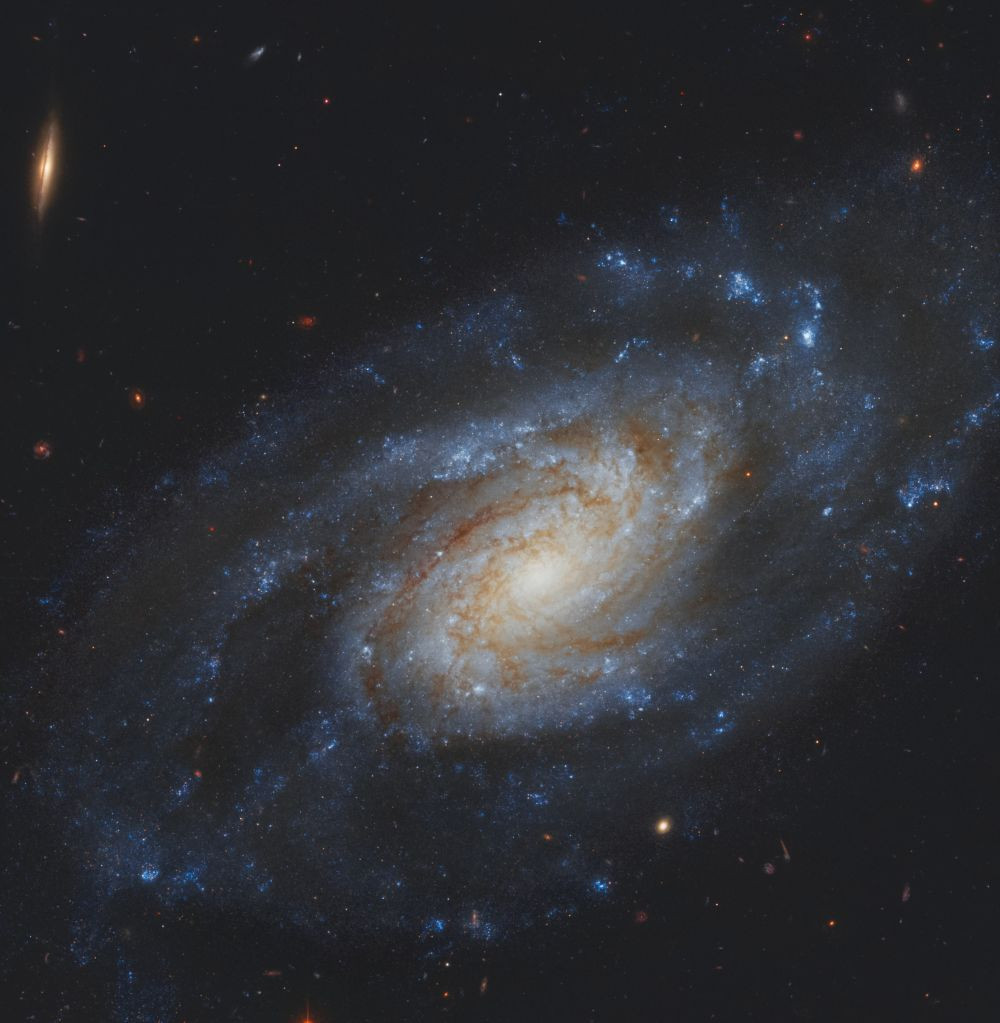

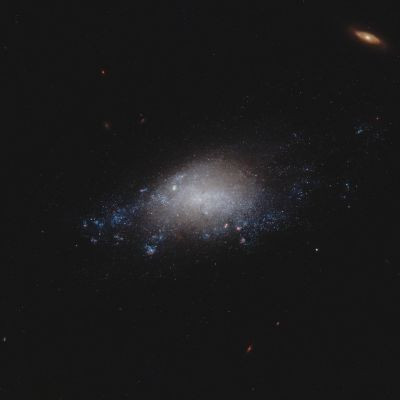
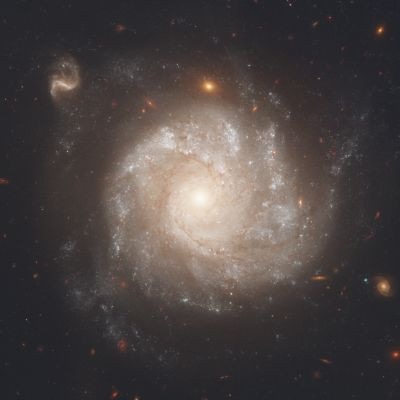
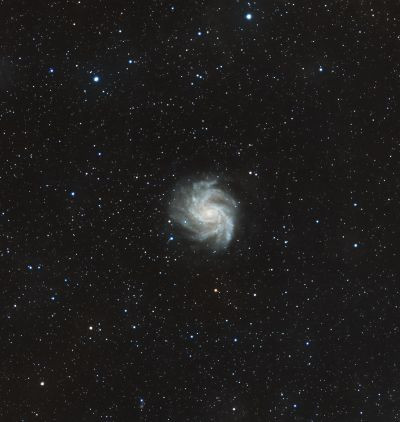
NGC 3370. Processing of linear RGB assembled from public archival data from the Hubble Space Telescope, ACS/WFC camera. FITS source — STScI/MAST; programs HST 9351 (F555W/F814W, visits 11 and 17) and 9696 (F435W, visits 01 and 02).
Used 24 independent exposures of 1200 seconds each: 8 frames per channel. Total nominal exposure — 8 hours, 2 h 40 min per channel. Observation dates: 31.03.2003, 10–11.04.2003 and 01.05.2003.
Preparation of archival FITS and alignment were performed programmatically with coverage verification and exclusion of defective measurements. Stacking in Siril: weighted mean by noise, additive normalization and winsorized rejection. Channel assignment: F435W → B, F555W → G, F814W → R. Before artistic processing, a white point based on the CALSPEC solar spectrum was used. F814W includes the near-infrared range, so this is an approximate B/V/I color representation.
Final artistic processing of the linear RGB, brightness and color corrections in Photoshop (Camera Raw, selective color correction, curves). Final size 2930 × 3000 pixels, field about 2.44 × 2.5 arcminutes. Generative inpainting was not used in the preparation of the source RGB.
Observations: NASA/ESA Hubble. Archive and source FITS: STScI/MAST.
What can be seen when zooming in
• Blue OB associations and young star clusters of NGC 3370. Look for bright blue knots and chains along the outer spiral arms; the complexes above the nucleus and to its right are especially prominent. These are regions of recent star formation, not individual blue "stars" from processing.
• Red distant galaxies shining through the outskirts of NGC 3370. Best seen in the dark gaps between blue clusters in the outer arms: these are small reddish blurred spots, often elongated, unlike point-like stars.
• A large background spiral seen edge-on. Located almost at the left edge, approximately in the upper quarter of the frame. It has a bright elongated bulge, a dark dust lane across the disk and a slight warp; NASA describes it as a "Sombrero twin."
• A compact background galaxy with a warm core. Look in the upper right part, approximately at 15% of the frame height and 10% from the right edge: an orange core surrounded by a faint asymmetric bluish-gray halo.
• Two clearly distinguishable small background spirals to the left of NGC 3370. They are located near the left edge at the level of the upper part of the main galaxy's disk: one almost face-on, with reddish arms; the other higher and to the right, more compact, with a bright orange center.
• A foreground Milky Way star. This is a bright, almost round creamy-yellow object below NGC 3370 and slightly to the right of the frame center. Its point-like core and symmetric halo help distinguish a star from small galaxies.
• A complex group of distant galaxies near this star. Look below and to the right of the foreground star: a thin elongated reddish galaxy, a rounded deformed object and several faint neighbors are visible. In Hubble materials, this region is described as an interacting system onto which the foreground star and another background galaxy are projected.
• A faint chain of merging blue galaxies. Look in the upper half of the frame to the left of center, away from the bright disk of NGC 3370: it appears as a short broken thread of several very faint bluish-gray elongated spots.
Most distant galaxies in this field do not have commonly used individual names in the accompanying Hubble release, so here they are indicated by reliably distinguishable morphology and position, without questionable catalog identifications. The historical supernova SN 1994ae is no longer visible as a separate bright object in these 2003 exposures; individual Cepheids also cannot be reliably identified from a single final RGB without a time series.


Comments
Comments are available only to registered users. Register or log in to leave a comment.