Thank you for sharing your photos - this is exactly what this project is all about! :-)
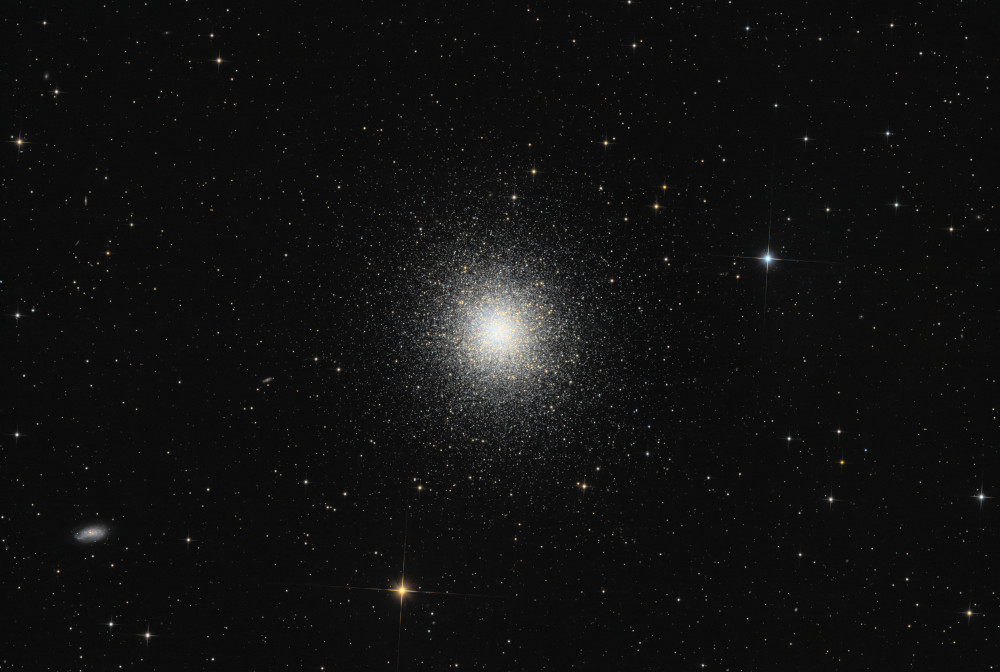
**M 13** (**NGC 6205**, **GCL 45**, also known as the **Great Cluster in Hercules**) is a globular star cluster in the constellation Hercules. It has an apparent magnitude of +5.8 and can be seen with the naked eye under good conditions. The cluster was discovered in 1714, and in 1974, the Arecibo message was sent toward it. It is one of the brightest and most well-studied clusters in the Galaxy.
A somewhat challenging star cluster to process, because when shooting with short exposures, the 294 sensor does not perform very well and produces noticeable horizontal banding on R, G, and B. Thankfully, I captured L frames, which have significantly less banding in the frame, saving the work. Maybe I should have increased the exposure to 30 seconds or lowered the gain to 0 and increased the exposure, but then other noise would have appeared. I don't know, overall. If anyone with experience could advise on what should have been done. In any case, I just need to figure out the technical details and everything will be clear =) Otherwise, if there were no banding, I would have added more "exposure." It would have been brighter and more vivid.
**M 13** (**NGC 6205**, **GCL 45**, also known as the **Great Cluster in Hercules**) is a globular star cluster in the constellation Hercules. It has an apparen…
Show changes
Add comment
Comments
There are no comments on this picture yet
Comments are available only to registered users. Register or log in to leave a comment.



Comments
There are no comments on this picture yet
Comments are available only to registered users. Register or log in to leave a comment.