
Sh2-174 Valentine's Rose Nebula

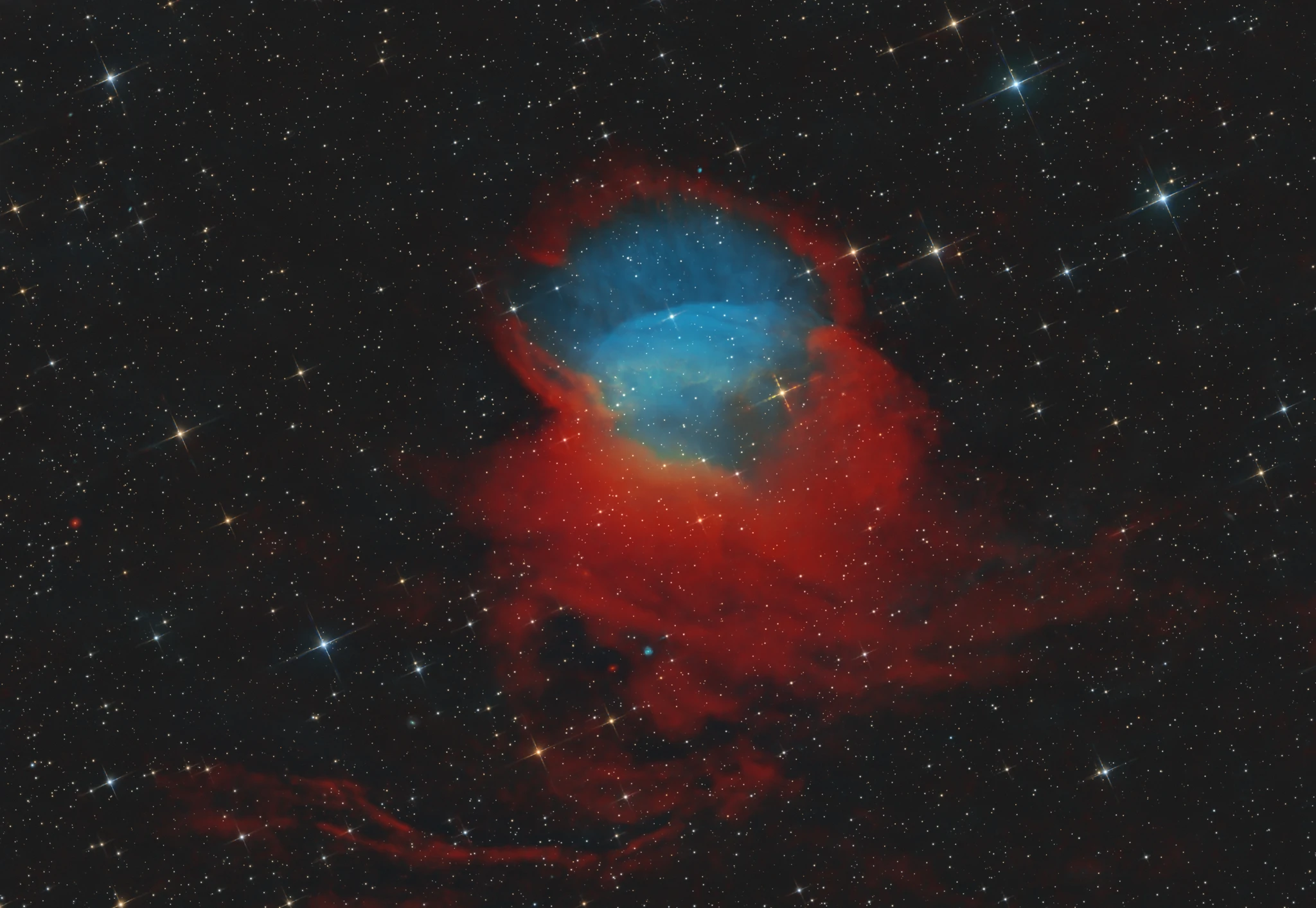
Photo description / processing
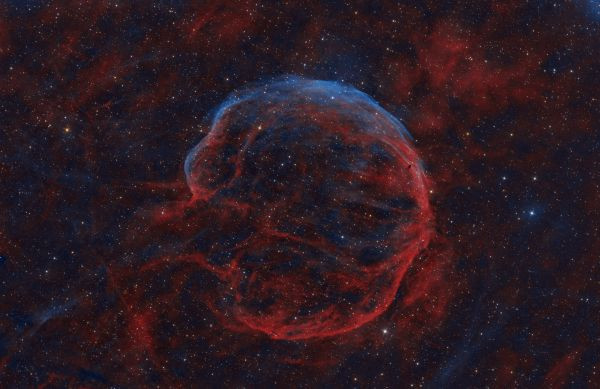
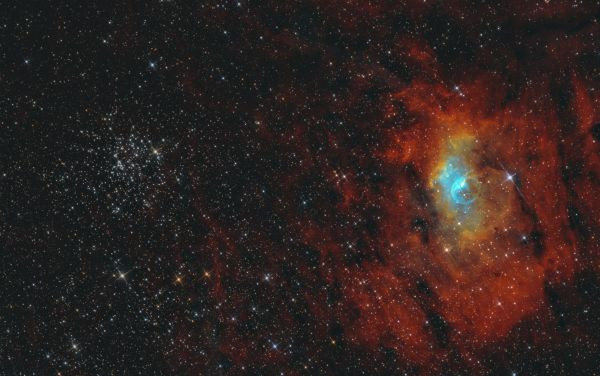
SH2-174 The Valentine Rose Nebula
Second approach to this object, now with faster optics so the result is more interesting, on single frames you can only guess that there is something there, if the moon is shining then it's completely empty, to get a better result one needs to move under a dark sky.
The nebula Sh2-174, located in the constellation Cepheus at a distance of about 1000 light-years, is one of the northernmost nebulae in the sky and has an amazing feature: its true nature has still not been precisely established! Discovered in 1959 by the American astronomer Stewart Sharpless, it is the 174th entry in his catalog. A few years later his colleague Beverly T. Lynds observed it with the Mount Palomar telescope and added it to his catalog of bright nebulae ("LBN"). However, a problem soon arose: no star formation was observed in this nebula, and the star responsible for the ionization was not identified... Only in 1970 was this star, a white dwarf named GD 561, identified, and in 1993 two astronomers, R. Napiwotzki and D. Schönberner, established an obvious connection with the nebula and proposed classifying it as a "planetary nebula". Indeed, at first glance Sh2-174 possesses characteristics typical of planetary nebulae, with a noticeable signal in the Ha (hydrogen) and OIII (oxygen) lines — the filters used for this image. However, there are a number of mysterious details, and not least the morphology unusual for a planetary nebula. Such nebulae are usually spherical or very symmetrical. But not in the case of Sh2-174, where the HII and OIII zones seem to not even intersect... What is even more curious is that the white dwarf — the star that gave rise to the planetary nebula when its outer layers were ejected at the end of its life — is usually located close to the "center" of the nebula; however, in the case of Sh2-174 the star is strongly offset to the west, so much so that the astronomers Tweedy and Napiwotzki in a 1994 paper establishing the physical connection between the white dwarf GD 561 and the nebula, describe the latter as a "planetary nebula abandoned by its star". GD 561 is moving at a speed of 71 km/s relative to the surrounding interstellar medium.
Technical information
- Telescope/Lens
- Прямофокусник 300/996 "Изд.No3"
- Camera
- ToupTek ATR2600M
- Mount
- МТ-120
- Guide Scope
- Kenko ED 60/400
- Guide Camera
- T7M
- Accessories
- Sharpstar 0.95x MPCC
- Software
- N.I.N.A., Pixinsight, Adobe Photoshop
- Location
- Екатеринбург, район озера Глухое., Russia
Light pollution
Orange, Bortle 6 zone
- Date taken
Exposure
- 105 × 300″ · ISO/Gain: 177 · Scorpio Ha-3nm · · -10 °C
- 50 × 30″ · ISO/Gain: 177 · R- ToupTek · · -10 °C
- 50 × 30″ · ISO/Gain: 177 · G- ToupTek · · -10 °C
- 50 × 30″ · ISO/Gain: 177 · B- ToupTek · · -10 °C
- 59 × 300″ · ISO/Gain: 177 · Scorpio O-3nm · · -10 °C
- 16 × 600″ · ISO/Gain: 177 · Scorpio O-3nm · · -10 °C
- 8 × 300″ · ISO/Gain: 177 · Scorpio Sii-3nm · · -10 °C
Total exposure: 18 h 15 m

Comments
Reply
Sign up or sign in to leave a comment.
Reply
Sign up or sign in to leave a comment.
Sign up or sign in to leave a comment.