What is known about it
Discovery. The comet was discovered by Australian astronomer Robert H. McNaught on May 20, 2004.
Type. It is a short-period comet: it completes a full orbit around the Sun in about 5.5 years. i
Return in 2026. The latest close approach to the Sun is exactly what drew attention: the comet became one of the brightest that year.
What was the surprise?
Initially, astronomers expected nothing special from the object: they predicted a maximum brightness of magnitude 17–18. But the comet delivered a surprise — it experienced two powerful outbursts of activity.
The first occurred on May 31.
The second — on August 3.
Scientists link these outbursts to partial fragmentation of the comet's nucleus and the ejection of a large amount of material. The ejected material began to reflect sunlight better — and the brightness increased sharply.
After the first outburst, the brightness increased by roughly 10,000 times (from magnitude 18 to 8).
After the second — by another roughly 600 times (from magnitude 14 to 7).
What is visible in the images?
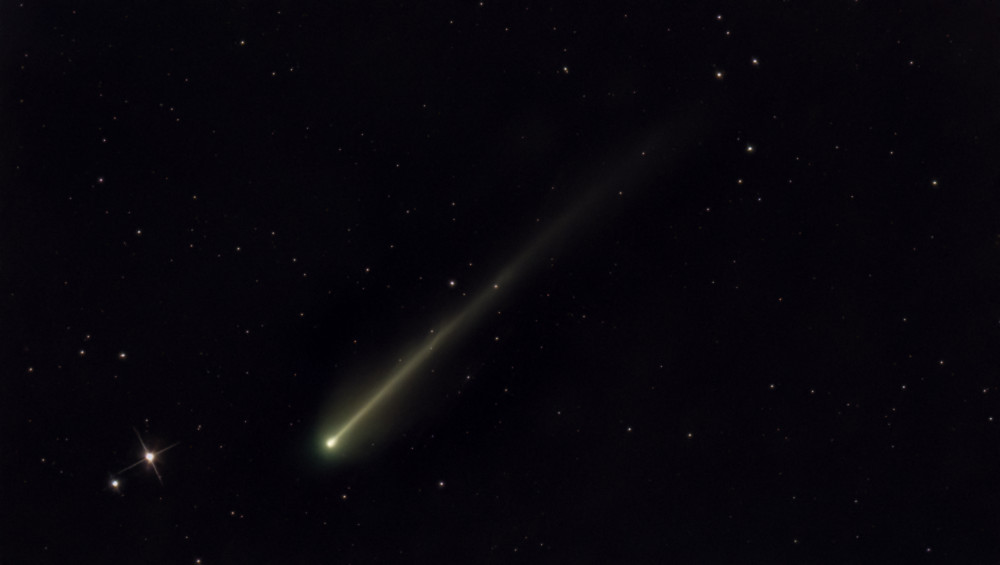
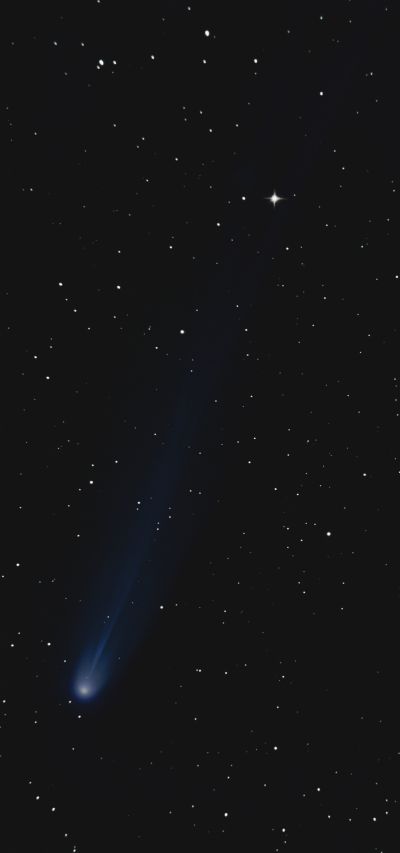
The photographs clearly show a yellowish fan-shaped dust tail. Its brighter central part consists of large dust particles that spread along the comet's orbit. Around the nucleus, a bluish-green glow is visible — it is created by ionized gases. These gases break down fairly quickly under solar radiation and dissipate into space.
And what about now?
As of August 2026, the comet's brightness is gradually declining. If no new outbursts occur, the ejected material will dissipate within about two to three months, and the object will return to its usual, much fainter state.

Comments
There are no comments on this picture yet
Comments are available only to registered users. Register or log in to leave a comment.