
NGC 2403 - C 7
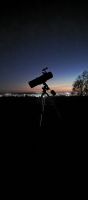
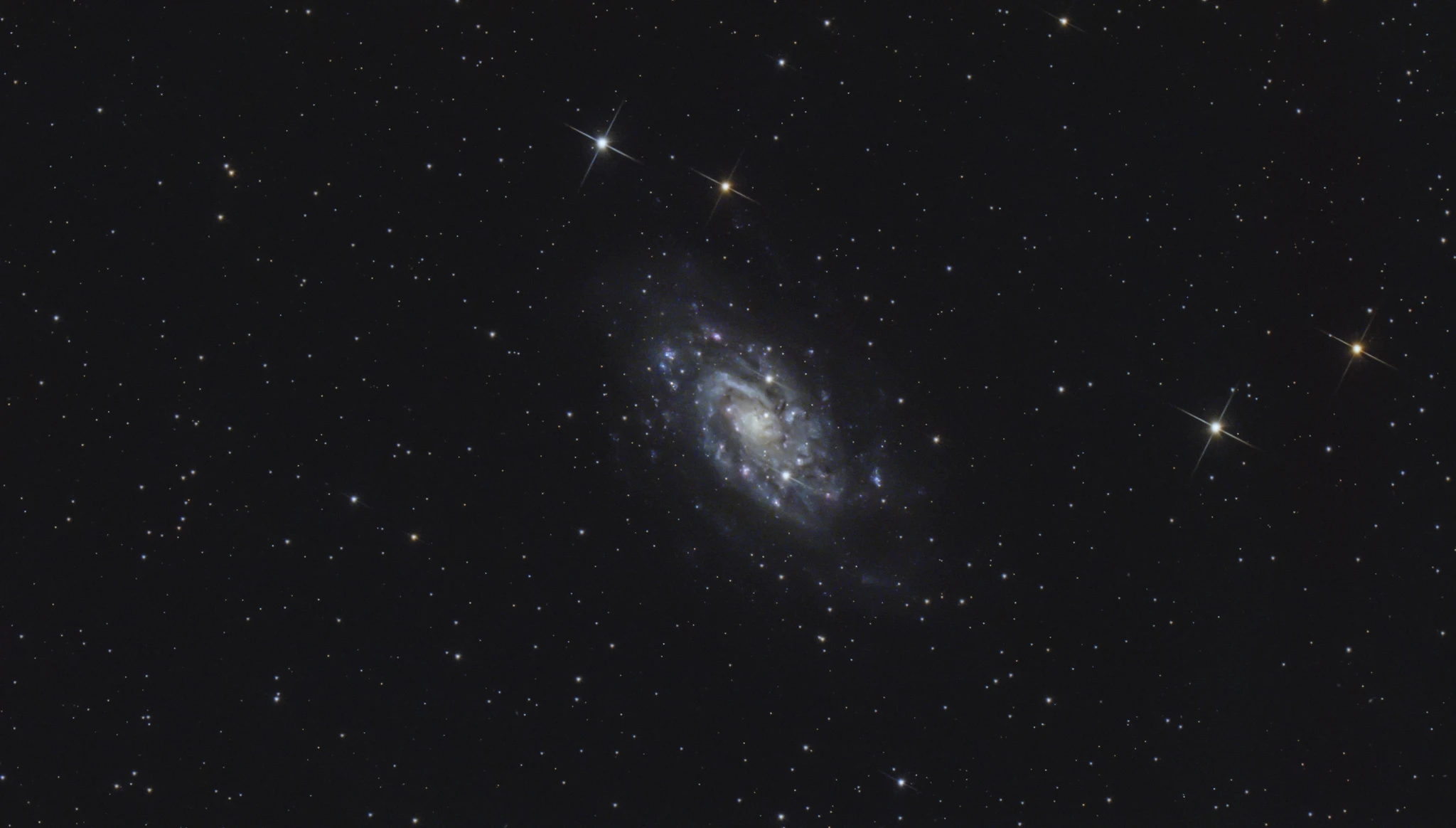
Photo description / processing
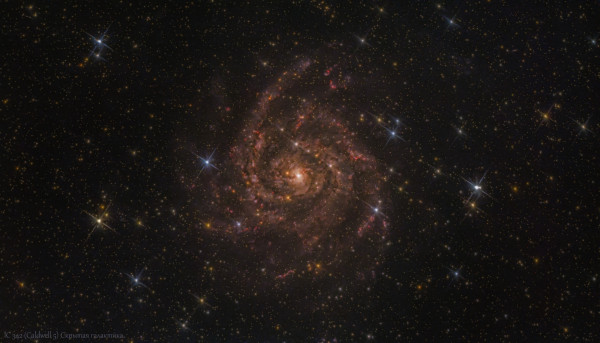
Yesterday, for the first time in almost a month, the stars appeared, and under a 90% lunar disk that shone mercilessly, I managed to capture very little) over almost 5 hours minus a few minutes)) an interesting galaxy, but it seems a lot of signal is still missing here.
NGC 2403 — a galaxy in the constellation Camelopardalis, belonging to the M81 group. It was discovered by William Herschel on November 1, 1788.
Location: the galaxy is located in the eastern part of the constellation Camelopardalis, near the border with Ursa Major.
Characteristics.
Distance to the galaxy — approximately 8 — 11 million light-years.
Diameter — about 50 — 70 thousand light-years.
Apparent dimensions: 23.4' × 11.8'.
Apparent magnitude: 8.2.
Photographic magnitude: 8.9.
Position angle: 127°.
Three supernova outbursts have been recorded in the galaxy: SN 1954J, SN 2002kg, and SN 2004dj.
Structure
The galaxy contains numerous regions of ionized hydrogen where star formation is occurring. It is believed that the galaxy has about 100 such giant glowing regions.
Features:
The spiral arms are studded with a characteristic reddish glow.
NGC 2403 contains NGC 2404 — a massive HII region about 940 light-years in diameter.
Two ultraluminous X-ray sources have been detected in the galaxy.
Research
In 1954, a bright blue variable star was discovered in NGC 2403, initially perceived as a supernova outburst.
In 2025, astrophysicists from Saint Petersburg State University, together with colleagues from Moscow State University and the Pulkovo Observatory, conducted a study that showed spiral arms of galaxies can form not by one but by several different mechanisms. Signs of different types of waves were found in NGC 2403, indicating multiple mechanisms of spiral formation.
Technical information
- Telescope/Lens
- Synta SkyWatcher 150/750, F/5
- Camera
- SV 705С
- Mount
- Bresser EXOS-2 (OnStep)
- Guide Scope
- Angeleyes 50/180
- Guide Camera
- ToupTek GPCMOS02000KPA
- Accessories
- Sharpstar 0.95x 2-inch Coma Corrector
- Location
- Черемхово, Russia
Light pollution
Yellow, Bortle 5 zone
- Date taken
Exposure
- 199 × 90″ · ISO/Gain: 150 · UV/IR Cut · · -15 °C
Total exposure: 4 h 59 m

Comments
There are no comments on this photo yet.
Sign up or sign in to leave a comment.