Thank you for sharing your photos - this is exactly what this project is all about! :-)
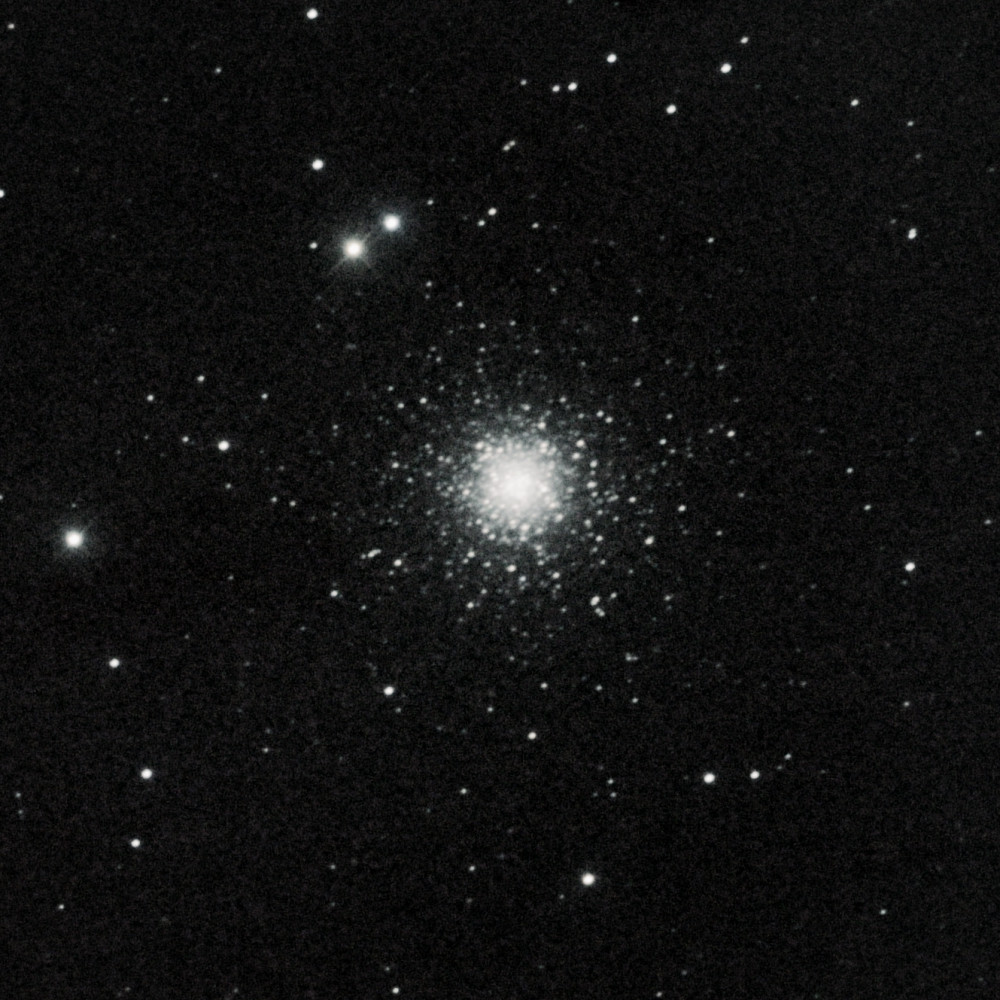
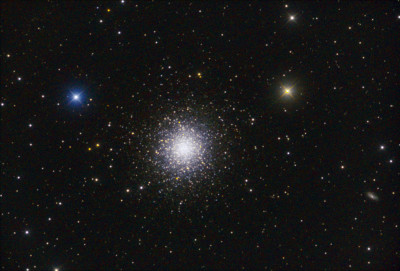
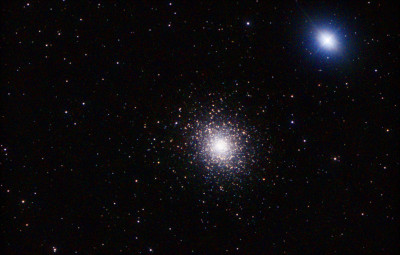
This is one of the most distant globular clusters—located about 58,000 light-years from Earth. The cluster contains a 33-millisecond pulsar in a binary system with an orbital period of 256 days, discovered in 1991.
M53 is in the constellation Coma Berenices—a spring sky object easily spotted with binoculars or a telescope finder about one degree northeast of the faint α Comae Berenices. In a medium amateur telescope, this is one of the most distant Messier globular clusters and is barely resolved into individual stars, appearing as a small fuzzy ball with a fairly bright center and a gradual drop in brightness toward the edges. Starting with apertures of 250–300 mm, the halo begins to resolve into stars fainter than 13.5m.
About 10 arcminutes south of M53, a pair of 9th-magnitude stars can be seen. One degree to the southeast (not in the frame) lies the faint globular cluster NGC 5053.
Add comment
Comments
There are no comments on this picture yet
Comments are available only to registered users. Register or log in to leave a comment.


Comments
There are no comments on this picture yet
Comments are available only to registered users. Register or log in to leave a comment.