
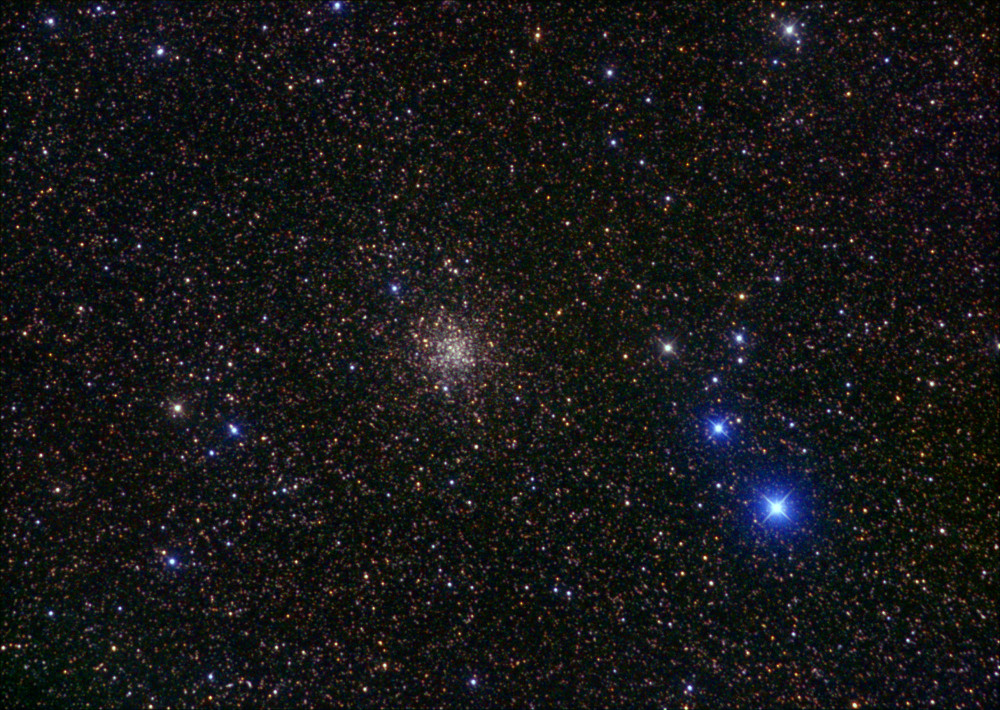
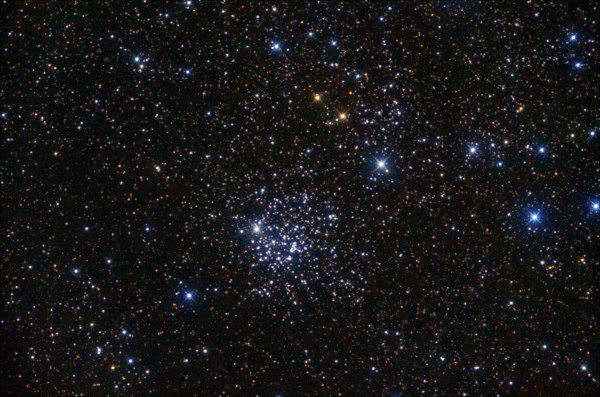
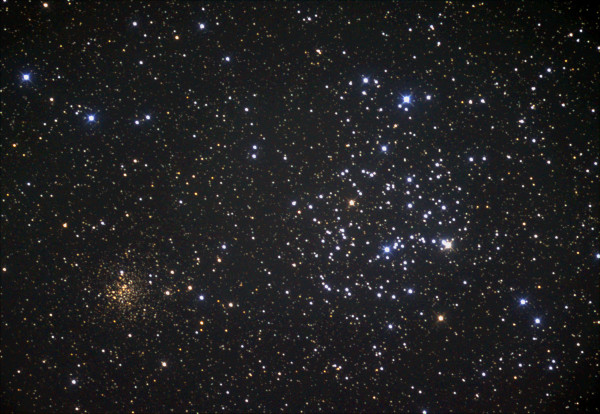
Globular Cluster M 71 in Sagittarius

- Resolution:
- 2429x1727 px
- File size:
- 7657 KB
Photo description / processing
Globular cluster M 71 in the constellation Sagitta.
The cluster was discovered by Jean-Philippe de Chéseaux in 1745 and was included in Charles Messier’s catalog of comet-like objects in 1780.
M 71 is located 13,000 light-years from Earth and spans 27 light-years. The irregular variable star Z Sagittae belongs to this cluster.
This cluster is observed in late summer to early autumn, often together with M 27—the “Dumbbell Nebula.” In a telescope with an aperture of 200–250 mm, this very sparse globular cluster resolves into numerous stars forming a V-shaped pattern resembling the tip of a spear. With a smaller aperture, most of the “unresolved” stars create a diffuse background glow in the cluster region.
Even 40–50 years ago, there was debate about the nature of M 71—whether it was a globular or an open cluster. However, the prevailing view remains that it is indeed a globular cluster.
Technical information
- Telescope/Lens
- ТАЛ-2 150/1200
- Camera
- sony A7s
- Mount
- EQ5
- Software
- Deepskystacker, GraXpert
- Location
- Низовская, Ленобласть, Россия
Light pollution
Green, Bortle 4 zone
- Date taken
Exposure
- 48 × 20″ · ISO/Gain: 6400
Total exposure: 16 m

Comments
There are no comments on this photo yet.
Sign up or sign in to leave a comment.