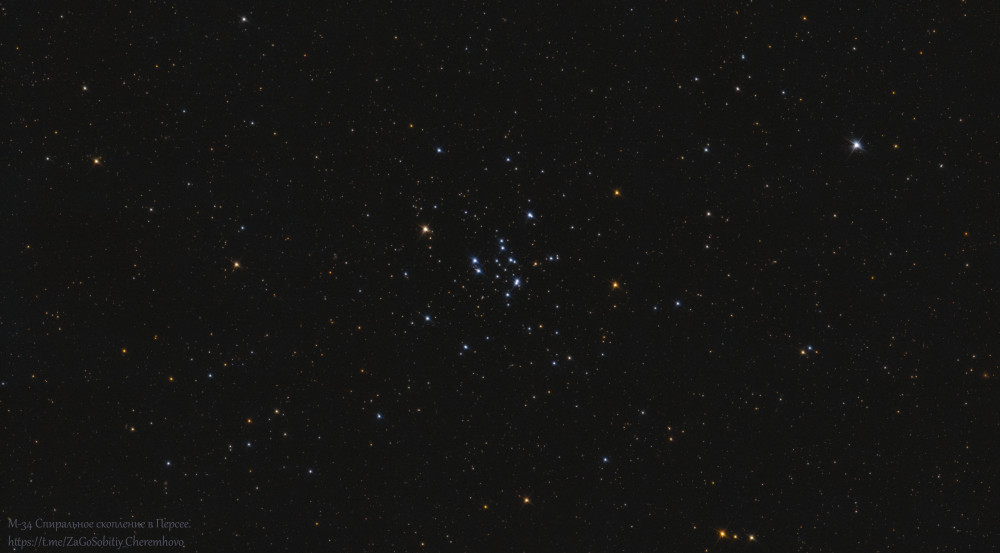
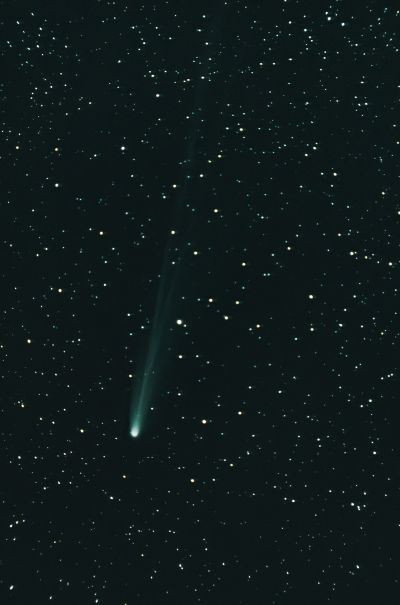
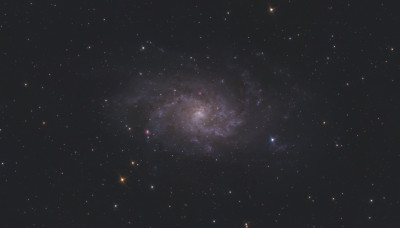
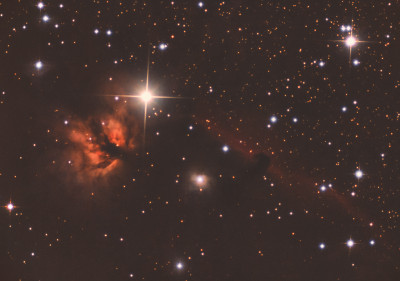
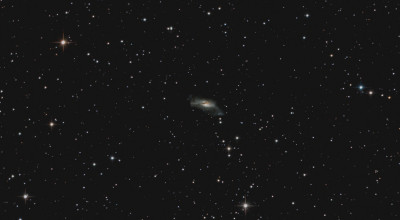
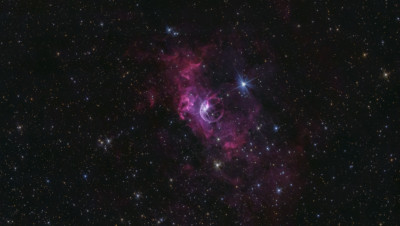
This mosaic was made from 9 panels, each with a 20-minute exposure.
What is this object?
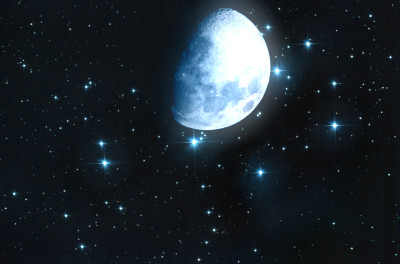
M 34 is located in the constellation Perseus. It is relatively close to Earth — about 1,500 light-years (or roughly 470 parsecs) away. On the sky, the cluster spans about 35 arcminutes — slightly larger than the Moon. Its apparent magnitude is 5.5.
Why "spiral"?
The name came from amateur astronomer Jeff Bondono, who noticed that through a telescope, the stars in the cluster form a pattern resembling spiral arms. Of course, this is an illusion — the stars are actually distributed evenly, but their concentration in the central region creates this visual effect.
Other characteristics.
The cluster contains about 400 stars.
Among them are white dwarfs — stellar remnants. At least 19 stars in M 34 are white dwarfs.
The cluster's age is estimated at about 200–250 million years. This makes it relatively young: it is older than the Pleiades (about 100 million years) but younger than the Hyades (800 million years).
The cluster's Trumpler class is I,3,m (characterized by increased star concentration toward the center).
Discovery history.
The cluster was discovered by Giovanni Battista Hodierna before 1654. Later, in 1764, Charles Messier included it in his catalog of comet-like objects. Messier himself described it as "a cluster of small stars slightly below the parallel of γ (Andromeda)."

Comments
There are no comments on this picture yet
Comments are available only to registered users. Register or log in to leave a comment.