Thank you! It's a pity the atmosphere didn't allow pulling out the details, only hints of them. Of course, you need to shoot at least ten degrees further south and with a telescope of at least 200mm.
What altitude is it at for you? Mine is at 24.8 at meridian transit. But my rig has been sitting in the yard for 3 days, I need to bring it into the garage for it, but the neighbor's light there gets in the way. I'm currently at 367mm focal length and 71mm aperture with a reducer, and for long focal length the weather just isn't right.
Good idea, by the way. Yesterday we switched from a one-second exposure to one and a half seconds, and guiding became calmer — you can't keep up with the seeing in our swamps. I'll try your version, I happen to have that filter, thanks!
For my mount, 1.5 seems too much! When it's calm, I set it to 0.5, usually with a 1-second exposure. I think if your guide scope has a 60mm aperture, everything should work smoothly. My stars have become excellent compared to the UVIR.
I should give it a try. Also, for details, I discussed with a friend today that it's better to set the main camera exposure to less than 30 seconds. Lucky imaging works better here; with a dark sky, aim for about 5-10 seconds. Possibly even less.
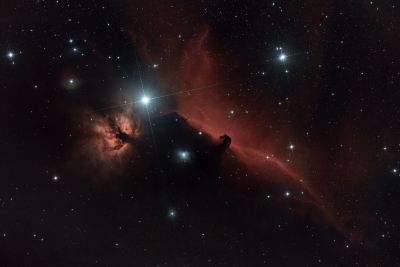
You could set up an experiment. I tried shooting for 30 seconds and for 300 seconds with the same total exposure time. In terms of total weight, there's a noticeable difference, but no difference in accumulated signal. However, the Horsehead Nebula isn't particularly faint. The idea is generally not bad. Dithering every five frames works fine. But as always, each target requires its own approach depending on weather, seeing, and other variables.
5 May, 2026
Reply
Comments are available only to registered users. Register or log in to leave a comment.

Comments
Comments are available only to registered users. Register or log in to leave a comment.