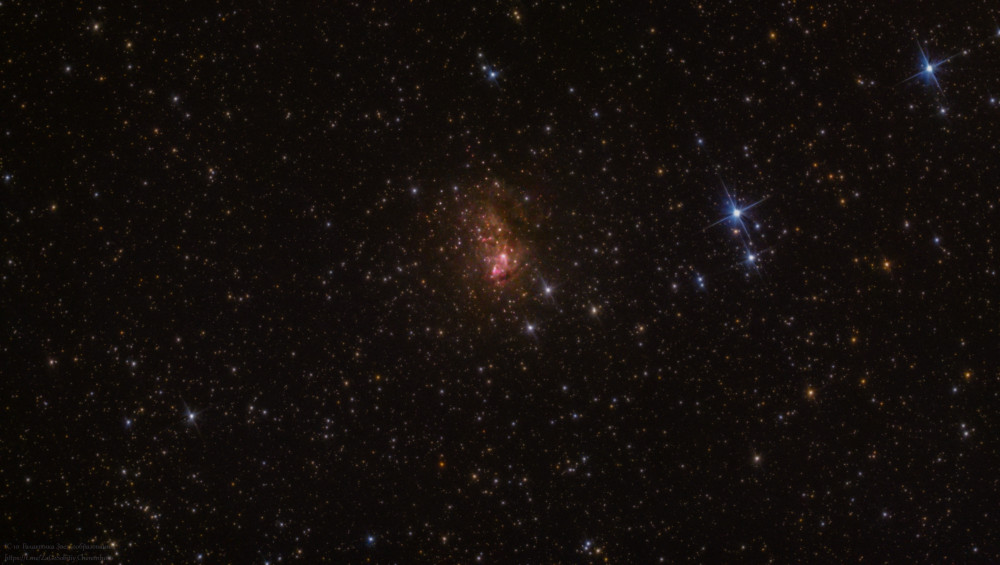

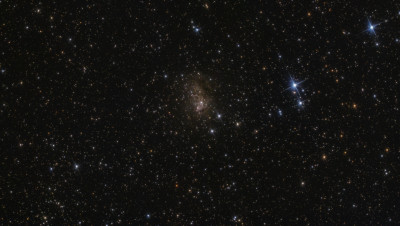
Key characteristics.
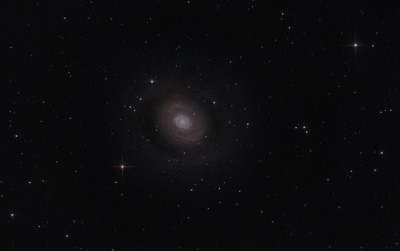
Distance from Earth. About 2.2–2.3 million light-years.
Diameter. Approximately 5,000 light-years.
Discovery. The galaxy was discovered by American astronomer Lewis Swift in 1887.
Star formation in IC 10
IC 10 is considered a starburst galaxy — meaning it is undergoing an intense burst of new star birth.
Some features of this process:
What is a "starburst"? This is a situation where the process of new star formation in a galaxy is very intense — much stronger than in most other galaxies. In the Milky Way, the star formation rate is about 3 solar masses per year, while in starburst galaxies it can reach 100 solar masses per year. If such a rate were sustained for a long time, the gas in the galaxy would quickly run out, so a starburst is a temporary phenomenon. Such a burst is often triggered by external events: a collision or close passage of galaxies, which stirs up the gas and ignites vigorous star formation.
High concentration of massive stars. IC 10 contains significantly more Wolf-Rayet stars per square kiloparsec (5.1 stars/kpc²) than the Large or Small Magellanic Clouds (2.0 and 0.9 stars/kpc², respectively).
Star formation rate. Currently, it is 0.04–0.08 solar masses per year. At this rate, the galaxy's gas reserves will last only a few billion years.
Structure of the interstellar medium. The galaxy exhibits numerous ionized and neutral shells, arc-like and ring-like structures ranging in size from 50 parsecs to 800–1000 parsecs. At the center lies a region of ionized hydrogen, sustained by the ultraviolet radiation of hot stars.
Unusual rotation. The visible part of the galaxy rotates in one direction, while the outer hydrogen envelope rotates in the opposite direction.
Additional features
Interstellar extinction. IC 10 is located 3.3° below the galactic plane, causing its light to be significantly dimmed by interstellar dust (reddening is estimated at 3 magnitudes).
Black hole. In 2007, a stellar-mass black hole (24–33 solar masses) was discovered in IC 10. It manifests as the X-ray source IC 10 X-1, which is periodically eclipsed by a companion star — a Wolf-Rayet star.
Synchrotron shell. The galaxy contains a unique synchrotron supershell, whose formation is linked to a hypernova explosion.
Studying IC 10 helps astronomers better understand the mechanisms of star formation and galaxy evolution, as well as the nature of black holes in binary systems.

Comments
There are no comments on this picture yet
Comments are available only to registered users. Register or log in to leave a comment.