DeepSkyHosting

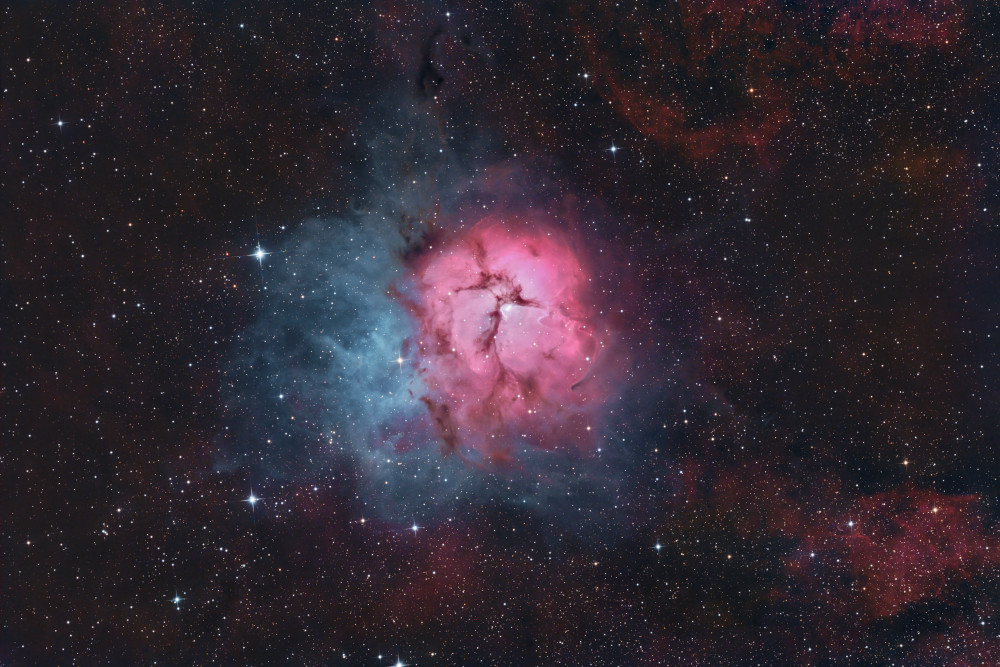
M20 Trifid Nebula

oeswww
531206
Published:
322
M20 Trifid Nebula
Resolution:
4012x2706 px
File size:
22222 KB

Photo description / processing

Trifid Nebula (M 20, NGC 6514, Three-lobed Nebula, Eng. Trifid Nebula) — a three-lobed diffuse nebula in the constellation Sagittarius. The name of the nebula was proposed by William Herschel and means "divided into three lobes."

Discovered by Charles Messier on June 5, 1764. Its exact distance is unknown, with various estimates ranging from 2 to 9 thousand light-years[1]. Its width is 50 light-years. It is represented by three main types of nebulae at once — emission (pinkish color), reflection (blue color), and absorption (black color). The dark dust filaments bordering the Trifid Nebula formed in the atmospheres of cold giant stars.

The largest star in this region is HD 164492A, an O7.5III star with a mass more than 20 times that of the Sun[2], surrounded by a cluster of 3100 young stars[3].

Technical information

Telescope/Lens
Sky-Watcher 200PDS
Camera
ZWO ASI294MM Pro
Mount
Sky-Watcher EQ6-R PRO
Guide Scope
SVBONY SV106 60/240
Guide Camera
Zwo ASI662MC
Accessories
MEYON F4/5 1x 2-inch MPCC
Software
Pixinsight, RC-Astro Plugins
Location
Научный (Астрохутор), Россия
Date taken

Exposure

  • 31 × 120″ · ISO/Gain: 120 · Antlia V Pro L ·
  • 31 × 120″ · ISO/Gain: 120 · Antlia V Pro R ·
  • 30 × 120″ · ISO/Gain: 120 · Antlia V Pro G ·
  • 31 × 120″ · ISO/Gain: 120 · Antlia V Pro B ·

Total exposure: 4 h 6 m

Photo versions

M20 Trifid Nebula
Updated
M20 Trifid Nebula

Aug 7th, 2026

4 h 6 m

Work on the errors has been done. The green cast has been removed. Stars and integration have been fixed. A more accurate HDR for the hydrogen nebula and more color =)In my opinion, the best M20 on this portal.

M20 Trifid Nebula
Current photo
M20 Trifid Nebula

Jul 27th, 2026

4 h 6 m

Trifid Nebula (M 20, NGC 6514, Three-lobed Nebula, Eng. Trifid Nebula) — a three-lobed diffuse nebula in the constellation Sagittarius. The name of the nebula was proposed by William Herschel and means "divided into three lobes." Discovered by Charles Messier on June 5, 1764. Its exact distance is unknown, with various estimates ranging from 2 to 9 thousand light-years[1]. Its width is 50 light-years. It is represented by three main types of nebulae at once — emission (pinkish color), reflection (blue color), and absorption (black color). The dark dust filaments bordering the Trifid Nebula formed in the atmospheres of cold giant stars. The largest star in this region is HD 164492A, an O7.5III star with a mass more than 20 times that of the Sun[2], surrounded by a cluster of 3100 young stars[3].


Show changes
Previous version
Current version

Comments

Anth
Not bad at all, the scale is nice — the image looks good.
Reply

Sign up or sign in to leave a comment.

oeswwwReply to Anth
Scale is good. But if you had framed it a bit higher and to the left, it would have been perfect. Though I wasn't really bothered and just centered on the object's marker without even rotating the camera, since I was shooting everything in a row anyway.
Reply

Sign up or sign in to leave a comment.

Slide
Zhen, could you crop it a bit? That would cut off the whitish streaks on the right and bottom. At least on my monitor, they're clearly visible. Other than that, it's all very good!
Reply

Sign up or sign in to leave a comment.

oeswwwReply to Slide
Yes, I know. It's more of a necessity than an option =) I noticed this band during processing, but on the desktop monitor it didn't look intrusive, so I decided to leave it as is, without any crop. But after a while, I looked at the work on the MacBook screen and realized I should have cropped it after all.)
Reply

Sign up or sign in to leave a comment.

More photos by oeswww