Thank you for sharing your photos - this is exactly what this project is all about! :-)
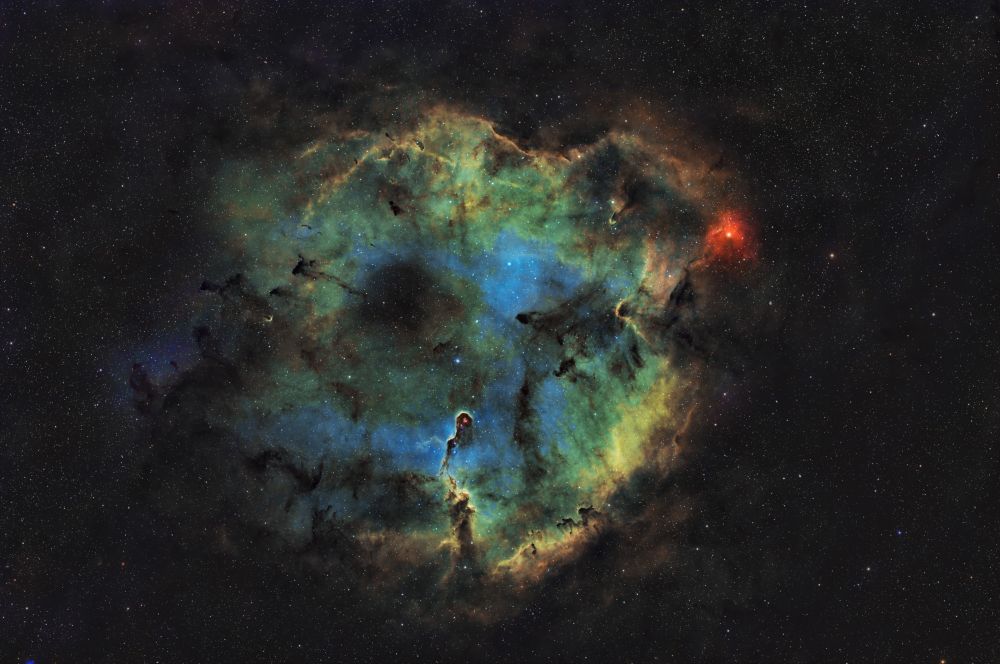
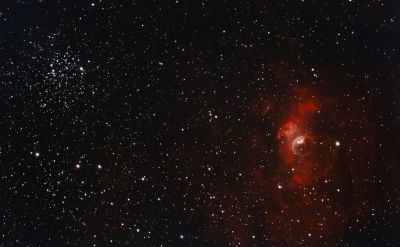
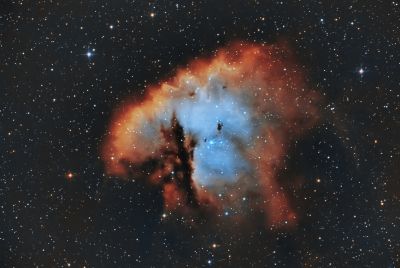
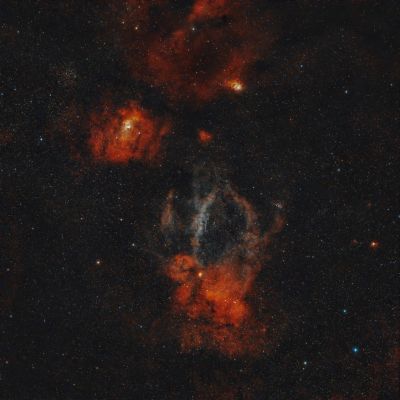
Added to the previous image with a 3nm Optolong L-Ultimate filter (imaging from 08.05), imaging from 16th, 17th, 18th of May with wider band filters Askar Colour Magic C1 (H O) and C2 (Sii O).
Combined and processed in the SHO palette.
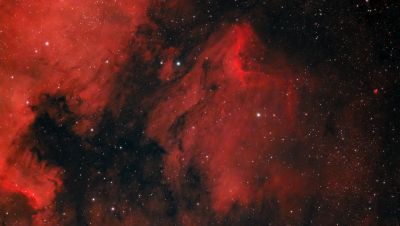
A red nebula appeared on the right, only when I checked in Stellarium did I realize it was the nebula around the Garnet Star. I didn't find images of it on our hosting, but on astrobin.com it appears a couple of times.
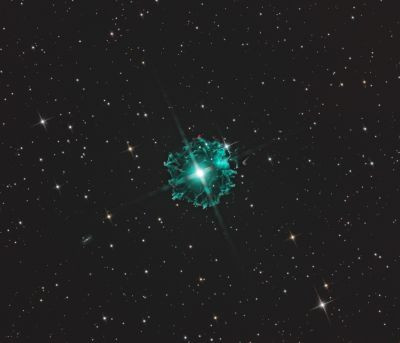
One of the most beautiful objects in the Universe – the Garnet Star, located in the constellation Cepheus. At the same time, it is one of the largest and most powerful stars in our Galaxy. The deep red color of the star was first noted by astronomer William Herschel, which is why it is also called "Herschel's Star".
It is a red supergiant, whose diameter is many times greater than the diameter of the Sun, reaching 3.5 billion kilometers. It is one of the largest and brightest stars named Mu Cephei.
If placed in the center of the Solar System, this star would engulf all planets up to and including Saturn.
Mu Cephei is very bright: in this indicator it is 60 thousand times greater than the Sun, and in luminosity – 350 thousand times.
The star's temperature is 3700 K.
A variable star with a complex light curve that changes every 2–2.5 years.
The distance to the star is 5255 light years.
The star Mu Cephei is gradually dying. Main sequence stars synthesize helium from the hydrogen they burn. But if evolution reaches its peak, a different process starts: stars release carbon by burning helium. This is exactly what is happening now with Herschel's Garnet Star. How long it will still exist – scientists do not know, but they are sure that it will explode as a supernova, the core of which will turn into a black hole.
Added to the previous image with a 3nm Optolong L-Ultimate filter (imaging from 08.05), imaging from 16th, 17th, 18th of May with wider band filters Askar Colou…
Finally assembled a setup with power distribution and a hub from WandererBoxLiteV3 USB3.0. Got rid of a bunch of wires, now everything runs from one 8-amp power…
Show changes
Add comment
Comments
There are no comments on this picture yet
Comments are available only to registered users. Register or log in to leave a comment.


Comments
There are no comments on this picture yet
Comments are available only to registered users. Register or log in to leave a comment.