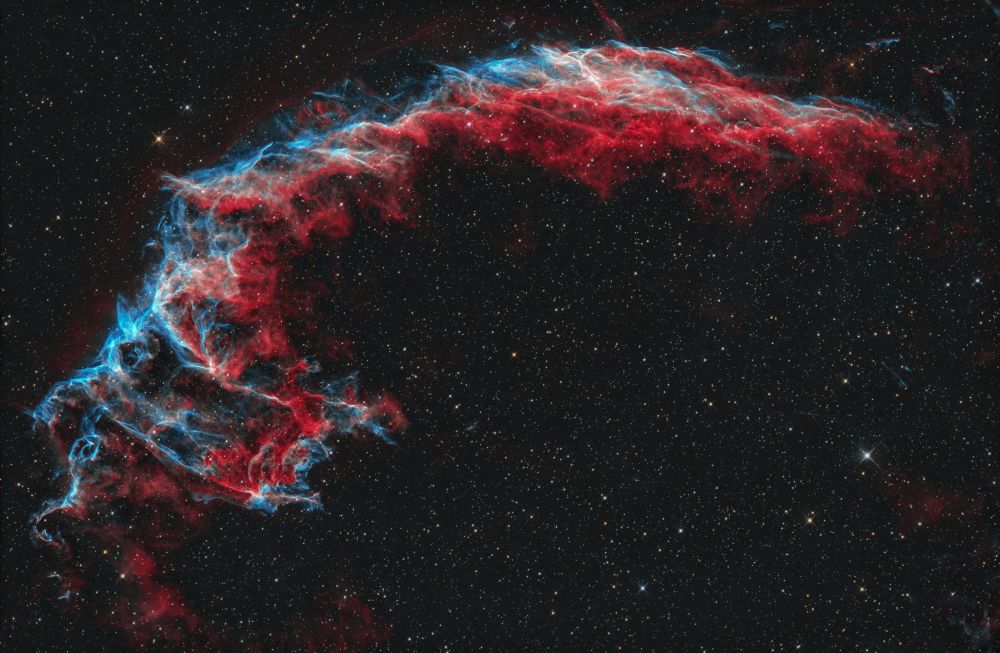
Thanks, I still need to work a bit on the stars. But what’s great about a refractor is that its field has even illumination, unlike a standard Newtonian, where there are always some reflections from the secondary mirror, and you can’t manage without flats—here there aren’t any, though I haven’t made a new flat panel yet.
Yes, the issue with Newtonians is that they can't achieve focus across the entire field of view (as I recently understood). In that sense, an apochromatic refractor does it, but the aperture of Newtonians and thus their light-gathering ability can surpass (compensate for) this shortcoming.
And what about flat fields with a prime-focus setup—a dumb question. How do you actually shoot them?
Haven't figured out PixInsight yet, no time, but I'll get to it. Thanks anyway.
Regarding flats, I haven't figured it out yet, but I think just a flat lamp (30x40 cm) with a 40x40 screen in front of it, at some distance. I'll write about it once I shoot.
A 30x40cm panel seems a bit small for a 300mm aperture.
I once considered using 60x60cm ceiling light panels; you can probably find diffusers for those as well.
For now, I've acquired a 300mm flat panel from Gemini for my 216mm scope, but for a 300mm I'll have to look for something else.
It's just there, and I used it to take flats for the 300. It works fine, so I don't plan to buy anything else for now—unless something goes wrong, then we'll see.
10 Sep, 2025
Reply
Comments are available only to registered users. Register or log in to leave a comment.



Comments
I once considered using 60x60cm ceiling light panels; you can probably find diffusers for those as well.
For now, I've acquired a 300mm flat panel from Gemini for my 216mm scope, but for a 300mm I'll have to look for something else.
Comments are available only to registered users. Register or log in to leave a comment.