
M27

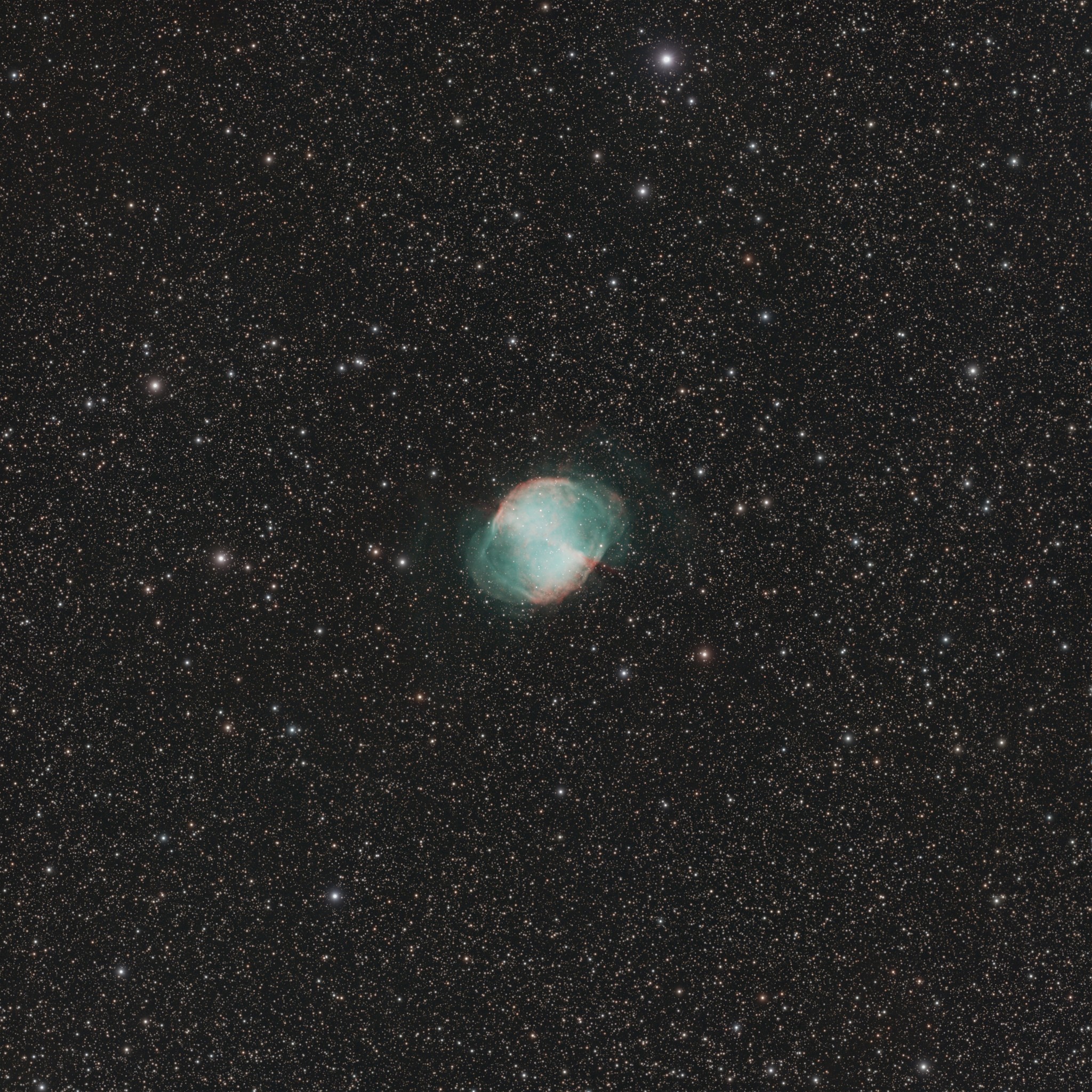
Photo description / processing
M27 (the Dumbbell Nebula, or NGC 6853) is a true jewel of the night sky and the first object of its kind ever discovered (by Charles Messier in 1764). It is a classic planetary nebula. A star similar to our Sun reached the end of its life, exhausted its thermonuclear fuel, and shed its outer gas envelopes. These envelopes expand into space, and their glow is caused by hard ultraviolet radiation from the exposed hot core of the star, which ionizes the surrounding gas. So what colors does the nebula shine in? Answer: turquoise-green (the dominant color). This is the brightest emission of doubly ionized oxygen ([O III] at wavelengths of 495.9 and 500.7 nm). This is the absolutely natural physical color of the nebula. The human eye through a telescope sees it as a faint gray-green, while a camera records exactly this saturated hue. Pinkish-red (accent color): this is the emission of hydrogen (H-alpha, 656.3 nm). In M27 there is less of it than in emission nebulae like Orion, but it shows up beautifully as thin filaments and in the outer halo. Two faint dark-red diverging "jets" bursting from the poles of the nebula are polar jets (outflows), or ansae (from Latin for "handles"). To capture them well in a frame, you need either to use narrowband filters (such as H-alpha) or to have a very clean total frame with a low noise level. In this frame they are visible, but not at full strength. Their surface brightness is several times lower than that of the central body, and it is precisely they, together with the main body of the nebula, that form that very dumbbell shape. M27 is a classic bipolar nebula. When the progenitor star was at the red giant stage, it shed its outer layers of gas. This gas accumulated predominantly in the equatorial plane, forming a dense "belt" or torus. When the hot core was exposed—a white dwarf—it generated a very fast stellar wind. It was easiest for this wind to "punch" through the envelope along the star's rotation axis (at the poles), where there was less gas. As a result, gas burst outward at enormous speed in the form of these two cones or jets, forming the polar lobes. The central star is located almost at the ideal geometric center of the nebula, between the two main "lobes" of the dumbbell, and it is one of the largest and hottest known white dwarfs; its spectral class is classified as DAO (a hot white dwarf with hydrogen and helium lines in its atmosphere), and its surface temperature reaches an enormous ~85,000 Kelvin, its apparent magnitude is about 13.6m–13.8m, and it is precisely this star that "makes" all this beauty glow! The kinematic age (the time since the envelope was shed) is estimated at approximately 9,800–14,600 years, that is, the light we see at this moment began its journey to us when Neanderthals still existed on Earth—such are the things… The nebula is located at a distance of about 1,360 light-years (or ~417 parsecs) from Earth, which, given the apparent angular size of the nebula, means that its real physical diameter is almost 3 light-years.
The colors in the resulting frame are very close to the true emission spectrum of M27, not "overcooked" and not artificially stretched, but exactly as they are. The blue color that is sometimes seen in amateur images is not what is actually there.
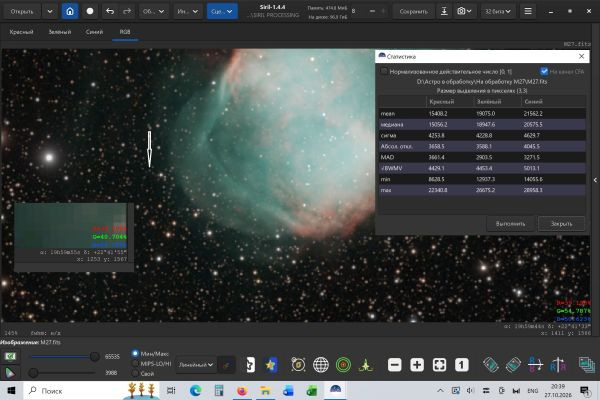
There is one more point in the frame that can be noticed—the background stars have a slightly brownish color. Here I have two hypotheses. The first (less likely)—M27 was not photographed at the zenith, but at a moderate altitude, where the atmosphere acts as a filter, scattering blue light more strongly than red. This makes all the stars in the frame slightly more yellow or red than they actually are. This is a physical fact, and it is difficult to combat except by imaging at a higher altitude. Here even PCC or SPCC cannot, as I suspect, fully cope with the situation for the background stars. There is also a second hypothesis—JPEG compression algorithms (for example, 4:2:0 chroma subsampling) for publication greatly cut the color information while preserving luminance. For bright stars this is unnoticeable, but for faint background stars, where the signal is barely above the noise, this often tints them yellowish or brownish. In the original FITS file on the monitor at 100% scale, the stars are white, bluish, i.e., they have the correct spectral color (from blue to orange, but not brownish).
And one more thing—I have not yet determined the limiting magnitude of this frame; when I have the figure, I will add it.
... To estimate the limiting magnitude of the image, I had to "sweat" and write and debug a special Python script that calculates the field of view size in degrees based on the frame size and the telescope scale, and then accesses the online service VizieR (Strasbourg Astronomical Data Center, France) via the astroquery library. VizieR in response returns from the Gaia DR3 catalog a list of all stars in this field with their coordinates and magnitudes in the G, BP, and RP filters. After that, the script analyzes the distribution of stars by magnitude, estimates the limiting magnitude of the frame, and saves a full report to a text file. The script produced the following statistics:
============================================================
Photometry results for M27
============================================================
Imaging parameters:
Telescope: Askar 107PHQ (107 mm, f/7)
Camera: ZWO ASI533MC
Exposure: 2h 45m
Sky: Bortle 4-5
Field center coordinates:
RA: 299.902°
Dec: 22.716°
Field size: 0.8673° x 0.8673°
Field radius: 0.6133°
Gaia DR3 catalog:
Total stars in the field of view: 312365
Gmag range: 5.60m - 22.05m
Mean Gmag: 19.62m
Magnitude distribution:
10m - 12m: 193 stars
12m - 14m: 1297 stars
14m - 16m: 6782 stars
16m - 18m: 28924 stars
18m - 20m: 119948 stars
20m - 22m: 155187 stars
Limiting magnitude estimate:
According to the Gaia catalog: up to 22.05m
Practical estimate: ~22.0m
============================================================
Star list (first 50 faintest):
============================================================
No. Gmag
--------------------
1 22.049
2 21.972
3 21.897
4 21.889
5 21.882
6 21.813
7 21.794
8 21.786
9 21.780
10 21.760
11 21.754
12 21.740
13 21.730
14 21.726
15 21.725
16 21.721
17 21.715
18 21.672
19 21.663
20 21.658
21 21.648
22 21.634
23 21.622
24 21.620
25 21.617
26 21.614
27 21.611
28 21.605
29 21.603
30 21.593
31 21.588
32 21.584
33 21.581
34 21.578
35 21.578
36 21.568
37 21.567
38 21.564
39 21.545
40 21.542
41 21.540
42 21.536
43 21.533
44 21.533
45 21.532
46 21.530
47 21.527
48 21.526
49 21.525
50 21.524
Technical information
- Telescope/Lens
- Askar 107PHQ
- Camera
- ZWO ASI533MC Pro
- Mount
- Sky-Watcher EQ6-R Pro (belt-modified)
- Guide Scope
- Askar M54 OAG
- Guide Camera
- ZWO ASI220MM
- Accessories
- ZWO UV/IR-Cut Filter, SVBONY SV241 Power Box
- Software
- StackingWizard, BlurXTerminator, GraXpert, AstroWizard
- Location
- Shatura
Light pollution
Green, Bortle 4 zone
- Date taken
Exposure
- 35 × 300″ · ISO/Gain: 100 ·
Total exposure: 2 h 55 m

Comments
Рад тебя здесь видеть и очень интересный текст к твоей фото.
Наверное ты меня не помнишь, но как-то ты согласился отъюстировать мой первый серьезный телескоп - триплет TS APO 130/7
До сих пор вспомнию тот случай с теплыми чувствами )
Reply
Sign up or sign in to leave a comment.
Reply
Sign up or sign in to leave a comment.
50км по Дмитровскому шоссе, недалеко от бетонки.
Построил обсерваторию с откатной крышей и удаленным управлением, иначе вообще труба что-то снять у нас, с нашим небом
Reply
Sign up or sign in to leave a comment.
Reply
Sign up or sign in to leave a comment.
а с наледью вообще ничего не делаю, так как зимой не снимаю
Пару раз пробовал - не понравилось. За всю зиму было 3 или 4 ясные ночи, но FWHM ужасный - что-то около 8"
Так что я для себя решил что в отрицательные температуры я не снимаю )
Reply
Sign up or sign in to leave a comment.
Sign up or sign in to leave a comment.