
Potential white dwarf near M27

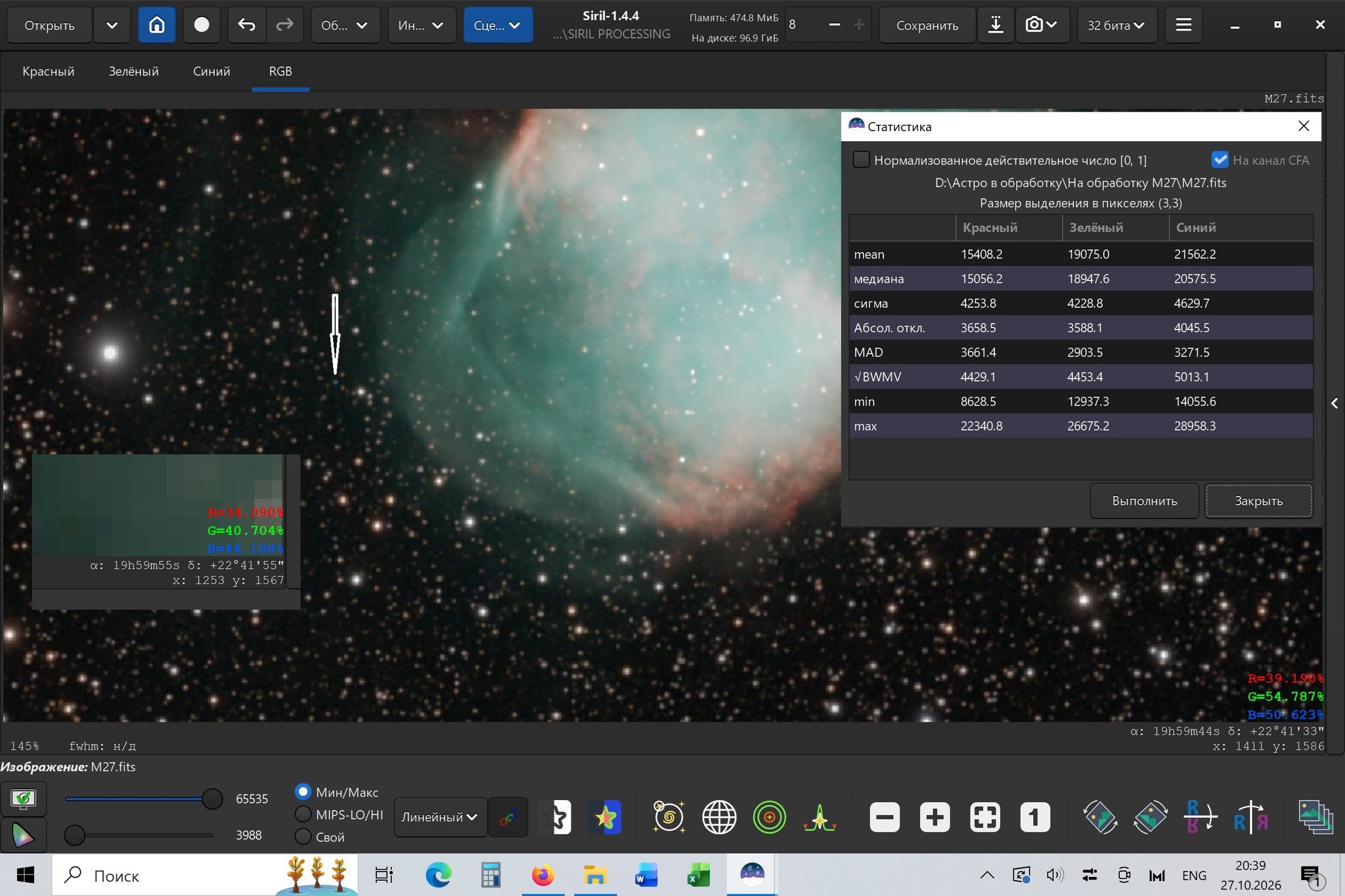
Photo description / processing
While carefully examining the FITS from the already published image of M27, next to this planetary nebula I saw an anomalously blue star-like object, which interested me extremely, since nothing similar is observed nearby. Trying to figure out what it was, a whole investigation began, a detective story, since I could not find anything about it anywhere, except that I stumbled upon one of the so-called "super blue stars" in the field of M27. This is a known and very interesting phenomenon that astrophotographers often notice in deep images of this nebula, and it has a quite specific astrophysical explanation. It seems that this is most likely a white dwarf (or a white dwarf candidate). It was said that according to Gaia DR3 catalog data, several stars in the immediate vicinity of the edge of M27 are classified as white dwarf candidates. This is not part of the nebula, but independent stars located either in the foreground (much closer to us) or in the background, which simply happen to be projected onto the edge of the nebula from our point of view. Why are they so intensely blue? Because of temperature. Like the central star of M27, white dwarfs have a very high surface temperature. Their spectral peak is shifted into the ultraviolet and blue region. Bright blue stars in images usually look white with a bluish halo, because during processing all three channels (R, G, B) overflow (saturate) and mix into white. But these "super blue" stars are quite faint (usually around 15–17m). When you stretch the histogram to reveal the faint nebula, the signal in the blue channel of such a hot star becomes dominant, while the red and green channels remain almost empty. As a result, the star acquires that very unnatural, saturated, "acid" blue color that stands out sharply against the background of the others.
I decided to recheck this version more thoroughly. I selected a 3×3 pixel region directly on the star. Here are the raw data:
- Red (R): mean = 15,408
- Green (G): mean = 19,075
- Blue (B): mean = 21,562
- Red: 15,408
- Green: 19,075 / 2 ≈ 9,537
- Blue: 21,562
- Magnitude (Gmag): 19.05m (the object is faint, so it is not in older catalogs such as SIMBAD/Hipparcos).
- Parallax: 2.93 mas. This translates to a distance of about 340 parsecs (~1100 light-years). The object is relatively close to us, in front of the main mass of interstellar dust of the Milky Way.
- Color index (BP-RP): -0.18!!!
- For the Sun (a yellow star) it is about +0.8.
- For red stars it is positive and large (+1.5 and higher).
- A negative value (-0.18) means that the star is brighter in the blue filter than in the red one. This is a direct mathematical marker of a surface temperature above 10,000–15,000 Kelvin.
- Linear FITS shows the dominance of the blue channel over red and green (after Bayer correction).
- Gaia DR3 catalog shows a negative color index (BP-RP = -0.18).
- Distance (~1100 light-years) confirms that this is a local object whose light has not had time to redden due to galactic dust (which rules out distant quasars).
- Absence in SIMBAD is explained by its faintness (19m), which is typical for white dwarfs discovered only thanks to the ultra-precise Gaia telescope.
Technical information
- Telescope/Lens
- Askar 107PHQ
- Camera
- ZWO ASI533MC Pro
- Mount
- Sky-Watcher EQ6-R Pro (belt-modified)
- Guide Scope
- Askar M54 OAG
- Guide Camera
- ZWO ASI220MM
- Accessories
- ZWO UV/IR-Cut Filter, SVBONY SV241 Power Box
- Software
- StackingWizard, BlurXTerminator, GraXpert, AstroWizard
- Location
- Shatura, Russia
Light pollution
Green, Bortle 4 zone
- Date taken
Exposure
- 35 × 300″ · ISO/Gain: 100 ·
Total exposure: 2 h 55 m

Comments
Reply
Sign up or sign in to leave a comment.
Reply
Sign up or sign in to leave a comment.
Reply
Sign up or sign in to leave a comment.
Reply
Sign up or sign in to leave a comment.
Reply
Sign up or sign in to leave a comment.
Reply
Sign up or sign in to leave a comment.
Sign up or sign in to leave a comment.