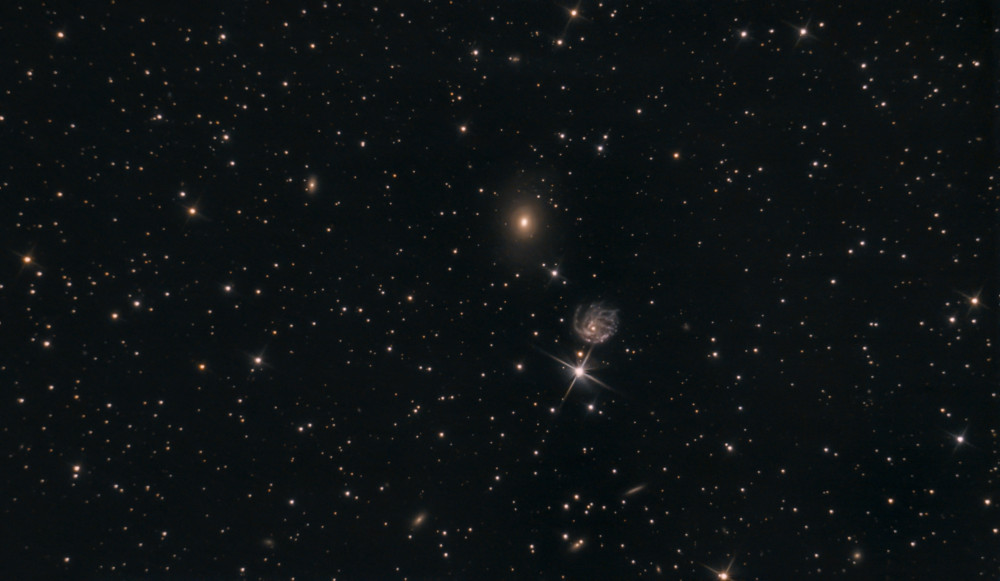

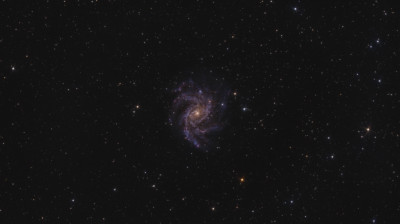
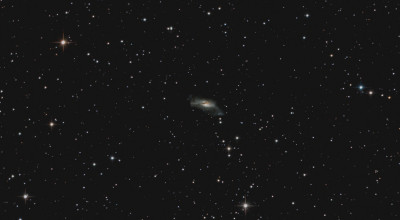
NGC 2276 is a barred spiral galaxy (SBc) in the constellation Cepheus. It is part of the NGC 2300 group of galaxies, which includes the elliptical galaxy NGC 2300.
Discovery date: June 26, 1876, by F. A. T. Winnecke.
Distance: approximately 120 million light-years from Earth.
Characteristics
Asymmetric shape of the galactic disk, which may be explained by interaction with NGC 2300.
Enhanced star formation rate — possibly caused by a past collision with a dwarf galaxy or gravitational interaction with NGC 2300, which triggered the compression of molecular clouds.
Active star-forming regions — evidenced by numerous bright blue star clusters and H II regions in the galaxy.
Diameter — given its angular size (2.7–2.8 arcminutes), the galaxy's diameter is approximately 90,000 light-years.
An intermediate-mass black hole, NGC 2276-3c, was discovered in one of the spiral arms, with a mass 50,000 times that of the Sun.
Notable features:
Listed in the original edition of the New General Catalogue.
Included in the Atlas of Peculiar Galaxies.
Research
Morphology studies — NGC 2276 has been extensively studied at various wavelengths, including optical, infrared, and X-ray emissions. This helps understand its stellar population, gas content, and dynamic processes.
Black hole discovery — in 2015, NGC 2276-3c was found in one of the galaxy's spiral arms, featuring a radio jet 1.8 pc long.
X-ray source study — based on Chandra data from 2004, 16 sources were detected, 8 of which are ultraluminous X-ray sources (ULX).
Important: NGC 2276 is an example of how galaxy interactions can affect morphology and star formation, making it a subject of interest for studying galactic evolution.



Comments
Comments are available only to registered users. Register or log in to leave a comment.