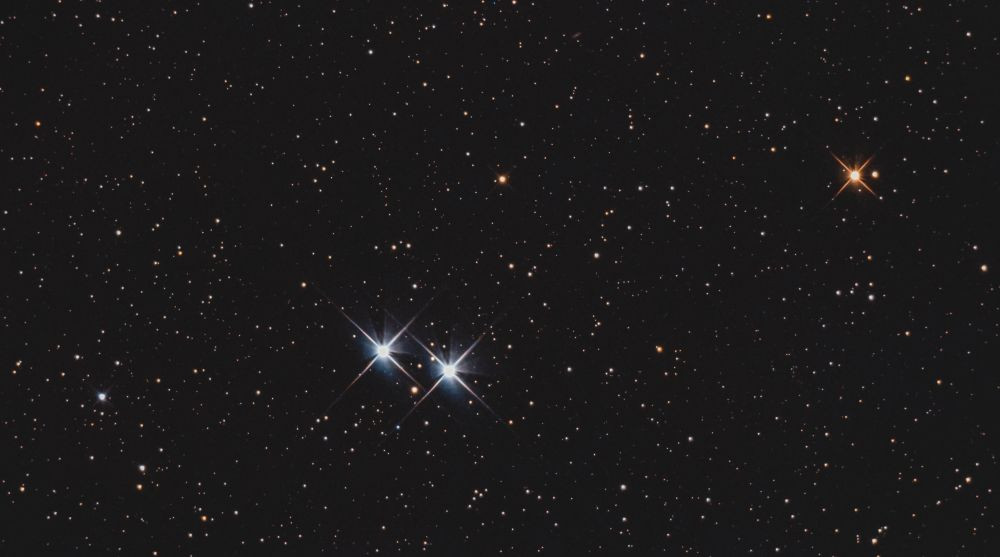

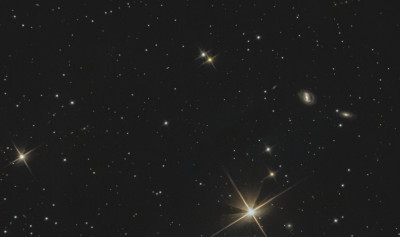
Epsilon Lyrae (ε Lyr, ε Lyrae) is a multiple star system in the constellation Lyra, known as the "Double Double." It is one of the most well-studied stars, consisting of at least five components.
Key Characteristics
Distance from the Sun: about 160 light-years.
Apparent magnitude: approximately +4.66.
The two widest components can be separated when observed with binoculars, and under excellent conditions, even with the naked eye. The northern component is called Epsilon 1 (ε1), and the southern one is Epsilon 2 (ε²).
Each of these components, in turn, consists of two stars. The angular separation between the subcomponents of ε1 is about 2.8 arcseconds, and for ε², it is approximately 2.2 arcseconds.
Orbital periods: for the ε1 system, about 1200 years; for the ε² system, about 720 years. The overall orbital period for ε1 and ε² is about 244,000 years.
All four stars are similar to Sirius in mass and spectral class. For example, ε1 A has a spectral class of A3, a mass of 1.9 solar masses, and a magnitude of 5.1; ε1 B has a spectral class of A7, a mass of 1.5 solar masses, and a magnitude of 6.0.
Some additional facts:
The system is located near the bright star Vega (α Lyrae), making it easier to find in the sky.
In the mid-1980s, astronomers discovered a fifth star in the system using speckle interferometry.
The ability to see the system's subcomponents is a common test of telescope resolving power, as they are very close together.
The constellation Lyra can be observed in the northern hemisphere; in Russia, it is visible from May to October.


Comments
There are no comments on this picture yet
Comments are available only to registered users. Register or log in to leave a comment.