DeepSkyHosting

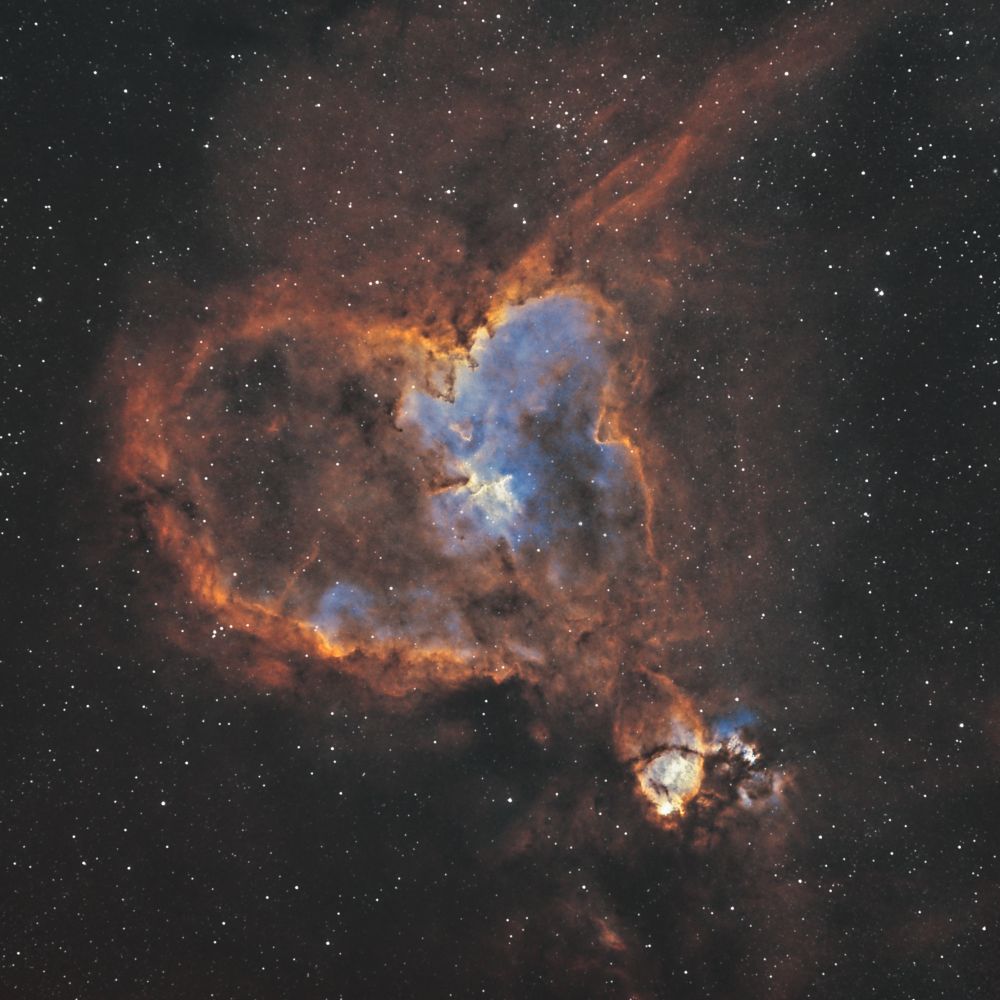
The Heart Nebula (IC 1805) and the Fish Head Nebula (IC 1795)

Category:Deep Sky
Published:
2842
The Heart Nebula (IC 1805) and the Fish Head Nebula (IC 1795)IC 1824NGC 896NGC 1027IC 1795IC 1805IC 1831
Resolution:
2780x2780 px
File size:
3820 KB

Photo description / processing

While the weather is still not cooperating, I continue learning PixInsight and processing old data with it. This is a bi-color image, approximating the Hubble palette.

Technical information

Telescope/Lens
Jupiter-21A
Camera
ZWO ASI533MC Pro
Mount
DIY Equatorial Tracker Mount
Guide Scope
Noname 120/480
Guide Camera
ZWO ASI 120 MM mini
Accessories
Optolong L-eXtreme
Software
Pixinsight, Adobe Photoshop
Location
Kolomna, Russia

Light pollution

Yellow, Bortle 5 zone

Date taken

Exposure

  • 85 × 300″ · ISO/Gain: 100 · f5.6, -20C, No calibration ·

Total exposure: 7 h 5 m
Comments

Bootlegger
Never would have thought that Jupiter-21 provides such detail )
Reply

Sign up or sign in to leave a comment.

Evgeniy SergeevReply to Bootlegger
I'm still amazed myself! Of course, the astro camera performs well and so does the processing. I think with a monochrome camera and separate SHO filters, the result could be improved even further. The signal-to-noise ratio would be better, and there would be no chromatic aberration.
Reply

Sign up or sign in to leave a comment.

BootleggerReply to Evgeniy Sergeev
Does chromatic aberration become noticeably apparent with the L-eXtreme?
Reply

Sign up or sign in to leave a comment.

Evgeniy SergeevReply to Bootlegger
Yes. There are two bands there, red and green. If you focus on the red, the green is slightly out of focus, and the stars appear bloated. And vice versa.
Reply

Sign up or sign in to leave a comment.

BootleggerReply to Evgeniy Sergeev
Understood. I want to experiment with my Takumar lens. It's sharp, but shows chromatic aberration. A workable option is to capture hydrogen and oxygen separately with refocusing.
Reply

Sign up or sign in to leave a comment.

Evgeniy SergeevReply to Bootlegger
It's too long and inefficient to shoot separately with a color camera this way. Stars can be adjusted during processing, rather than wasting precious clear skies. I focus on hydrogen, and this is how it turns out.
Reply

Sign up or sign in to leave a comment.

Evgeniy SergeevReply to Bootlegger
More precisely, with this processing, I remove the stars from the image and only take them from the hydrogen channel.
Reply

Sign up or sign in to leave a comment.

Smirnov Andrey
Evgeny, I didn't like the photo. Yes, a lot of work went into it, but the blue parts look somewhat unnatural, as if they were glued on, like in a child's paper craft. I'm sure the next attempt with this material will be more successful.
Reply

Sign up or sign in to leave a comment.

Oleg
I see there are two photos of the Heart Nebula. How was the color achieved in the other one?
Reply

Sign up or sign in to leave a comment.

Evgeniy SergeevReply to Oleg
I split it into channels and processed it in the Hubble palette, as if from a monochrome camera. The sulfur channel mimics the luminance channel. In the comments for the North America Nebula, there are links to several processing videos.
Reply

Sign up or sign in to leave a comment.

More photos by Evgeniy Sergeev