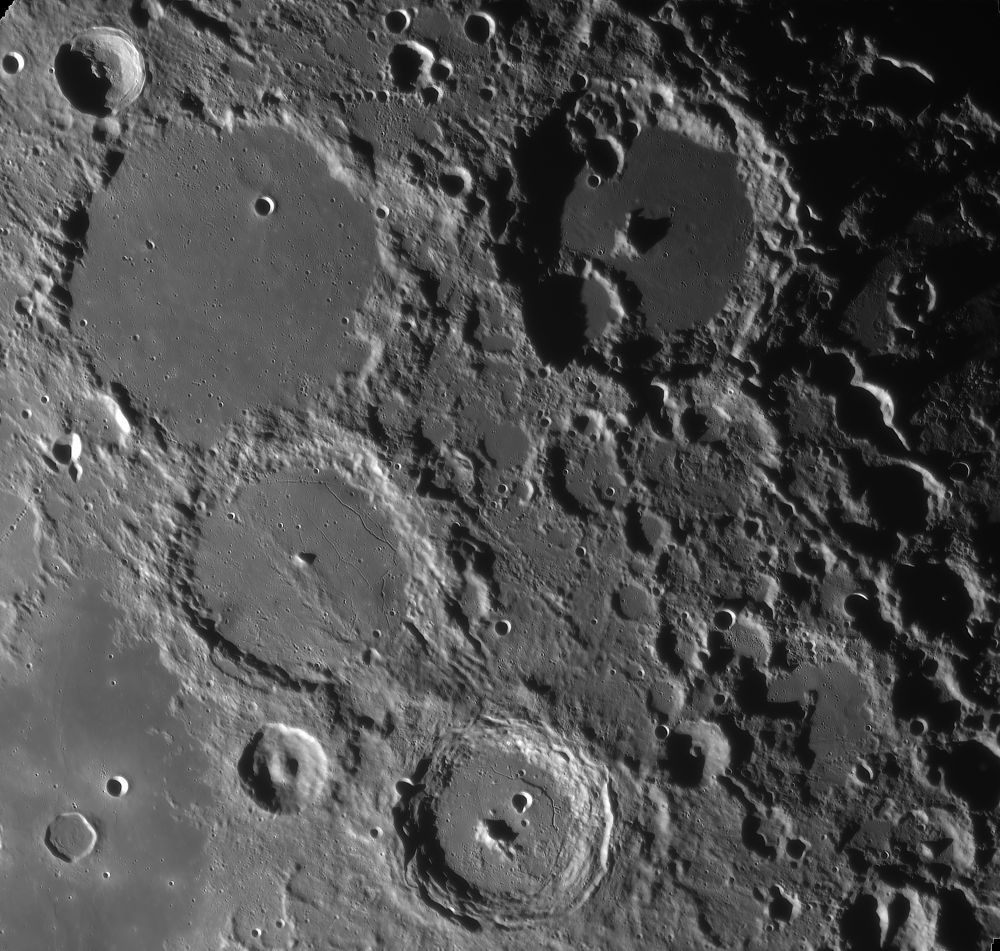
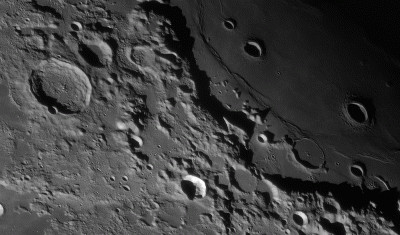
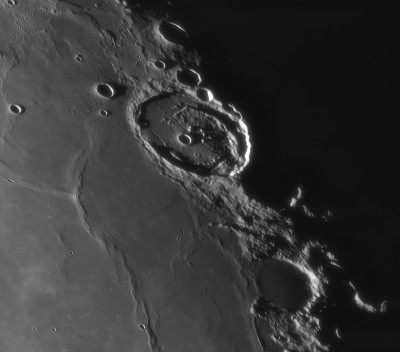
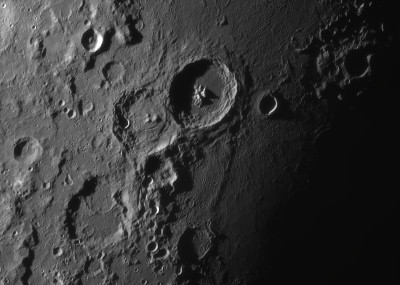
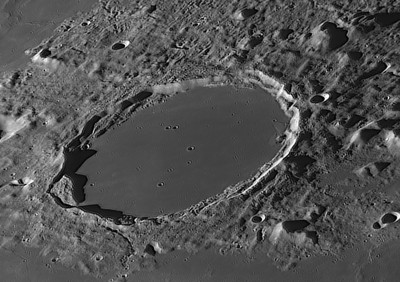
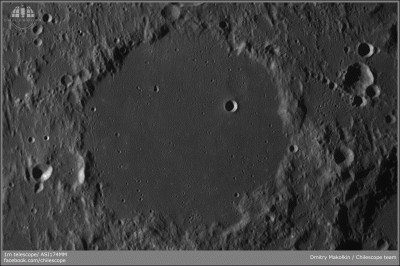
Here it can be said that the theoretical limit for a 14" aperture has been reached - 0.4"
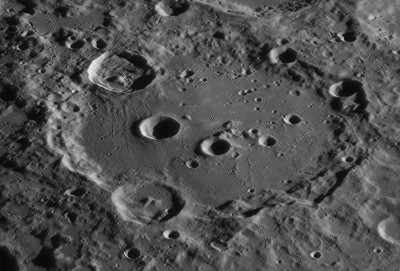
Working against us is the fact that we are still shooting not through a vacuum but through the atmosphere, while working in our favor is the "super-resolution" effect from stacking and drizzle. The linear scale is about 100 m/pixel.
In this video, the atmosphere was caught at 9 out of 10 (the only time in my life I have seen such a thing)
So it can be said that this is the limit for amateur aperture in general.
Slightly better I have seen only with the 1 m Chilescope (if you find a better photo of Ptolemaeus, be sure to let me know!)
Your suggestion seemed interesting )
The answer is ambiguous.
The claimed best resolution is there.
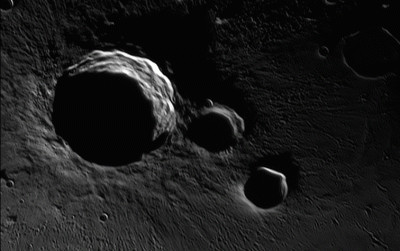
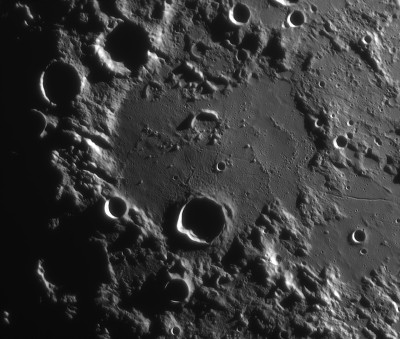
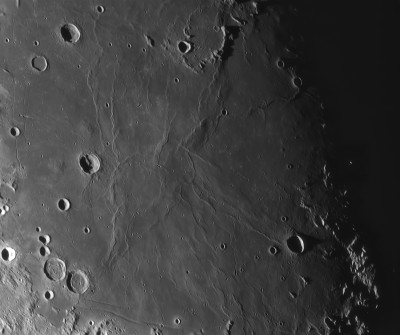
- Author: Maximus Photography. Date of shooting: September 5, 2015. Telescope: homemade ground-based Newtonian 355 mm, operating at f/20. Camera: ASI120MM-S, red filter. Three-frame mosaic.
The author indicates the distinguishability of details of about 400 m on the surface of the Moon.
Calculation of the actual angular resolution: 0.22 arcseconds at a distance of 377 thousand km
https://maximusphotography.net/2015/09/27/high-resolution-lunar-images-part-iii-september-5-2015/
I would rate the images as close in quality to the resolution you mentioned.
Well.. the maximum theoretical resolution is quite hard to surpass)) (It's about 0.35" for 14")
Our images are indeed comparable.
But it seems his goal was "to pull out details at any cost" - the sharpening is "piled up way beyond the limit", beyond the limit that the noise allows. At the micro-scale, diffraction doubling mixes with noise and it's unclear what's actually there.
I have some margin on noise and the image is natural. Theoretically, it could be processed "in his style" ;)
Oh yes, the "detection" of a 400m crater does not mean such resolution at all.
After all, for example, a star is a point object with zero angular size.
Nevertheless, we see it) With a single crater it's exactly the same thing.
"Detection" is not equal to "Resolution".
Resolution is the distance at which one object is confidently separated from another..
27 Sep, 2026
Reply
Comments are available only to registered users. Register or log in to leave a comment.



Comments
Have you tried estimating the resolution in arcseconds and absolute magnitudes?
Working against us is the fact that we are still shooting not through a vacuum but through the atmosphere, while working in our favor is the "super-resolution" effect from stacking and drizzle. The linear scale is about 100 m/pixel.
In this video, the atmosphere was caught at 9 out of 10 (the only time in my life I have seen such a thing)
So it can be said that this is the limit for amateur aperture in general.
Slightly better I have seen only with the 1 m Chilescope (if you find a better photo of Ptolemaeus, be sure to let me know!)
Our images are indeed comparable.
But it seems his goal was "to pull out details at any cost" - the sharpening is "piled up way beyond the limit", beyond the limit that the noise allows. At the micro-scale, diffraction doubling mixes with noise and it's unclear what's actually there.
I have some margin on noise and the image is natural. Theoretically, it could be processed "in his style" ;)
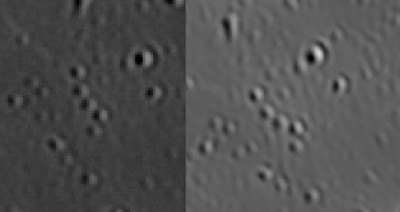
https://deepskyhosting.com/YdKR8l5
After all, for example, a star is a point object with zero angular size.
Nevertheless, we see it) With a single crater it's exactly the same thing.
"Detection" is not equal to "Resolution".
Resolution is the distance at which one object is confidently separated from another..
Comments are available only to registered users. Register or log in to leave a comment.