Thank you for sharing your photos - this is exactly what this project is all about! :-)
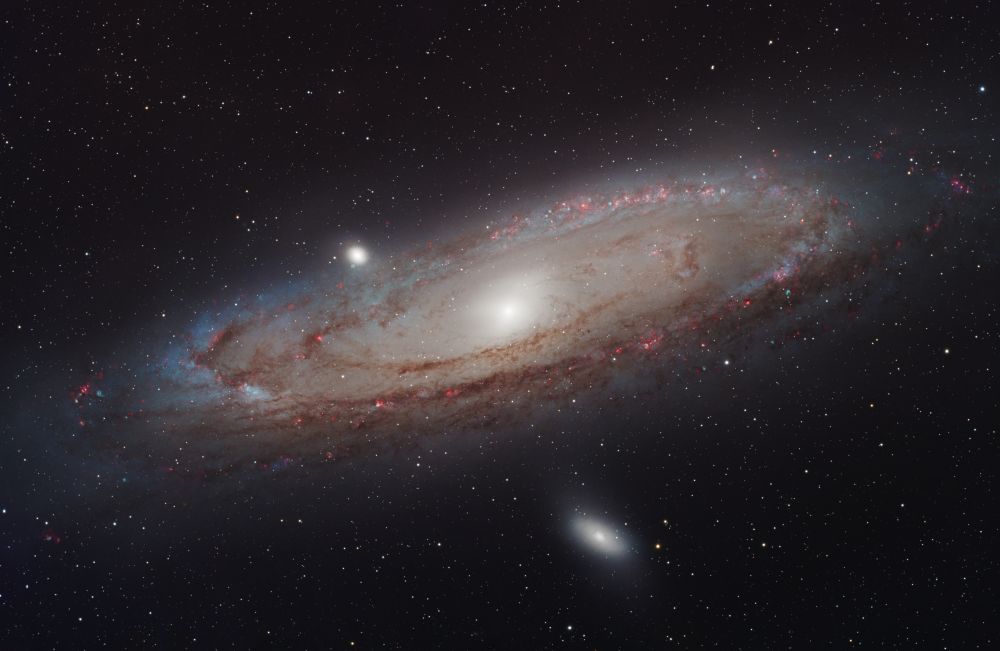
M31, the Andromeda Galaxy. It was periodically photographed from 2023 onwards, every summer when the sky allowed.
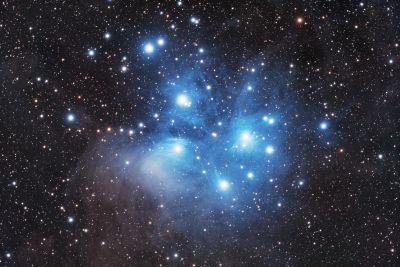
Calibration, stacking - PixInsight, processing in Photoshop and GraXpert, without neural network deconvolution. Without aggression and boosting saturation, the goal was specifically to preserve the dust at the edges. Hydrogen is already appearing in the background at the top, so it seems like there's a reddish gradient.
Plans include collecting another 15-20 hours of oxygen data as it has only just started to appear; I specifically didn't suppress it during processing. And another 10 hours or so of hydrogen data.
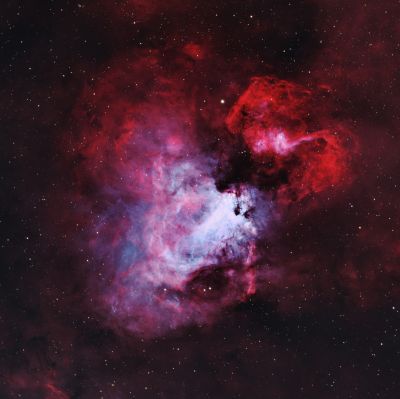
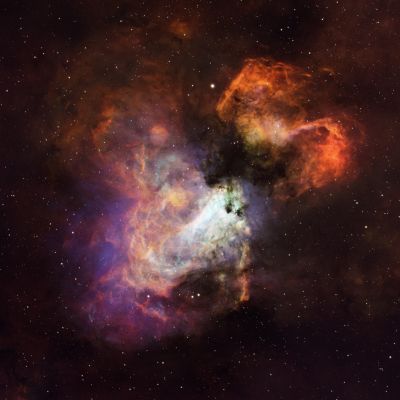
Hydrogen is mixed into the red channel, oxygen into the blue and green channels evenly.
Discussion in the astrochat - https://t.me/dalniycosmos_chat , there are many of us there, a special welcome to the haters)
You have a lot of great work in your profile. Feel free to join the Telegram group—it's easier to ask questions there, especially about the comet and Orion.
What's the point of taking multiple series with the same filter but different exposures? Why do red twice, 60s then 180s? Can't you just do 200 at 180s right away?
You can shoot in different locations, under different conditions, and at different times. Today you’re shooting near the city with poor atmospheric conditions—exposures longer than 60 seconds already show light pollution and gradients. In six months, you’ll be shooting from a dark-sky site where even 600-second subs are fine with a single-shot camera.
Hmm. I'm planning to do a long integration on the FRA500 (91mm) with a 0.75x reducer on the 2600mm, and now I'm having a few doubts. The result will definitely be significantly better than what I already have on my "tube" 61mm, but I was expecting a bit more. Still, I think it's worth a try.
26 Oct, 2025
Reply
Comments are available only to registered users. Register or log in to leave a comment.


Comments
Comments are available only to registered users. Register or log in to leave a comment.