
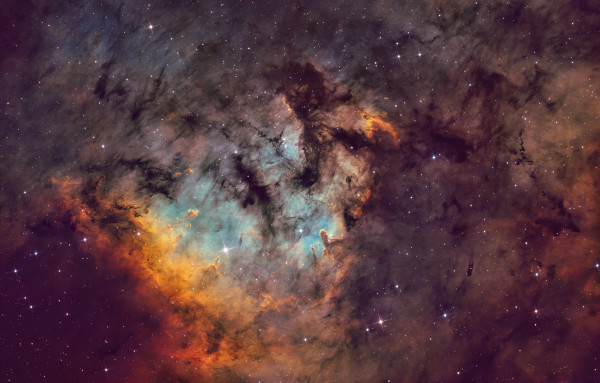
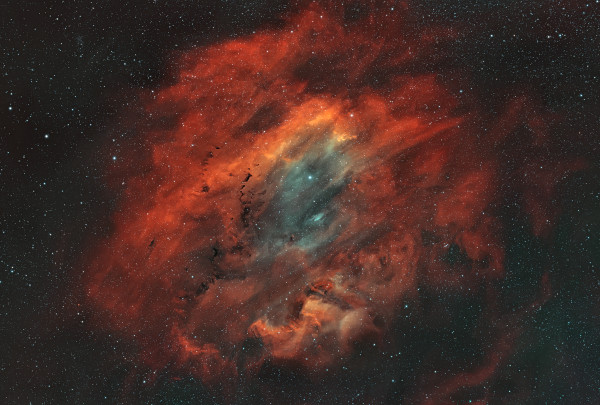
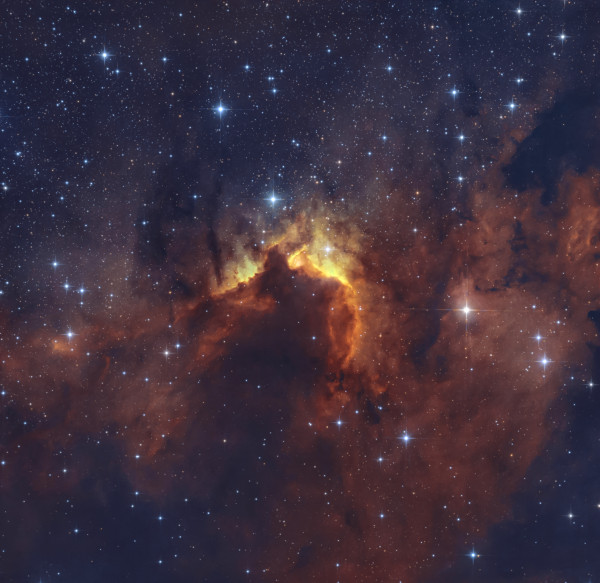
Sh2-129 "The Squid Nebula"

- Resolution:
- 3816x3402 px
- File size:
- 18583 KB
Photo description / processing
My largest project to date. I'm not happy with the result, but I can't bring myself to throw it away—after all, I spent more than one night capturing it. I had to discard a lot of frames... On top of that, I had to crop the image due to stacking artifacts. I plan to re-shoot it a bit later, add Oxygen, Sulfur, and a bit more Hydrogen, and do it without cropping. For now, let this version stay as a reminder of my "baptism by fire," so to speak. A challenging object.
Technical information
- Telescope/Lens
- SharpStar 61EDPH III + 0.75x reducer
- Camera
- ToupTek ATR2600M
- Mount
- JUWEI 14
- Guide Scope
- Svbony sv 165 Mini 40mm
- Guide Camera
- ASI120mm
- Accessories
- StellaVita
- Software
- Dss, Pixinsight, Photoshop
- Location
- Смоленск, Россия
Light pollution
Orange, Bortle 6 zone
Exposure
- 138 × 300″ · ISO/Gain: 100 · Olll Scorpio astro 3nm
- 69 × 300″ · ISO/Gain: 100 · Ha Scorpio astro 3nm
Total exposure: 17 h 15 m

Comments
Why gain 100? That's the minimum, you could crank it up higher.
And what Stella offset did she set?
Reply
Sign up or sign in to leave a comment.
Reply
Sign up or sign in to leave a comment.
Recently, I experimented with another camera - the Touptek AE676C - and there, for deep sky, I liked the result with High Gain (2000) more than at 100 and 500.
My shooting isn't really a benchmark yet, though, since I was capturing during white nights, just to test the camera in action.
Reply
Sign up or sign in to leave a comment.
Sign up or sign in to leave a comment.