Thank you for sharing your photos - this is exactly what this project is all about! :-)
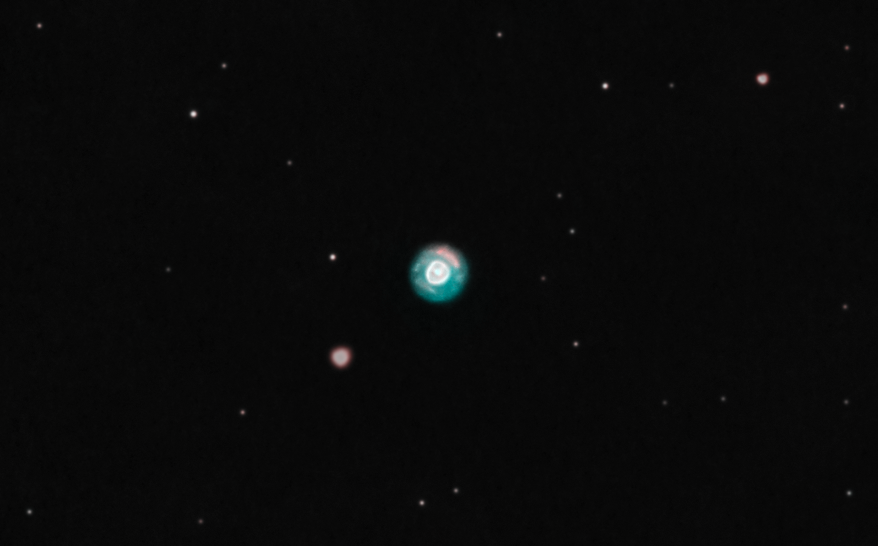
First experience using lucky imaging technology for planetary nebulae with the ZWO ASI290MM mini monochrome camera. LRGB channels. Manually changing filters, refocusing, and then reacquiring the target as it was already setting—that was quite a challenge, but in any case, the experience was gained, and it will only get more interesting from here))
NGC 2392, or the Eskimo Nebula, in the constellation Gemini. It was discovered by William Herschel in 1787. It earned its name because, from Earth, it resembles a person's head in a fur-lined hood. The distance from the Solar System to the nebula is 3,000 light-years, and the nebula itself is about a third of a light-year in size, though some gaseous filaments extend up to a light-year. The orange color of the nebula is due to nitrogen, which it is composed of. This nebula is bipolar and has a complex structure.
Add comment
Comments
There are no comments on this picture yet
Comments are available only to registered users. Register or log in to leave a comment.

Comments
There are no comments on this picture yet
Comments are available only to registered users. Register or log in to leave a comment.