DeepSkyHosting

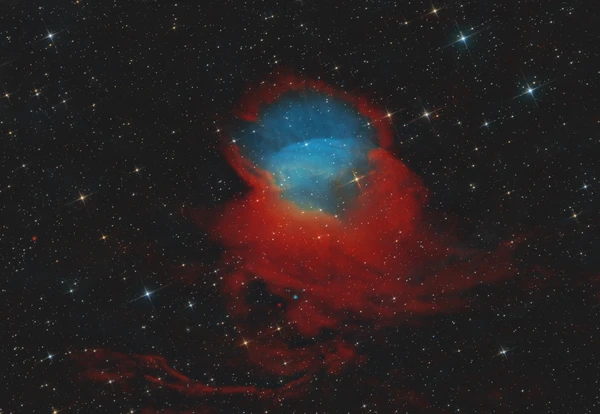
NGC 7380 also known as "Wizard" also known as "Sorcerer" in SHO

Category:Deep Sky
Published:
877
NGC 7380 also known as "Wizard" also known as "Sorcerer" in SHONGC 7380
Resolution:
5490x3996 px
File size:
4830 KB

Photo description / processing

I shot over several nights from August to mid-September, it lay around for a long time, a lot of work on it and also the vegetable garden. Processing features: 1. Laida SII 5 nm filter on a color camera, I didn't bother, extracted the L channel and used it for the SII channel. 2. I didn't like the stars from SHO, so I used HOO, on a too bright blue background, the stars still remained bloated, so I slightly suppressed their brightness.

Technical information

Telescope/Lens
Прямофокусник 300/996 "Изд.№3"
Camera
Touptek IMX 571 C
Mount
МТ-120
Guide Scope
Kenko ED 60/400
Guide Camera
T7M
Accessories
GPU 1.0
Software
N.I.N.A., Pixinsight, Adobe Photoshop
Location
Екатеринбург, район озера Глухое., Россия

Light pollution

Orange, Bortle 6 zone

Date taken

Exposure

  • 90 × 300″ · ISO/Gain: 152 · Optolong L-Ultimate ·
  • 83 × 300″ · ISO/Gain: 152 · Laida SII 5 nm ·

Total exposure: 14 h 25 m
Comments

Stanislav Borodinov
How do you manage to achieve an even background?
Reply

Sign up or sign in to leave a comment.

Oleg NovoselovReply to Stanislav Borodinov
So, I should have taken flats, but I took this shot without them.
Even so, it turned out almost fine, just needed a little tweaking in the software.
The light pollution in the narrowband isn't too bad; it's when you're shooting galaxies that flats are absolutely essential.
Reply

Sign up or sign in to leave a comment.

oeswww
It's a bit faint and the background is noisy (not enough contrast, in my opinion).
Reply

Sign up or sign in to leave a comment.

Oleg NovoselovReply to oeswww
I tried to process it more gently, because those eye-straining images were getting to me.
Reply

Sign up or sign in to leave a comment.

oeswwwReply to Oleg Novoselov
By the way, I tried increasing the monitor brightness to 100% (I usually use 60-70%), and it became a bit livelier, but it's still somewhat grayish.
Reply

Sign up or sign in to leave a comment.

Oleg NovoselovReply to oeswww
Try adjusting your monitor settings properly, not just the usual way, and then the colors will look right (I'm talking about the Veil Nebula).
Reply

Sign up or sign in to leave a comment.

oeswwwReply to Oleg Novoselov
And how should it be? If you choose the "Photo" preset, both saturation and brightness increase. But you can't sit at the monitor like that for long—your eyes start to bulge. That's why most people use the "Custom" preset with moderate brightness and contrast (above average). You, it seems, went to the trouble and applied restrained processing in the right settings, which unfortunately looks a bit dull on most monitors. The Veil Nebula in photo mode does indeed look very saturated. However, even without considering that, there are "clumpy" areas. But I didn't do any processing there at all.)
Reply

Sign up or sign in to leave a comment.

oeswww
Would you like to combine the signal? I'll send you the stacks, and we can collaborate just for fun. It'll be 36 hours total. Not 50, of course, but the noise should be reduced by about half, and the details will be a bit better.
Reply

Sign up or sign in to leave a comment.

Oleg NovoselovReply to oeswww
Let's give it a try. I'm curious to see how it turns out, and I'll also learn how to combine different sessions.
Just send the data channel by channel, and it would be great to have clean stacks without any subsequent processing.
Reply

Sign up or sign in to leave a comment.

oeswwwReply to Oleg Novoselov
Sent links to the archives in a private message on the astronomy forum.
Reply

Sign up or sign in to leave a comment.

More photos by Oleg Novoselov