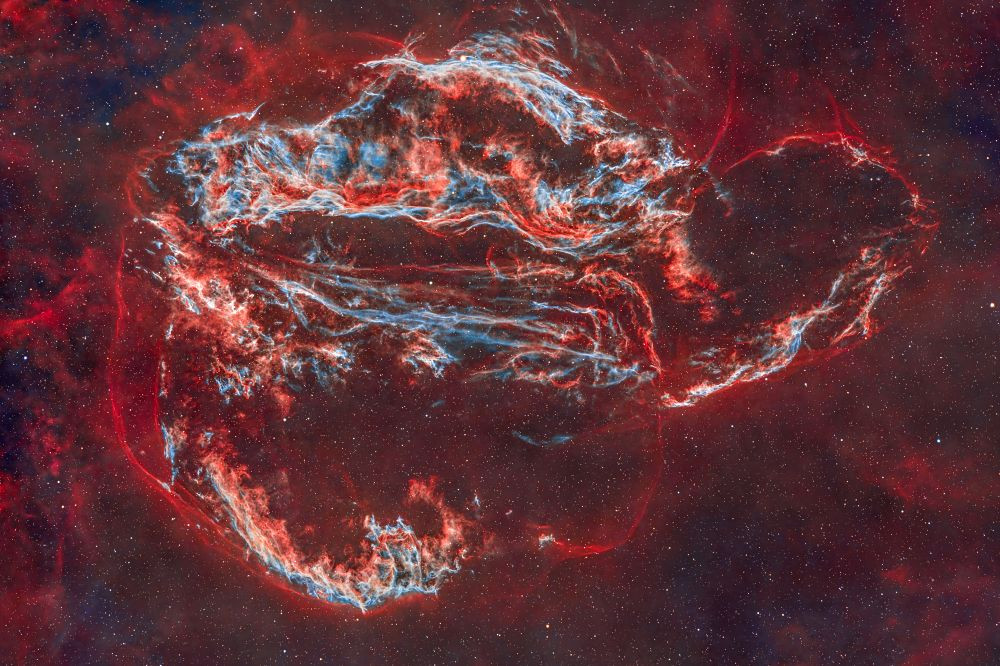
"Veil" 52.5 hours.

 Posted: Sep 16th, 2026
Technical Info
Telescope/Lens: Askar SQA55 55 мм f/4.8
Camera: ZWO ASI2600MC PRO
Mount: Juwei 17
Exposure:
630 x 300" ISO/Gain: 0
 Novosibirsk, Россия
52 h 30 m
353
Resolution: 5837x3891 px
Scale: 12439 KB

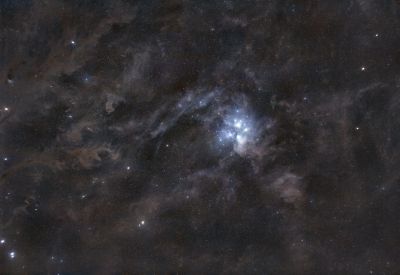
Friends, I am glad to present to you the September Veil nebula in the constellation Cygnus! 7 clear nights were not wasted. We photographed it together with Mikhail Mikhailov using two identical setups, so a collaboration on the accumulated signal suggested itself. In total, we managed to collect 52.5 hours, Misha gathered 19.5 hours and my setup collected 33 hours. Most likely I will return to this work again to rethink the processing, since not everything pleases me, but for now this is it. The nebula itself is the remnant of a supernova explosion of a star about 20 solar masses, at a distance of about 2400 light-years. This happened about 5-8 thousand years ago and now the shock waves from the explosion (or as the media like to write, the "bang") are expanding in space.
Technical part: two Askar SQA55 telescopes, two ZWO ASI2600MC cameras, two Antlia APT DualBand 3nm filters. Light pollution zone is blue (tending toward gray) SQM21.79, 150 km from Novosibirsk.
Add comment

Comments

52 hours - great. But the stars didn't come out at all.
16 Sep, 2026 Reply
Polyakov Aleksey Replied to Dmcl
I put out and extinguished the stars as best I could; there were several options, but I didn't like any of them. In the end, I gave up—after all, it wasn't for their sake that all this was started.
16 Sep, 2026 Reply
Dmcl Replied to Polyakov Aleksey
I can add my own 25 hours and do the processing. The telescope is the same. If you're interested, my Telegram is listed in my profile. Here is my image: https://deepskyhosting.com/gVu23Iy
16 Sep, 2026 Reply
Polyakov Aleksey Replied to Dmcl
I'd like to make those mistakes myself.
16 Sep, 2026 Reply
Lex Kasatkin Replied to Dmcl
In PixInsight, everything can be fixed. And you can get RGB stars from NB as well.
16 Sep, 2026 Reply
Polyakov Aleksey Replied to Lex Kasatkin
PixInsight still has a lot to teach me, 7/8 is a dense forest for me. I've heard about the GHS tool too, but haven't used it yet, nor about plugins specifically for color filters. I'll watch tutorials, as far as the speed of slow YouTube allows...
16 Sep, 2026 Reply
Dmcl Replied to Lex Kasatkin
It's too late to fix anything here. The photo is of very poor quality. Personally, I don't understand what people are liking here. You can't get proper RGB stars from NB data. Stars need to be photographed separately without any NB. And why Pixinsight specifically? Why not Siril, for example? Why is everyone so fixated on Pixinsight?
17 Sep, 2026 Reply
Lex Kasatkin Replied to Dmcl
It's trivial because it's a convenient all-in-one processing tool with lots of scripts and a community. Maybe it's possible in Siril too, I have no idea, I don't process there. You can also manually combine stars in NB with a certain proportion and get something similar to RGB. Why waste time on that.
17 Sep, 2026 Reply
Dmcl Replied to Lex Kasatkin
"The point of wasting more time on this" - if in the "good enough" style, then of course make the stars from NB )
17 Sep, 2026 Reply
Lex Kasatkin Replied to Dmcl
And what exactly is the difference?)
17 Sep, 2026 Reply
Lex Kasatkin Replied to Dmcl
Are there any standards? Or maybe it's worse in NB?
17 Sep, 2026 Reply
Dmcl Replied to Lex Kasatkin
I wrote a short article about the color of stars with NB/DB filters: https://dzen.ru/a/aqtRFKSvPk1kKkal
17 Sep, 2026 Reply
Lex Kasatkin Replied to Dmcl
So what's the point? Why did you decide that a synthetic image should have stars of natural color?)
17 Sep, 2026 Reply
Lex Kasatkin Replied to Dmcl
NB + SPCC - quite similar to natural ones. This can be one of the processing options
17 Sep, 2026 Reply
Dmcl Replied to Lex Kasatkin
Yes, go ahead and make green stars. Nobody is stopping you. I commented on your phrase "And get RGB stars from NB as well." That statement is false — you cannot get quality RGB stars in normal colors from narrowband filters. As for the image being discussed — the stars here are categorically bad. I photograph with two of the same telescopes and the same sensors. And I know perfectly well that the Askar SQA55 "draws" stars excellently. Here, though, they turned out as some kind of uneven flat spots. It's not even about the color. And this applies not only to the stars. In this connection, I expressed surprise that the image is getting a lot of likes.
17 Sep, 2026 Reply
Lex Kasatkin Replied to Dmcl
Apparently you haven't heard of SPCC?)
17 Sep, 2026 Reply
Dmcl Replied to Lex Kasatkin
This is from the series "heard the bell, but doesn't know where it is." SPCC uses stars to calculate color correction based on photometric catalogs. But this correction is applied not to individual stars, but to the frame as a whole. Therefore, it is equivalent to changing the overall color balance. And if there is a color skew in the stars, it will remain that way. First understand the issue, and then we'll talk.
17 Sep, 2026 Reply
Lex Kasatkin Replied to Dmcl
Blah-blah-blah))
17 Sep, 2026 Reply
Lex Kasatkin Replied to Dmcl
I see that you don't even understand what an
RGB image is)))
17 Sep, 2026 Reply

Comments are available only to registered users. Register or log in to leave a comment.