
New V1405 Cas during its outburst

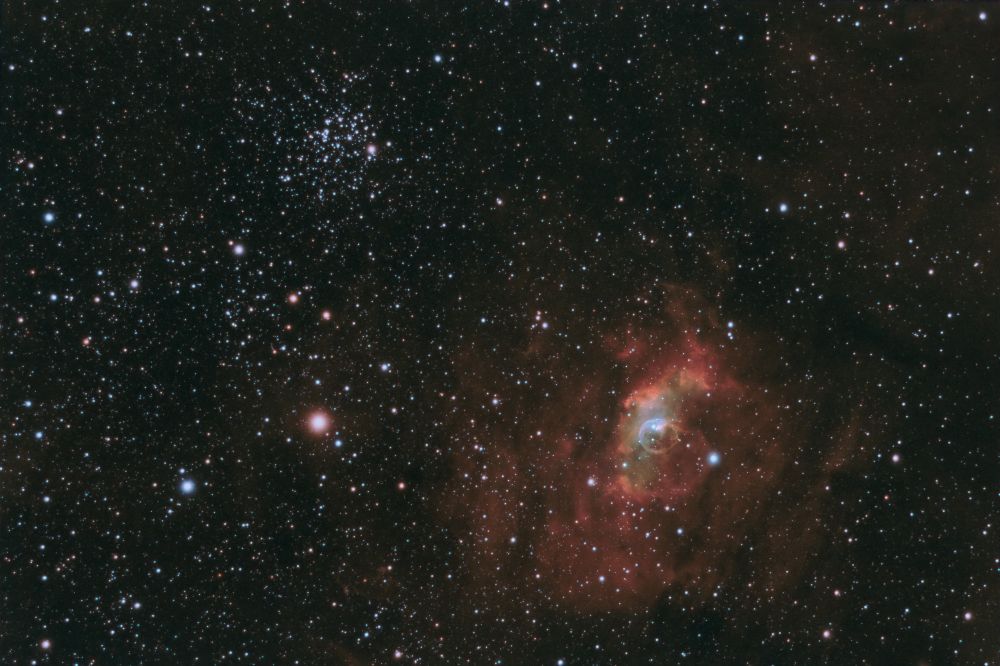
Photo description / processing
The imaging was done over several nights from May 11th to 15th. I tried to capture hydrogen and oxygen data for about half the night each, alternating between them, but it wasn't always possible due to clouds. During the outburst, the star's brightness remained around magnitude 5.2-6, gradually fading (the change in brightness isn't very clear in my single frames or daily stacks; I would need to very carefully normalize the background brightness between frames. If I manage that, I might make an animation).
Due to the relatively small aperture and sensor size, the bright stars are heavily bloated even with narrowband filters. This is especially noticeable against the faint stars, which were further reduced after some sharpening and noise reduction in Topaz Denoise AI.
Technical information
- Telescope/Lens
- TS-Optics Photoline 60mm f/6 FPL53
- Camera
- QHY5III178M Cool
- Mount
- Sky-Watcher HEQ5 Pro
- Guide Scope
- SVBONY 60/240
- Guide Camera
- QHY QHY5L-II-C
- Accessories
- TS-Optics Photoline 2-inch 0.79x Reducer, Baader 7nm H-alpha Filter 1.25-inch, Astronomik OIII 6nm Filter 1.25-inch
- Software
- Astro Pixel Processor, GIMP, Topaz DeNoise AI, Adobe Lightroom
- Location
- Старые Кены, Россия
Light pollution
Yellow, Bortle 5 zone
- Date taken
Exposure
- 56 × 600″ · ISO/Gain: 10 · H-alpha ·
- 36 × 600″ · ISO/Gain: 10 · OIII ·
Total exposure: 15 h 20 m


Comments
There are no comments on this photo yet.
Sign up or sign in to leave a comment.