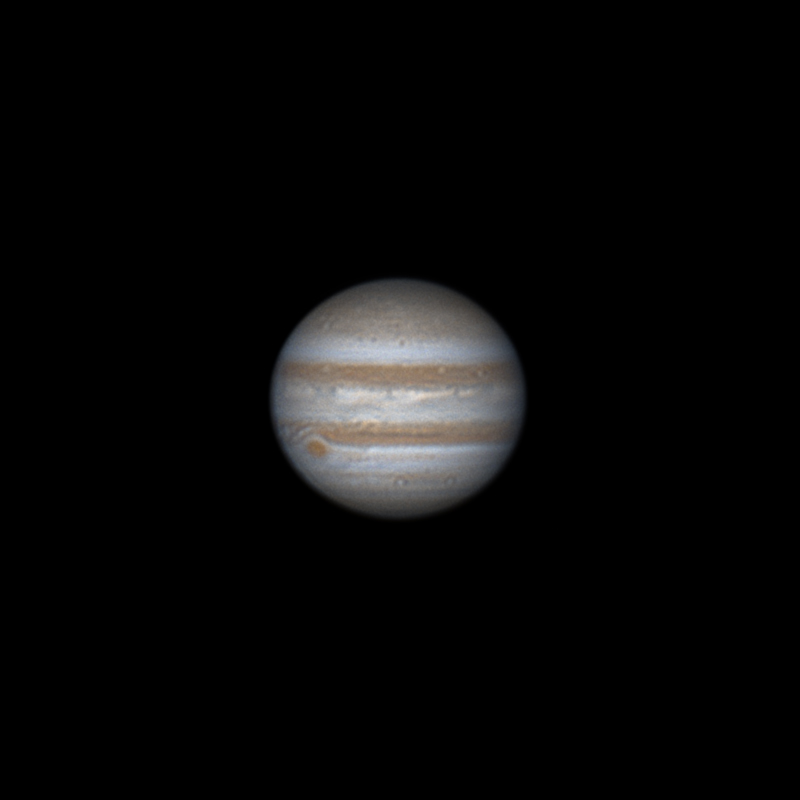
Good afternoon. I see you captured this with an ASI662MC on a 130mm Newtonian, and in my opinion, the result is very solid. I shot Jupiter with a 200mm Newtonian using an SV350Pro camera, which has similar sensor specs. I used similar processing. But for some reason, my final image is much worse than yours—it lacks that sharpness and fine detail. Even though I feel the equipment and camera are capable of more.
What could be the reason? Could you describe how you conducted the shoot and processed the raw data?
Hello, the issue is most likely with the seeing. The atmosphere was very calm on the day I was shooting, and I think the result would have been much better with a larger instrument. Also, the dispersion corrector adds sharpness, in addition to aligning the channels. There might also be problems with collimation or processing, but it's most likely poor seeing.
Yes, image quality varies from night to night. It's especially noticeable in different seasons—I've captured Jupiter both in late summer, in the early morning, and in October, in the frosty January. And, I must admit, the images are different. Collimation, again, plays a role.
As for processing—yes, maybe I'm doing something wrong in the process, so the final result ends up worse than on smaller instruments.
Perhaps you have a link to a video or a guide that describes step-by-step how to process planetary videos.
Regarding seeing, I just tried shooting Jupiter with a 200mm Newtonian, and the result was much worse than with the 130mm, precisely due to atmospheric quality.
As for processing, nothing unusual—a stack of 300–1000 frames, I find the optimal number experimentally, wavelets in PixInsight, and a slight adjustment in Photoshop.
Thanks for the tips. Yes, you have to wait for calm and transparent atmospheric conditions, which is far from always the case. Sometimes it seems like the night is clear, the air is so transparent, the planets should probably be visible well. You point the telescope at Jupiter—and it's a mess! Everything is streaming, trembling, and blurring!

Comments
As for processing—yes, maybe I'm doing something wrong in the process, so the final result ends up worse than on smaller instruments.
Perhaps you have a link to a video or a guide that describes step-by-step how to process planetary videos.
Comments are available only to registered users. Register or log in to leave a comment.