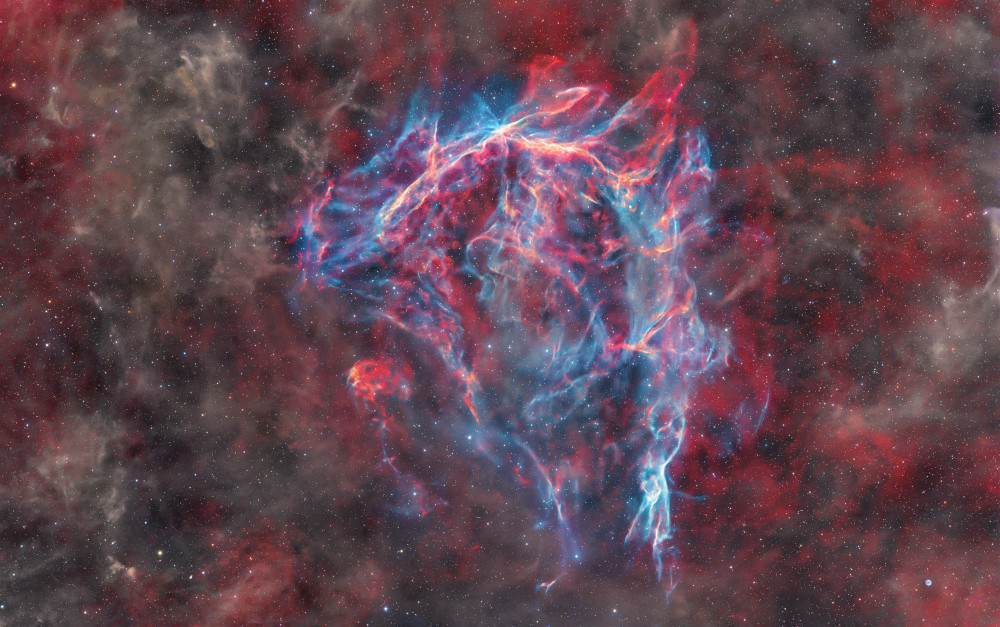

CTA 1 — Echoes of a Hidden Remnant
Project organizer: Andrew Batov (KonFuz)
Assistant: Lex Kasatkin (Darth Maul)
Image processing: Maksim Zaharov (svarschik911) https://deepskyhosting.com/svarshchik911
Processing software: PixInsight, Adobe Photoshop
Capture period: late July — mid-September 2026
The idea to image CTA 1 arose because, until now, no wide-field image of this region existed that simultaneously showed both the IFN structure and the faint background hydrogen emission well. Our goal was to show both components in a single frame while preserving their natural contrast and large-scale structure. This approach allowed us to present the CTA 1 region in a way rarely seen in previous images of this object.
This project shows CTA 1 in an unusually deep and wide field, combining the faint structures of the supernova remnant in Hα and OIII with vast regions of galactic dust and IFN. Rather than filling the frame with CTA 1 itself, the composition was built to emphasize the contrast between the relatively compact supernova remnant and the enormous dust structures surrounding it across the entire image field.
Deep broadband data revealed extremely faint dust on large angular scales, while narrowband integration brought out the delicate emission structures of CTA 1. The result is a rather rare type of image in which both the supernova remnant itself and the faint dust surrounding it play comparable visual roles.
CTA 1, also known as SNR G119.5+10.2, is an ancient supernova remnant in the constellation Cepheus, located approximately 4,600 light-years from Earth. Its age is estimated at roughly 10,000–14,000 years. Its expanding shell is particularly prominent in radio, while extremely faint optical shock fronts can be observed primarily in Hα and OIII lines. At the center of CTA 1 lies PSR J0007+7303 — a neutron star completing one rotation in approximately 316 milliseconds. This object is especially notable for being the first pulsar discovered through its gamma-ray pulsations rather than through previously detected radio pulsations. The vast dust structures visible throughout the image lie along the same line of sight but are not necessarily physically associated with the supernova remnant itself.
Exposure
Hα — 230 h
OIII — 110 h
RGB — 51 h
L — 9 h
Total integration — 400 hours
Participants
1. Dmitry — 65 h
35 h Hα + 30 h OIII
Takahashi FSQ-106 / QHY600
2. Evgeniy Morozov — 55 h
55 h Hα
William Optics RedCat 71/350 / ZWO ASI2600MM Air
3. Poppy8micro — 39 h https://deepskyhosting.com/id1803
26 h Hα + 13 h OIII
Askar 71F + 0.75× reducer / ZWO ASI2600MM Pro
4. Lex Kasatkin — 35 h
21 h Hα + 5 h OIII + 9 h L
Askar SQA60 / ZWO ASI294MM Pro
5. Andrew Batov (KonFuz) — 29 h
23 h Hα + 6 h OIII
Askar 106SQA / SkyEye62AM
6. Alexey (lxkor) — 26 h https://deepskyhosting.com/lxkor
13 h Hα + 13 h OIII
Askar SQA55 / ToupTek ATR2600M
7. Maria-Mria — 24 h https://deepskyhosting.com/id1528
21 h OIII + 3 h Hα
Askar SQA55 / ZWO ASI2600MM Pro
8. Dmitry — 24 h
15 h Hα + 9 h OIII
Askar SQA85 / ZWO ASI2600MM Pro
9. Cho YongJun — 23 h
13 h Hα + 10 h OIII
Askar FRA400 / ZWO ASI2600MM Pro
10. Alena Kiseleva (BeautyS89)— 23 h https://deepskyhosting.com/BeautyS89
23 h RGB
Askar SQA55 / ZWO ASI2600MC Pro
11. Sergay Nazarov — 19 h
16 h Hα + 3 h OIII
Celestron C11 + HyperStar, ~580 mm / camera on IMX6200
12. Pingulator — 13 h
13 h RGB
Askar SQA55 / ZWO ASI2600MC
13. Yu Mar — 10 h
10 h Hα
Askar SQA55 / ZWO ASI2600MM Pro
14. Timofey Prozorov — 9 h
9 h RGB
Askar SQA55 / Player One Poseidon-C Pro (IMX571)
15. Anastasii — 4 h https://deepskyhosting.com/Anastasii
4 h RGB
Askar SQA55 / ZWO ASI294MC Pro
16. Serge — 2 h https://deepskyhosting.com/id2287
2 h RGB
Askar SQA85 / ZWO ASI2600MC
This image is the result of a collaborative effort by astrophotographers shooting with different optical systems and collecting data over nearly two months. A total integration of 400 hours made it possible to simultaneously reveal the extremely faint emission structures of CTA 1 and the large-scale galactic dust surrounding the object in the image field.
Huge thanks to everyone who took part in this collaborative project and contributed their time and data. Each participant's contribution became an important part of the final image, and without the joint work of all participants this project would have been impossible.

Comments
Amazing.
Comments are available only to registered users. Register or log in to leave a comment.