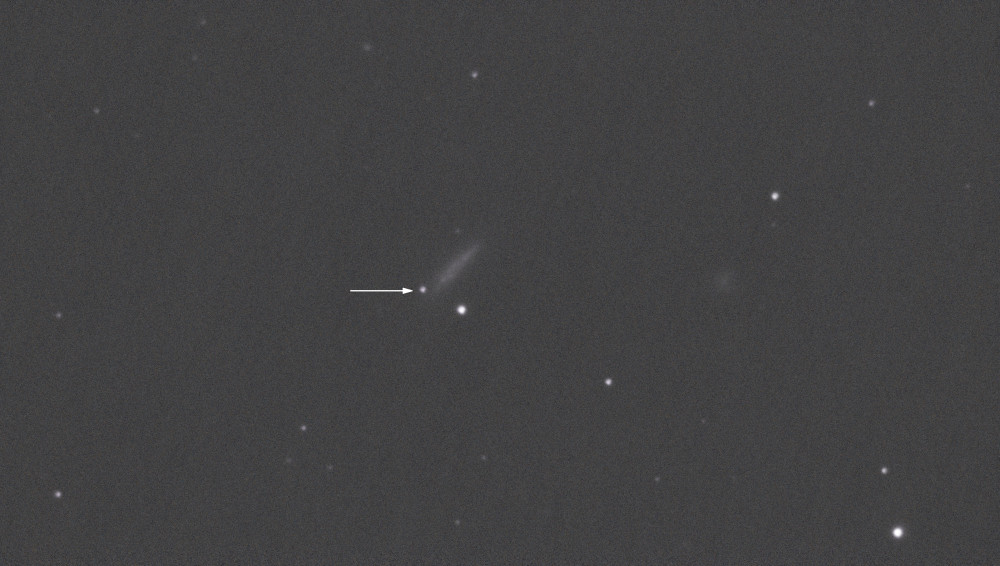
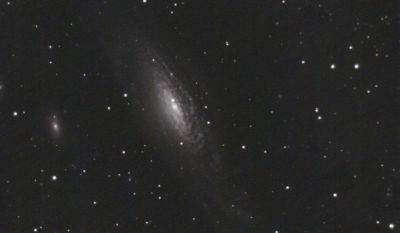
Supernova SN 2026fvx was discovered on March 17, 2026, in the galaxy NGC4205 by the automated sky survey system ATLAS.
This event is a Type Ia supernova, one of the most important types in modern astronomy. It occurs when a white dwarf in a binary system accretes matter from a companion star, eventually reaching the Chandrasekhar limit and triggering a thermonuclear explosion that completely destroys the star in seconds. Due to their predictable brightness, Type Ia supernovae serve as "standard candles" in astronomy. They are used to measure intergalactic distances and to provide evidence that the universe is expanding at an accelerating rate.
The galaxy NGC4205 is located approximately 70 million light-years away, meaning the light captured here began its journey tens of millions of years ago. A supernova is a colossal cosmic explosion that occurs in the final stage of a massive star's life. The outburst increases the star's brightness by millions or billions of times, briefly outshining the entire galaxy, after which the star disintegrates and gradually fades.
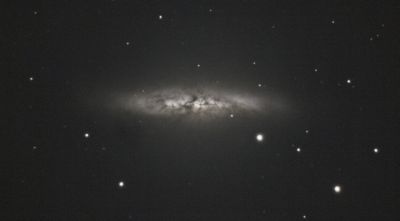
In early April, SN 2026fvx reached its peak brightness at approximately magnitude 12.3, appearing as a bright point of light that visually outshines the surrounding galaxy in the image, even though that galaxy contains billions of stars. At the time of imaging on May 15, its brightness was magnitude 13.5.



Comments
There are no comments on this picture yet
Comments are available only to registered users. Register or log in to leave a comment.