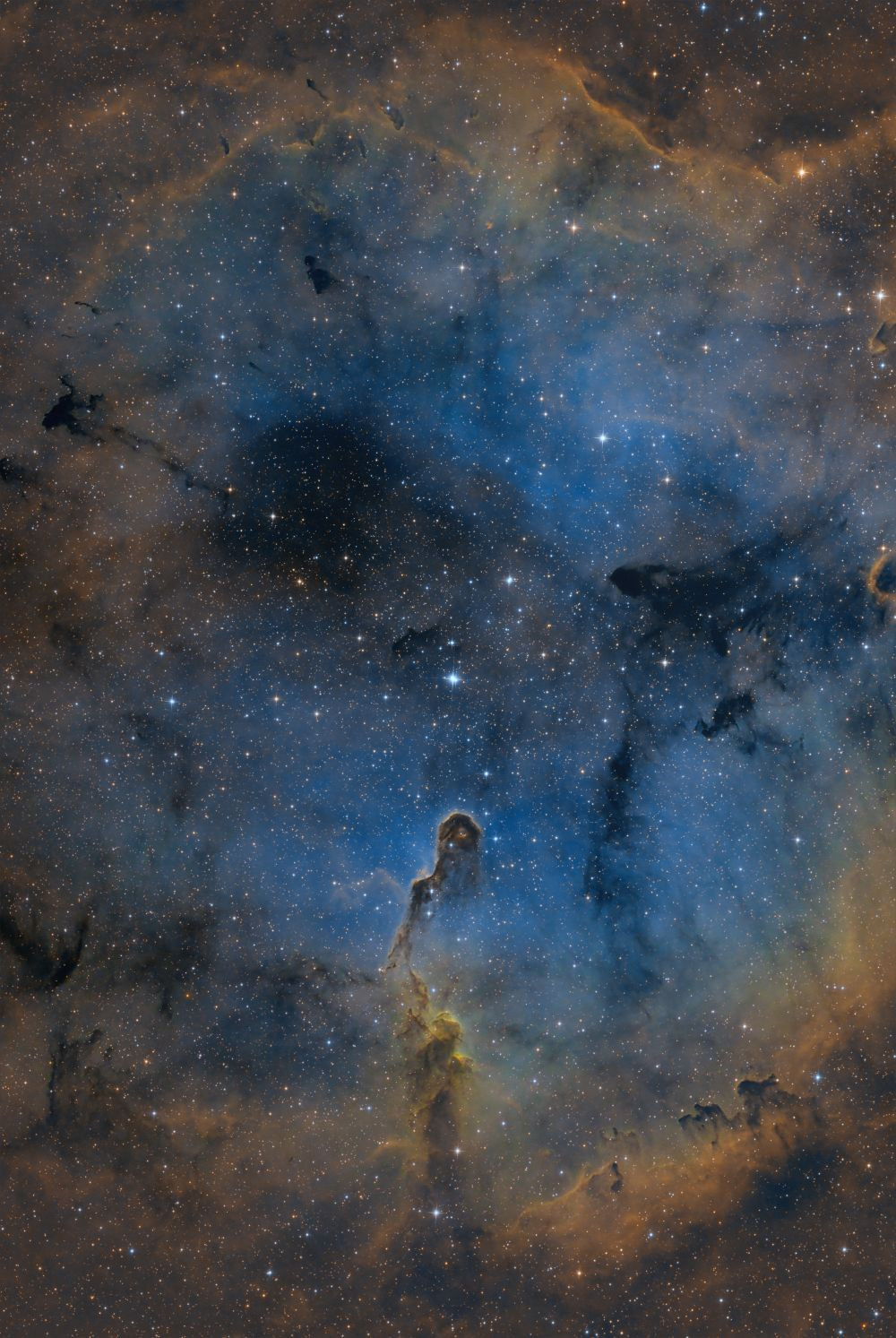

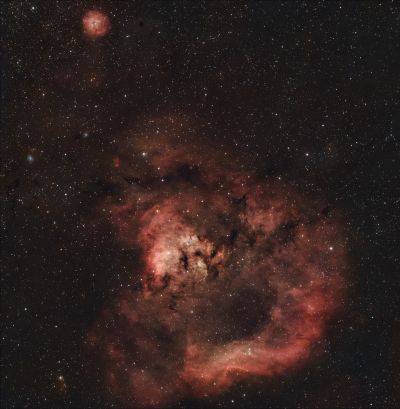
My plans for April–May included capturing the Markarian Chain, but the weather didn’t cooperate. A clear night finally came, but it fell right on the full moon, so shooting broadband data, especially near the Moon, was out of the question. That’s how the idea of shooting the Elephant’s Trunk with narrowband filters was spontaneously born, as it gradually rose in the northeastern part of the sky during the short night. I was quite pleased with the result.
IC 1396A close-up:
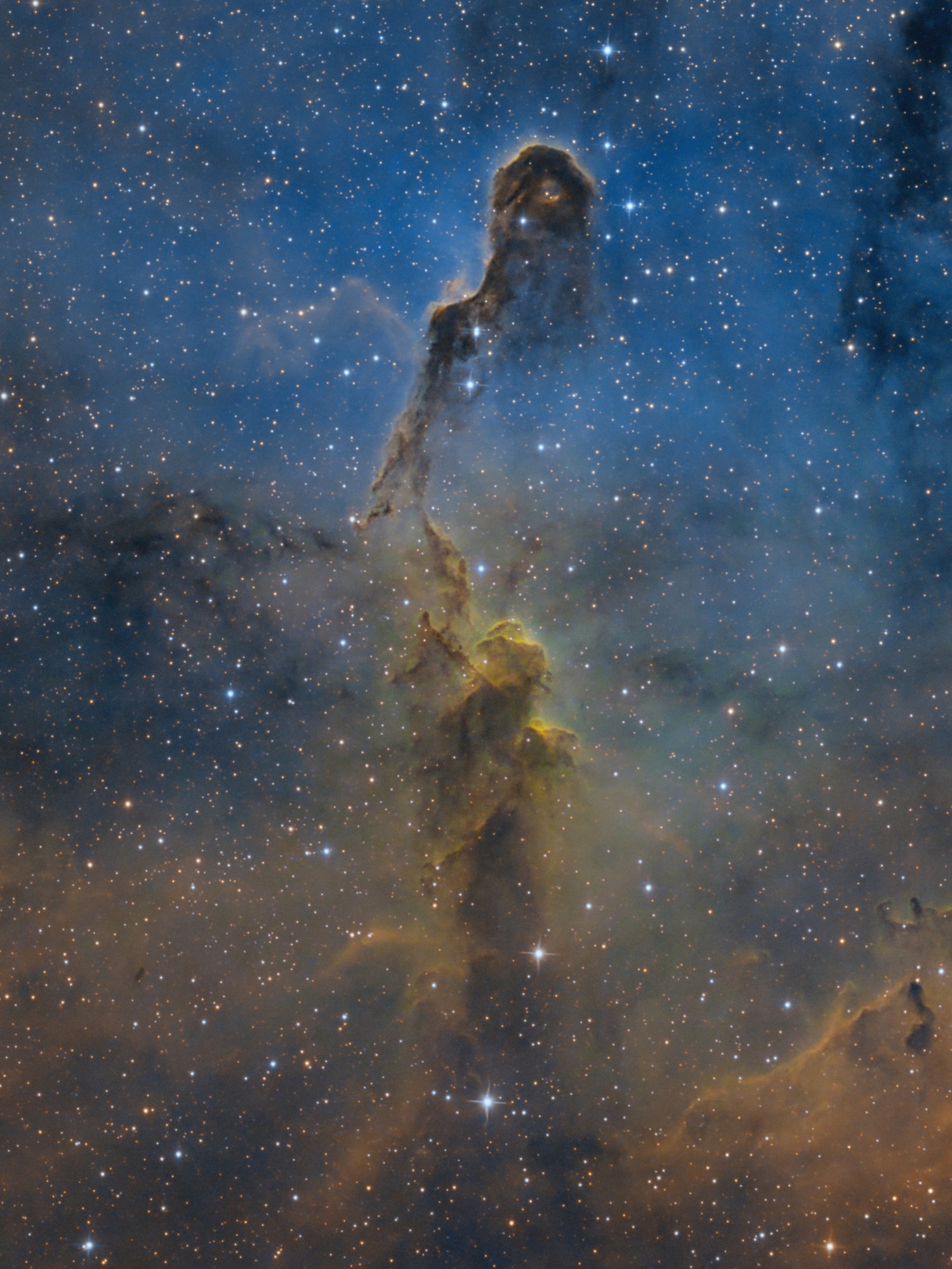
The Elephant’s Trunk Nebula is a concentration of interstellar gas and dust within the much larger region of ionized gas IC 1396, located in the constellation Cepheus about 2,400 light-years from Earth. The bright rim of the Elephant’s Trunk is the surface of a dense cloud illuminated and ionized by a very bright massive star (HD 206267) located east of IC 1396A. The entire IC 1396 region is ionized by the massive star, except for dense globules that can shield themselves from the star’s harsh ultraviolet radiation.
According to current understanding, the nebula is a star-forming region containing several very young stars—less than 100,000 years old—discovered in infrared images in 2003. Two older stars (a few million years old) lie in a small round cavity in the head of the globule. Winds from these young stars may have hollowed out this cavity. The combined action of light from the massive star, which ionizes and compresses the cloud’s edge, and winds from the young stars, which push gas outward from the center, leads to a very strong compression of gas in the local area, triggering the formation of the current generation of protostars.


Comments
Comments are available only to registered users. Register or log in to leave a comment.