
The Orb Weaver nebula

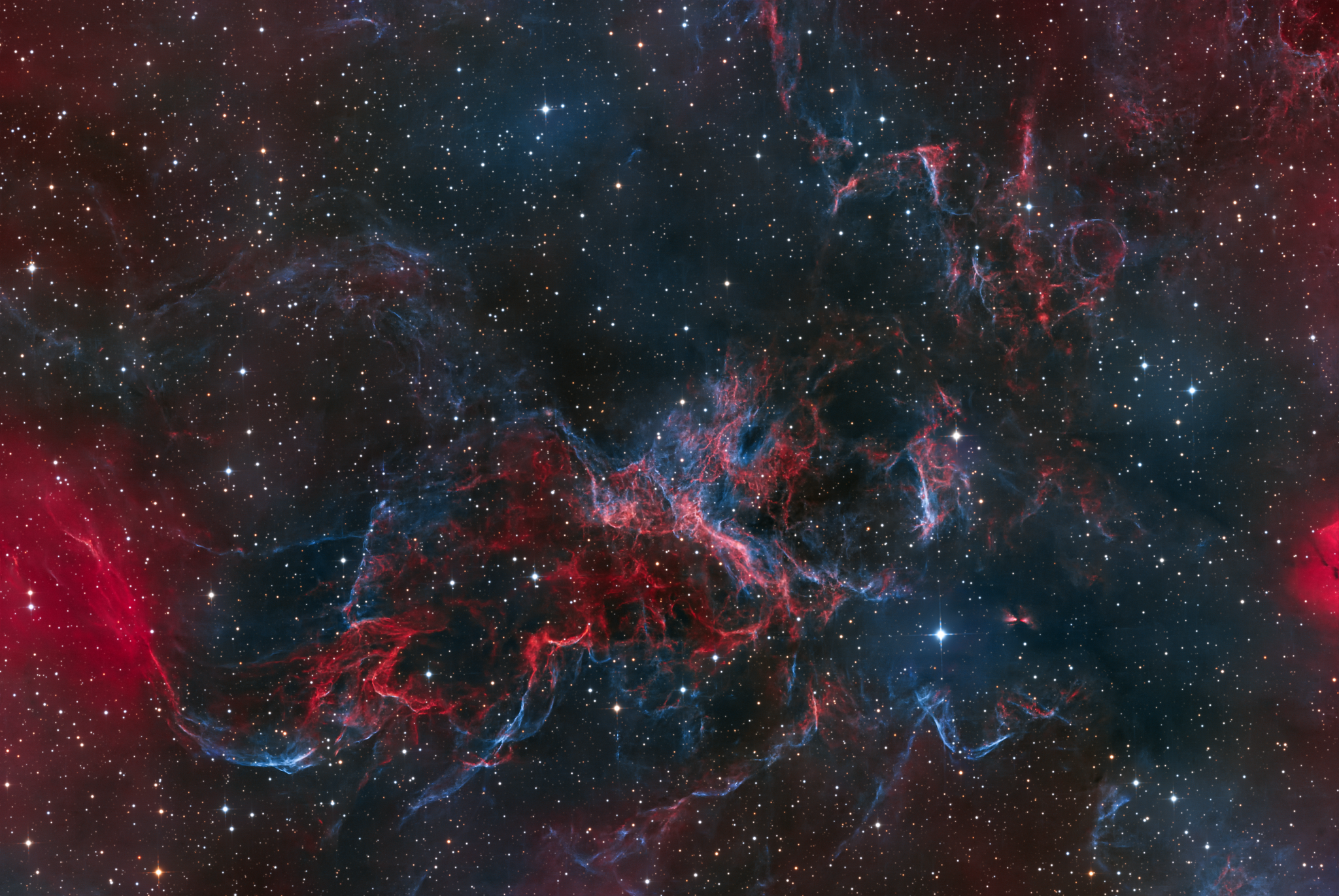
Photo description / processing
Supernova remnant SNG G108.2-0.6 - the Orb Weaver nebula.
Discovered in 2007 in the radio range - https://www.aanda.org/articles/aa/abs/2007/15/aa6935-06/aa6935-06.html
The optical image was first obtained in 2022. Interestingly, it was captured at almost the same time by 2 teams of astrophotographers.
Discovered in 2007 in the radio range - https://www.aanda.org/articles/aa/abs/2007/15/aa6935-06/aa6935-06.html
The optical image was first obtained in 2022. Interestingly, it was captured at almost the same time by 2 teams of astrophotographers.
One gave it the name The Orb Weaver nebula - https://app.astrobin.com/i/kigqzb, and the other named it after the son of one of the astrophotographers - Tim’s nebula - https://app.astrobin.com/i/bw553z?r=B
One of the interesting objects in the region of the nebula is YSO CPM38 - a protostar surrounded by a dense protoplanetary disk and with two polar jets that give the object an hourglass shape.
In the regions where the polar jets crash at enormous speed into the surrounding interstellar medium, shock waves arise. Water molecules (H₂O) in these zones transition to an excited state and begin to emit coherent microwaves.
This is a natural water maser.
Technical information
- Telescope/Lens
- Laniakea 417mm f/3.5
- Camera
- QHY268M
- Mount
- SW EQ8
- Software
- Pixinsight
- Location
- Краснодар, Россия
Light pollution
Green, Bortle 4 zone
- Date taken
Exposure
- 1210 × 120″ · ISO/Gain: 56 · Antlia Ha 3nm ·
- 1415 × 120″ · ISO/Gain: 56 · Antlia OIII 3nm ·
- 447 × 120″ · ISO/Gain: 56 · Antlia SII 3nm ·
Total exposure: 102 h 24 m


Comments
Reply
Sign up or sign in to leave a comment.
Reply
Sign up or sign in to leave a comment.
Reply
Sign up or sign in to leave a comment.
Reply
Sign up or sign in to leave a comment.
Sign up or sign in to leave a comment.